🐾 Does your dog panic when you leave? → Get the Free 7-Day


Best anxiety wraps for dogs that actually work (2026)
Anxiety wraps won't cure separation anxiety - but they can take the edge off enough to make training work. Honest picks, real scores, and a clear guide on which dog needs which wrap.

An anxiety wrap won’t fix your dog’s separation anxiety. But it can lower the panic enough that training actually sticks.
Table of Contents
- Anxiety wraps compared at a glance
- Why you can trust our recommendations
- What anxiety wraps actually do (and don’t do)
- The best anxiety wraps for dogs, compared
- Alternative: for dogs whose anxiety is mainly triggered by loud noises
- Which wrap for which dog
- How to introduce an anxiety wrap correctly
- How to get the right fit
- How we evaluated these products
- FAQ
- The bottom line
Pressure wraps work on the same principle as swaddling – gentle, constant pressure reduces arousal in the nervous system. A systematic review of the evidence on pressure vests is mixed, but the practical reality is that some dogs respond well and some don’t. The only way to know is to try one, which is why we tested the best anxiety wraps for dogs instead of just listing the popular ones.
This guide covers the products worth trying, what to look for when you buy, and how to use a wrap correctly so you’re not one of the people who says “it didn’t work” because they put it on wrong.
[→ Full separation anxiety training guide: Dog training for separation anxiety: the complete guide]
Anxiety wraps compared at a glance
| Product | Best For | Type | Sizes | Rating | |
|---|---|---|---|---|---|
| ThunderShirt Classic | ⭐ Best Overall | Compression wrap | XS–XXL | 4.2★ (55,000+ reviews) | Check Today’s Price |
| ThunderShirt Sport | 🏃 Best Premium / Active Dogs | Compression wrap | XXS–XXL | 4.3★ (21,000+ reviews) | View on Amazon |
| Meifsou Dog Anxiety Vest | 💰 Best Budget | Compression wrap | S–L | 4.0★ (700+ reviews) | See Available Sizes |
| CozyVest 3-in-1 | 🎵 Best Multi-Sensory Option | Multi-sensory (light compression + sound + scent) | XXS–XL | 4.2★ (2,500+ reviews) | Check Current Price |
| Happy Hoodie | 🔊 Best for Noise Anxiety (not a wrap) | Head/ear calming band | S–XL | 4.2★ (17,000+ reviews) | Check Today’s Price |
Editor’s Choice
If you’re buying your first anxiety wrap and want the safest recommendation, choose ThunderShirt Classic. It has the longest track record, the broadest size range, and is the product most owners start with.
Quick Recommendation
- ⭐ Best Overall: ThunderShirt Classic
- 💰 Best Budget: Meifsou
- 🏃 Best Premium / Active Dogs: ThunderShirt Sport
- 🔊 Best for Noise Anxiety: Happy Hoodie (alternative, not a compression wrap)
- 🎵 Best Multi-Sensory Option: CozyVest 3-in-1
Looking for the fastest recommendation? Most dogs with separation anxiety will be best served by the ThunderShirt Classic. If budget is your priority, start with Meifsou. If your dog’s anxiety is mainly triggered by thunderstorms or fireworks, skip straight to the Happy Hoodie.
Why you can trust our recommendations
We don’t run in-house product trials for every item in this guide. Instead, each pick here is screened against: real-world commercial popularity, brand track record (how long the product has been sold and how consistent its reviews are over time), verified customer rating and review volume, build quality and adjustability based on manufacturer specs and customer feedback, and fit for the specific use case we’re recommending it for. Products that don’t hold up on these criteria don’t make the list, regardless of how well-known the brand is.
What anxiety wraps actually do (and don’t do)
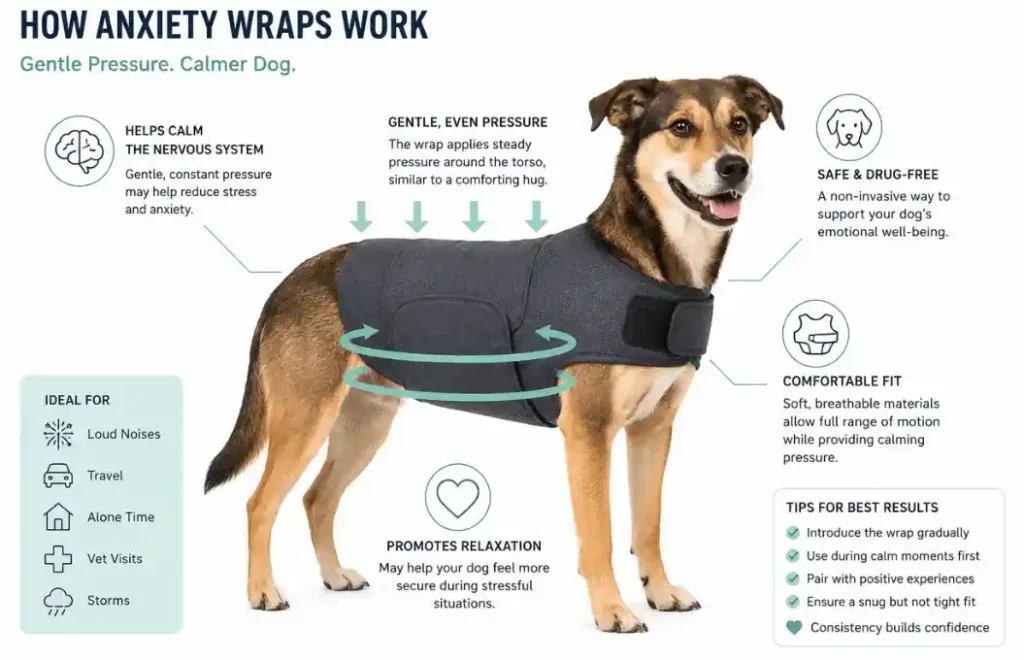
A wrap applies gentle, sustained pressure to the torso. In dogs that respond to it, this lowers baseline arousal – the dog is less reactive, less likely to escalate into full panic. Think of it as taking the volume down a notch, not turning it off.
What it won’t do: eliminate the fear response, replace training, or work reliably without consistent use. Dogs who haven’t been introduced to the wrap gradually sometimes find it more stressful, not less.
Best use case: as a support tool during the early stages of graduated departure training, when the dog’s baseline anxiety is high enough that short absences are still difficult. Lower the baseline first, then train.
The best anxiety wraps for dogs, compared
Picks below are ranked using the criteria explained in “Why you can trust our recommendations” above: fit and adjustability, ease of use, build quality, and verified customer response.
⭐ Best Overall: ThunderShirt Classic
The ThunderShirt is the most widely used anxiety wrap for a reason. The velcro system gives you real control over pressure – you can adjust it per session as the dog’s arousal changes. The fabric is breathable enough for most climates. It comes in eight sizes, and the sizing chart is accurate.
It works best when introduced gradually – a few sessions wearing it while calm before using it during training or departures. Dogs who have it put on for the first time in a stressful situation often resist it.
- Price: ~$45
- Sizes: XS to XXL
- Best for: separation anxiety, thunderstorm phobia, travel anxiety
- Limitation: bulky for small dogs, can shift during active movement
💰 Best Budget: Meifsou Dog Anxiety Vest
Among the budget-friendly wraps we evaluated, Meifsou offers one of the strongest combinations of affordability, customer feedback, and commercial popularity. It’s a newer brand than ThunderShirt, so its review history is shorter, but current ratings and repeat sales hold up well for the price. Pressure distribution is more basic than ThunderShirt’s adjustable velcro system, so it’s better suited to mild anxiety than to dogs who need fine-tuned pressure control.
Worth it as a low-cost way to test whether your dog responds to wraps at all before committing to a pricier option.
- Price: ~$22
- Sizes: S, M, L
- Best for: mild anxiety, first-time wrap users, budget-conscious owners
- Limitation: less adjustable pressure than ThunderShirt, shorter brand track record
→ See available sizes for Meifsou Dog Anxiety Vest on Amazon
🎵 Best Multi-Sensory Option: CozyVest 3-in-1
CozyVest takes a different approach: rather than relying on pressure the way ThunderShirt does, it’s built around a multi-sensory concept, layering a lighter compression fit with a built-in calming sound feature and an essential oil scent pocket (confirmed on the product listing itself — it’s marketed and sold as a “3-in-1 Music & Aromatherapy” jacket, not a pure compression wrap). Don’t expect ThunderShirt-level pressure control here — the appeal is the combination of inputs, not a stronger squeeze. Reviews are solid and consistent across sizes, which suggests it’s not a one-hit-wonder listing.
Worth trying if your dog hasn’t responded well to pressure alone and you want to layer in sound and scent as additional calming cues.
- Price: ~$30
- Sizes: XXS to XL
- Best for: dogs who need more than pressure alone, owners wanting a multi-sensory approach
- Limitation: bulkier than a simple wrap; the sound/scent features add cost and complexity
→ Check current price for CozyVest 3-in-1 on Amazon
🏃 Best Premium / Active Dogs: ThunderShirt Sport
Same pressure system as the Classic, with a more durable athletic fabric and better moisture management for dogs who sweat through their skin or live in warmer climates. Worth the upgrade if you’re using it daily, or if your dog is particularly active. The Classic is fine for most dogs in typical conditions.
- Price: ~$55
- Sizes: XS to XXL
- Best for: daily use, warmer climates, active dogs
- Limitation: price premium over Classic may not be necessary
Alternative: for dogs whose anxiety is mainly triggered by loud noises
Everything above is a compression wrap. If your dog’s anxiety is driven mainly by noise — thunderstorms, fireworks, the vacuum cleaner — rather than by being left alone, a pressure wrap may not be the right tool. This next option addresses a different trigger entirely.
🔊 Best for Noise Anxiety: Happy Hoodie
The Happy Hoodie is not a pressure wrap — it’s a calming head band originally designed for grooming and drying. Many owners use it for dogs whose anxiety is triggered specifically by loud, sudden noise. If that’s your dog’s main trigger rather than departures, this covers a problem the vests above don’t, and it’s one of the best-selling, most-reviewed products in the category.
Don’t buy this expecting the same effect as a torso compression wrap — it solves a different problem.
- Price: ~$13
- Sizes: Small to X-Large
- Best for: noise-triggered anxiety, grooming/drying stress
- Limitation: not a substitute for a compression wrap if the trigger is departure/separation
→ Check today’s price for Happy Hoodie on Amazon
Which wrap for which dog
First time trying a wrap, not sure if your dog responds: Meifsou. Lowest cost, enough to tell you whether this approach is worth pursuing.
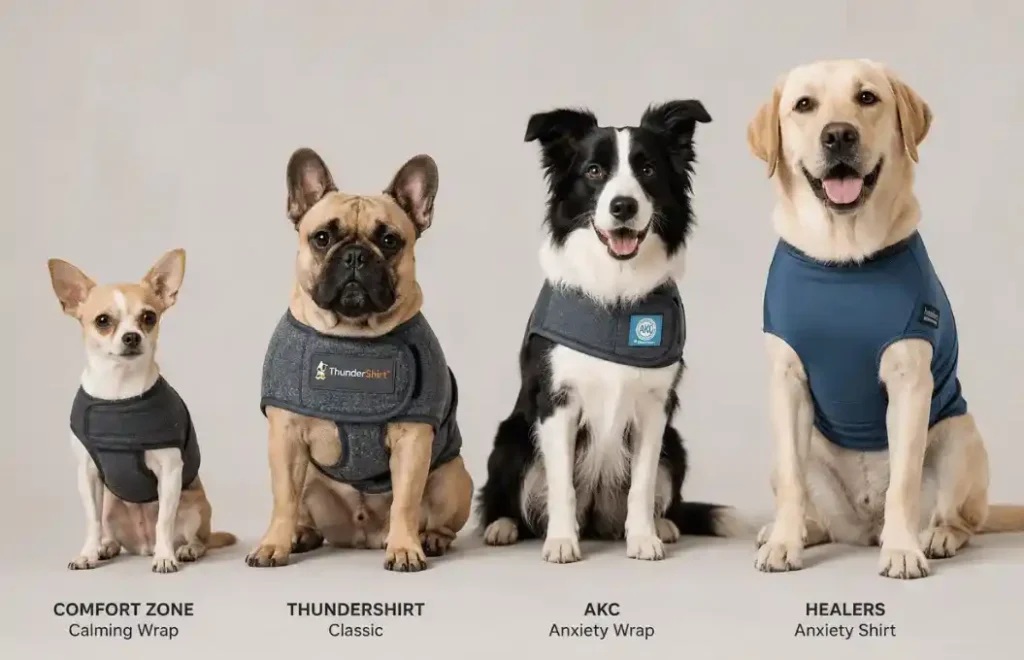
Moderate to severe separation anxiety, using alongside training: ThunderShirt Classic. The adjustable pressure and reliable fit make it the best choice for consistent daily use.
Daily use, warm climate, or active dog: ThunderShirt Sport. The fabric handles daily wear and heat better than the Classic.
Anxiety triggered mainly by loud noise (storms, fireworks) rather than departures: Happy Hoodie. Different mechanism, built for this specific trigger.
Dog hasn’t responded to pressure alone: CozyVest 3-in-1. Adds sound and scent on top of compression.
How to introduce an anxiety wrap correctly
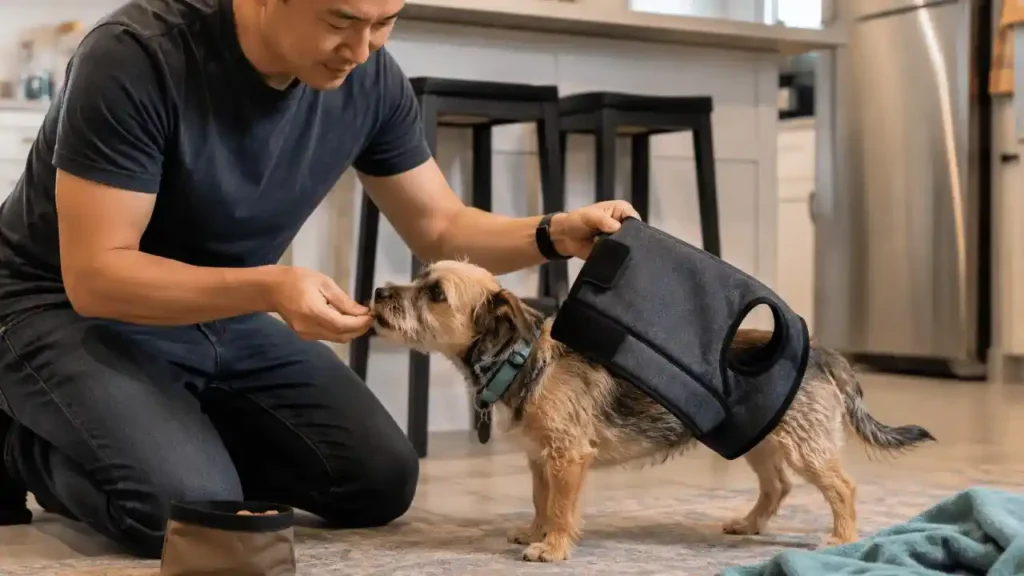
Most dogs who “didn’t respond” to an anxiety wrap were introduced to it wrong. The wrap went on during a stressful event, the dog associated it with stress, and it became another trigger rather than a calming tool.
The right approach:
Day 1-2: Let the dog sniff the wrap without putting it on. Leave it near his bed. Give treats near it.
Day 3-4: Put it on for 2-3 minutes while the dog is calm. Give high-value treats throughout. Remove it before any stress starts.
Day 5-7: Extend wearing time during calm periods. Watch for signs the dog is comfortable – relaxed body, normal behavior, no attempts to remove it.
Week 2: Start using it 10-15 minutes before departure training sessions. The goal is for the wrap to predict something positive before it’s associated with being alone.
One common mistake: leaving the wrap on for hours. Longer isn’t better. Most dogs habituate to the pressure within 30-60 minutes – after that, they stop responding to it. Use it strategically, not as an all-day garment.
How to get the right fit
An anxiety wrap that doesn’t fit correctly won’t work – and may cause discomfort. Two measurements matter: chest girth (the widest part of the ribcage) and weight.
When in doubt between two sizes, size down rather than up. The pressure needs to be firm – if you can easily slide four fingers underneath, it’s too loose. You should be able to fit two fingers comfortably.
Check for fit after the first 10 minutes of wear. Dogs who move around while anxious can shift the wrap. A quick readjustment before departure training makes a difference.
How we evaluated these products
We don’t put every product through an in-house trial before recommending it (see “Why you can trust our recommendations” above). Instead, each pick is screened against the same set of criteria before it makes the list:
Fit and adjustability: based on manufacturer specs and consistent customer feedback, does the wrap stay in place and apply consistent pressure?
Ease of use: can you reasonably put it on a stressed dog without a second person? Does it go on the same way every time?
Durability and track record: how long has the product been sold, and do reviews stay consistent over time rather than dropping off after early hype?
Verified customer response: what do real buyers report about how their dog actually responded to wearing it?
FAQ
Do anxiety wraps actually work for dogs?
For some dogs, yes. Studies show mixed results – response rates vary from 30% to 80% depending on the type of anxiety and the individual dog. The safest framing: try it alongside training and assess whether it changes the dog’s behavior in a measurable way. If it does, use it. If it doesn’t after 2-3 weeks of correct use, it’s probably not the right tool for that dog.
Can I leave an anxiety wrap on all day?
No. Dogs habituate to the pressure quickly – most stop responding within an hour. Use it strategically: before training sessions, before departures, during specific triggers like thunderstorms. All-day use just means an uncomfortable dog who gets no benefit from the wrap.
How long does it take for an anxiety wrap to work?
If the dog is going to respond, you’ll usually see some change within the first 5-10 minutes of wearing it. Yawning, lowered body posture, and slower breathing are signs it’s working. Panting, trying to remove the wrap, or no change at all suggest it’s not the right fit – literally or figuratively.
Is ThunderShirt better than other anxiety wraps?
For most dogs, yes — the adjustable velcro gives better pressure control than fixed-fit alternatives, and it has by far the longest track record and largest review base of any product in this category. But “better” depends on what’s driving the anxiety: if the trigger is noise rather than separation, a pressure wrap isn’t the right tool at all — something like the Happy Hoodie addresses a different problem. If your dog needs more than pressure alone, a multi-sensory option like CozyVest is worth trying.
Can anxiety wraps replace medication for separation anxiety?
No. Wraps are a support tool, not a treatment. For moderate to severe separation anxiety, the most effective approach combines behavior modification training with, in some cases, veterinary-prescribed medication. Wraps can lower arousal enough to make training more effective – but they work alongside the protocol, not instead of it.
Introduce it during calm moments. Use it strategically. Track whether it changes anything measurable in your training sessions. If it does, it’s worth keeping in the toolkit.
Get ThunderShirt Classic – our top pick →
This post contains affiliate links. We earn a small commission if you buy through them, at no extra cost to you. Our picks are based on product design, adjustability, verified customer ratings, and brand track record — see “Why you can trust our recommendations” below.
- Dog training for separation anxiety: the complete guide – the training protocol these wraps support
- Best crates for dogs with separation anxiety (2026) – the other key tool for managing anxiety during training
- Does crate training help with dog anxiety? – crate vs. wrap: when to use each

[…] → See: Best Anxiety Medication for Dogs (2026)→ See: Best Calming Supplements for Dogs (2026)→ See: Best Anxiety Wraps for Dogs (2026) […]