🐾 Does your dog panic when you leave? → Get the Free 7-Day

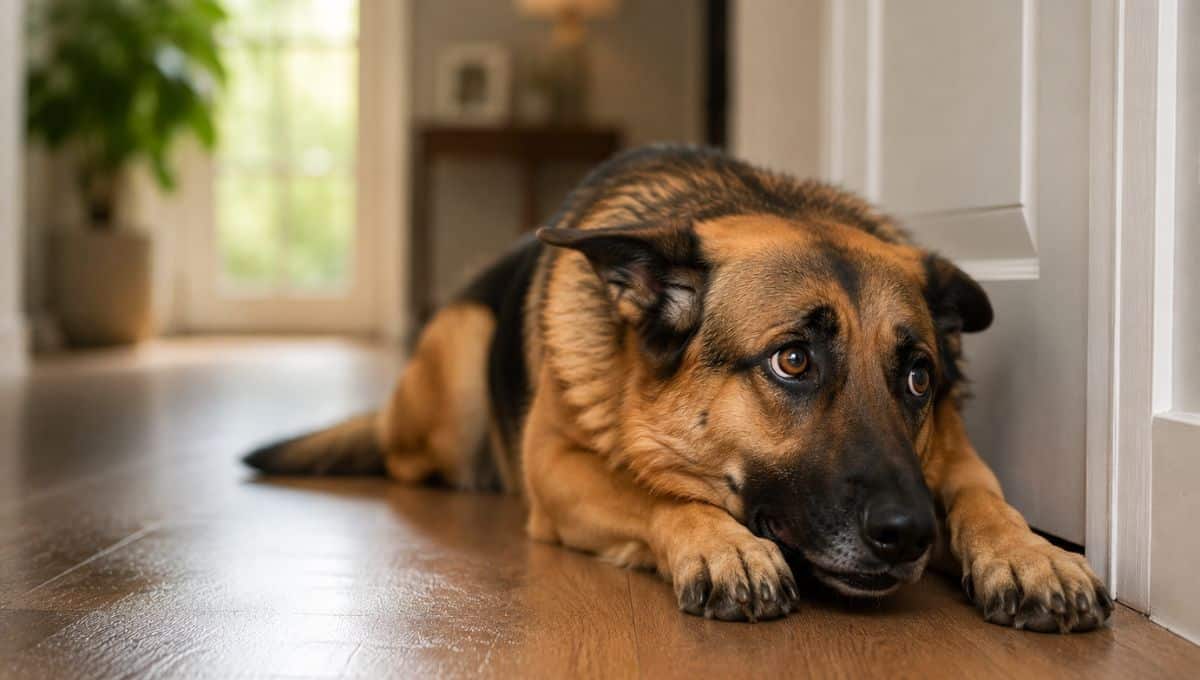
German Shepherd Separation Anxiety: Signs, Causes and Solutions (2026)
German Shepherd separation anxiety is more common than most owners expect. Learn to recognize the signs, understand the causes, and find solutions that actually work.

✓ Vet-reviewed ✓ Science-backed ✓ Updated June 2026 – This post contains affiliate links. We may earn a commission at no extra cost to you.
German Shepherd anxiety is more common than most owners expect. Despite their reputation for confidence and toughness, German Shepherds are deeply sensitive dogs — highly attuned to their environment and prone to distress when their needs are not met or when they are left alone.
If your German Shepherd is reactive, restless, destructive when you leave, or seems constantly on alert, anxiety is likely at the root. This guide covers what causes it, how to recognize it, and what actually works to fix it — based on behavioral science, not anecdote.
For the full intervention framework, see the complete guide to dog separation anxiety.
Why German Shepherds Are Prone to Anxiety
German Shepherds were bred for police, military, and herding work — roles that required constant alertness, rapid threat assessment, and close collaboration with a human handler. That hardwired vigilance is a strength in working contexts. In a family home, it translates into hypervigilance, reactivity, and a nervous system that is always primed to respond.
Four specific factors drive GSD anxiety risk:
Genetic vigilance. GSDs are wired to notice and react to everything in their environment. This is not a personality flaw — it is a feature of a breed selected for situational awareness. Without appropriate training and stimulation, that vigilance has no productive outlet and becomes anxiety.
Insufficient socialization. A GSD that was not exposed to diverse people, animals, and environments during the critical socialization window (8–16 weeks) is significantly more likely to develop fear-based anxiety as an adult. Under-socialized Shepherds often appear confident until a novel trigger — a stranger, a loud vehicle, an unfamiliar dog — exposes their underlying fear response.
Under-stimulation. German Shepherds need serious physical and mental exercise — not a 20-minute walk, but structured activity that engages their intelligence and working drive. A bored GSD will create its own outlet. That outlet is almost always destructive or anxious.
Deep owner attachment. Like Golden Retrievers, GSDs bond intensely with their primary person. That bond is one of their best qualities — and it is also what makes them vulnerable to separation anxiety when that person leaves.
Common Signs of German Shepherd Anxiety
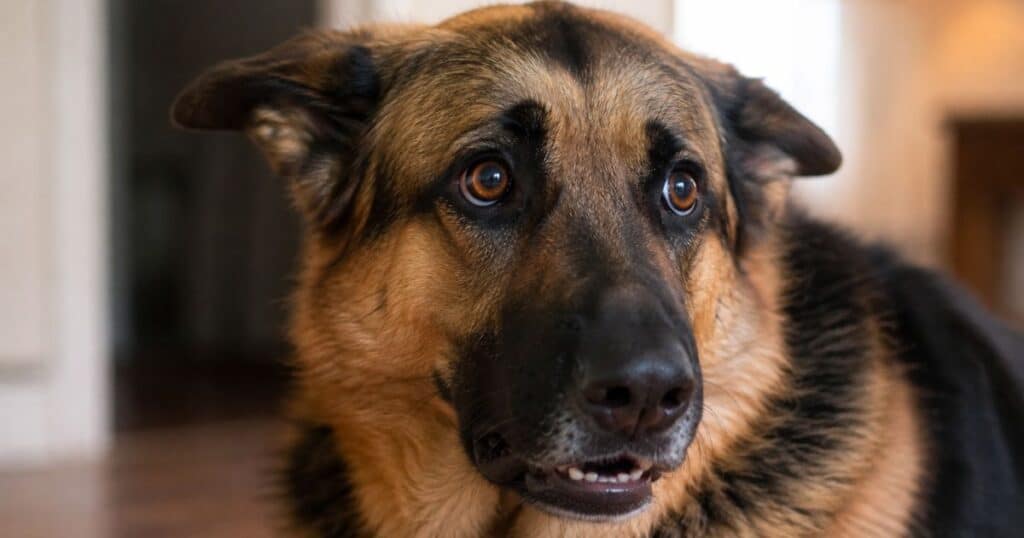
GSD anxiety often looks different from what owners expect. It does not always show up as cowering or shaking — it frequently looks like aggression, excessive barking, or obsessive behavior. This misreading leads owners to address the symptom (the barking, the lunging) rather than the cause (the fear).
Signs of general anxiety and reactivity:
- Barking or lunging at strangers, other dogs, or passing vehicles
- Pacing and inability to settle at home
- Excessive alertness — ears always up, always scanning
- Whining or restlessness before departures
- Overgrooming or chewing paws
- Refusing food in new environments
- Fear-triggered aggression — looking like dominance, rooted in fear
Signs specific to separation anxiety:
- Destructive behavior when left alone — targeting doors, windows, or your belongings
- Sustained barking or howling after departure
- Scratching at exits or attempting to escape the house or crate
- Indoor accidents despite being reliably house-trained
- Excessive drooling or vomiting from stress
- Self-harm from escape attempts (broken nails, abraded snout)
Set up a camera before assuming. Many owners are shocked by what their GSD does in the first 30 minutes after departure. Video footage is also useful if you work with a certified separation anxiety trainer. See the full list of separation anxiety signs to assess severity.
The Three Main Types of Anxiety in German Shepherds
Fear-Based Anxiety
The most common type in GSDs. Stems from under-socialization and surfaces as reactivity to strangers, unfamiliar dogs, loud noises, or new environments. The dog is not aggressive by nature — it is scared and responding defensively. A fearful GSD that feels cornered or overwhelmed will always escalate. Punishment in this context is counterproductive: it adds another stressor and deepens the fear association.
Separation Anxiety
GSDs bond intensely and can develop clinical separation anxiety. Behaviours typically begin within 15–30 minutes of departure and are absent when the owner is present. Destructive behavior, non-stop barking, and self-injury from escape attempts are common in moderate-to-severe cases. For German Shepherds specifically, anticipatory anxiety — distress that begins before you’ve even left — is particularly common due to their high intelligence and ability to read departure routines.
Boredom-Driven Anxiety
A GSD that does not receive adequate physical and mental stimulation will create its own outlet. This is not clinical anxiety in the strict sense, but it produces identical behaviors and responds to the same interventions. Destructive behavior from an under-stimulated GSD is often misdiagnosed as separation anxiety when the root cause is insufficient activity.
How to Help a German Shepherd with Anxiety
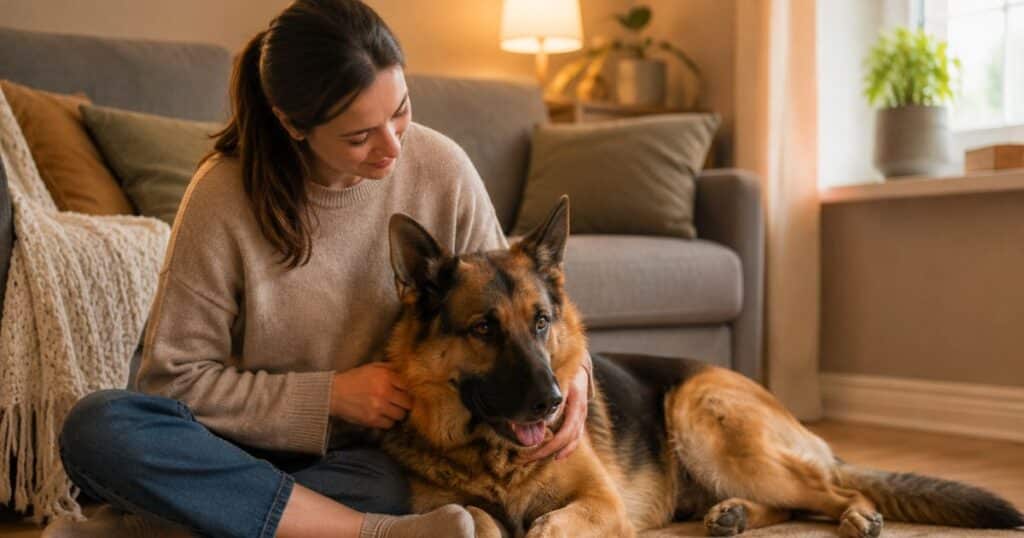
1. Structured Exercise — Non-Negotiable
A German Shepherd needs 90 minutes to 2 hours of activity per day. This means real exercise — running, fetch, hiking, or structured play — not a walk around the block. Mental stimulation is equally important and often more tiring: puzzle feeders, nose work, obedience training, and scent games can exhaust a GSD more effectively than an hour of physical exercise alone. A well-exercised, mentally engaged GSD has a significantly lower baseline anxiety level — which makes every other intervention more effective.
2. Graduated Departure Training for Separation Anxiety
For separation anxiety specifically, the evidence-based treatment is systematic desensitisation: controlled, gradual exposure to absences that stay below the anxiety threshold, building duration over time. The process for a GSD follows the same logic as for any breed:
- Decouple departure cues: Pick up keys without leaving. Put on shoes and sit back down. Open the door and close it. Repeat until your GSD stops reacting to these signals.
- Start with seconds: Step outside for 5 seconds. Return before anxiety starts. Build from there — slowly.
- Never exceed the threshold: If your dog can handle 3 minutes calmly, don’t jump to 20. Increase by 10–20% at most between sessions.
- Emotionally neutral departures: No prolonged goodbyes, no eye contact on the way out. Leave matter-of-factly.
German Shepherds — because of their intelligence — pick up on patterns quickly. They will also notice improvements quickly when the protocol is done correctly. The full step-by-step protocol is in our separation anxiety training guide.
3. Systematic Desensitisation for Reactivity
For fear-based reactivity, the only lasting fix is controlled, gradual exposure to the trigger at a sub-threshold distance, paired with high-value rewards. Over weeks, this rewires the emotional association: trigger = good thing, not threat. Punishment consistently makes fear-based reactivity worse. Counter-conditioning is the only approach with evidence behind it.
4. Give Them a Job
GSDs were bred to work. A dog with a clear sense of purpose has lower anxiety than a dog with nothing to do. “Jobs” for household GSDs can include: structured obedience sessions, nose work or tracking, carrying a backpack on walks (mild weight adds focus), agility, or even a complex daily training routine. The sense of purpose reduces baseline anxiety and channels the breed’s working drive productively.
5. Calming Supplements for Daily Support
Supplements with L-theanine, valerian root, or melatonin can reduce baseline anxiety in GSDs, making training more effective. They work best as part of a broader plan rather than as a standalone solution. For pre-departure use, give 30–45 minutes before a planned training session. → Best calming supplements for dogs
6. Anxiety Vests for Acute Stress Events
For situational anxiety — storms, vet visits, car travel — a pressure wrap can help GSDs stay below their stress threshold during the event. It is not a training tool, but it can prevent a stressful event from becoming traumatic and reinforcing existing anxiety patterns. → Best anxiety vests for dogs
7. Veterinary Medication for Moderate-to-Severe Cases
If your GSD’s separation anxiety is severe — defined as an inability to be left alone for even a minute without extreme distress — behavioral training alone may not be sufficient in the early stages. Fluoxetine (Reconcile®) and clomipramine (Clomicalm®) are both FDA-approved for canine separation anxiety. Used alongside a behavioral protocol, medication lowers the anxiety baseline enough for training to work. Discuss options with your vet. → Best anxiety medication for dogs
Common Mistakes German Shepherd Owners Make
Treating it like a dominance problem. Fear-based reactivity in GSDs is frequently misread as a dominance or aggression issue. Dominance-based corrections — alpha rolls, leash corrections, punishment — make fear-based anxiety significantly worse. If your GSD is reacting out of fear, adding threat to the equation escalates the problem.
Relying on exercise alone. Physical exercise is essential but not sufficient. A tired GSD is calmer than an under-exercised one, but exercise alone does not address the underlying fear response or the separation anxiety pattern. Mental stimulation and behavioral training are equally required.
Inconsistent routine. GSDs are acutely sensitive to unpredictability. Erratic schedules — varying departure times, irregular feeding, inconsistent rules — increase baseline anxiety. Predictable daily structure is one of the most underrated interventions for this breed.
Emotional departures and arrivals. Long goodbyes before leaving and excited reunions on return reinforce the idea that departures are significant emotional events. For a GSD already primed for anticipatory anxiety, this amplifies the distress. Keep both departures and arrivals calm and low-key.
Waiting too long to get help. Anxiety in German Shepherds does not resolve on its own. It tends to escalate as the dog rehearses anxious behaviors. Early intervention — before patterns are entrenched — produces dramatically better outcomes than late treatment.
Frequently Asked Questions
Do all German Shepherds have anxiety?
No — but the breed’s genetic temperament makes them more susceptible than many others. Individual variation is significant. A well-socialized, well-exercised GSD with consistent structure and early independence training may never show clinical anxiety. Breed predisposition is a risk factor, not a guarantee. The quality of early socialization and ongoing management matters enormously.
Is my GSD’s destructive behavior anxiety or boredom?
The diagnostic test is timing and context. Separation anxiety behaviors occur specifically during your absence and typically begin within 30 minutes of departure. Boredom-driven destruction can happen at any time, including when you are home. Set up a camera and watch the first 30 minutes after you leave. If your dog settles after the initial period, it is more likely boredom. If distress is sustained and escalating, separation anxiety is more probable.
How much exercise does an anxious GSD need?
90 minutes to 2 hours of combined physical and mental activity daily is a reasonable minimum for a working-age GSD. For anxious dogs, the mental component — nose work, puzzle feeders, structured obedience — is often more effective at reducing anxiety than physical exercise alone. A long run tires the body. Scent work tires the nervous system. Both are needed.
Can separation anxiety in GSDs be cured?
Most dogs — including GSDs — make meaningful progress with appropriate intervention. “Cured” in the clinical sense is less useful than “functionally comfortable with normal daily absences,” which the majority of affected dogs can reach. Severe cases may require ongoing management rather than a one-time fix, but progress is nearly always achievable with consistency. The earlier intervention begins, the better the outcome.
When should I involve a professional?
If your GSD cannot be left alone for even a minute without extreme distress, or if reactive behavior poses a safety risk to people or other animals, professional support is appropriate. A Certified Separation Anxiety Trainer (CSAT) specialises in this condition. A veterinary behaviorist (DACVB) is the highest level of care for complex or severe cases. General dog trainers without specific anxiety training are not the right choice for clinical separation anxiety.
Key Takeaways
- German Shepherds are genetically primed for vigilance and owner attachment — both traits that increase anxiety risk
- Anxiety in GSDs often looks like reactivity or aggression, not cowering — accurate identification matters
- The three main types are fear-based anxiety, separation anxiety, and boredom-driven anxiety — each needs a different approach
- 90+ minutes of daily physical and mental exercise is a non-negotiable baseline
- Graduated departure training is the gold standard for separation anxiety — start below the threshold and build slowly
- Predictable daily routine dramatically reduces baseline anxiety in this breed
- Punishment-based approaches make fear-based anxiety worse — counter-conditioning is the only evidence-backed method
- Early intervention consistently produces better outcomes than waiting
