🐾 Does your dog panic when you leave? → Get the Free 7-Day Starter Plan

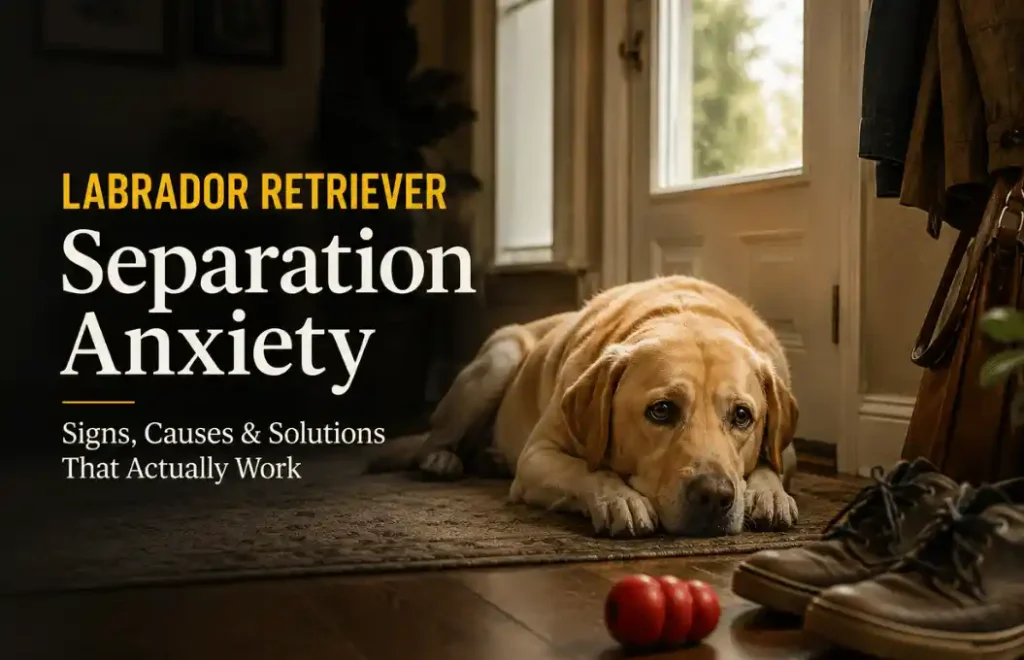
Labrador Separation Anxiety: The Complete Calming Guide for Retrievers
Labrador separation anxiety is common in this social breed. Learn the signs, causes, and a proven routine to calm your anxious Labrador when home alone.

Research-based content. This article is a general information guide, not a veterinary review. It is for informational purposes only and does not replace professional veterinary advice.
Table of Contents
- Why Labradors are especially prone to separation anxiety
- Signs of separation anxiety in Labradors
- Mild vs. severe separation anxiety: how to tell the difference
- Step-by-step: how to treat Labrador separation anxiety
- Best calming products for Labradors with separation anxiety
- CBD oil for dogs
- When to see a vet
- Common mistakes Labrador owners make
- Frequently asked questions
- Conclusion
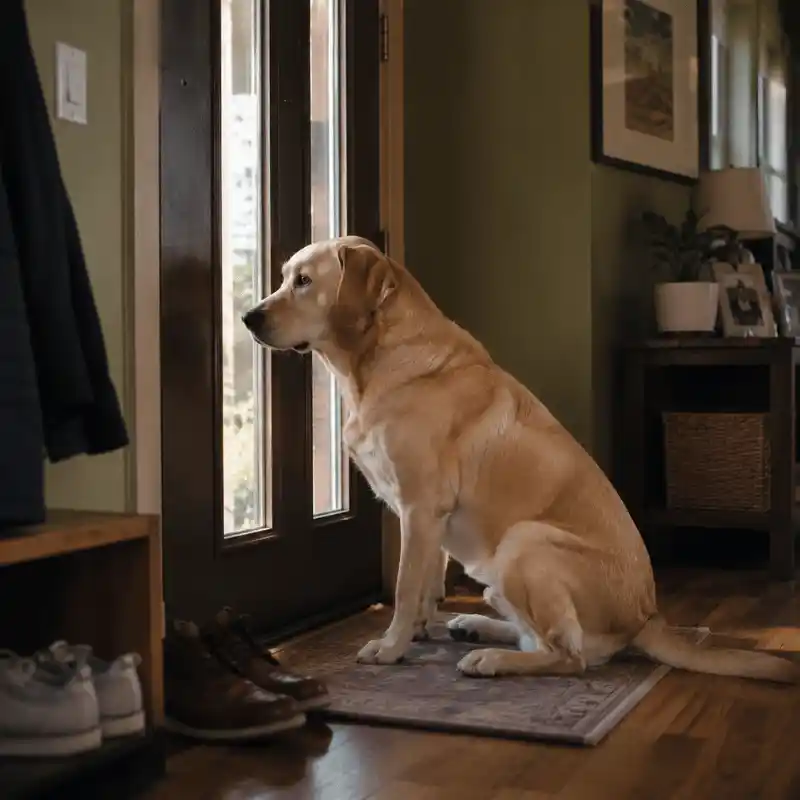
Labradors are the most popular dog breed in the United States, and Labrador anxiety is common in this breed, especially separation anxiety. Their intense social bonding, bred over centuries of working alongside humans, makes them exceptionally vulnerable when left alone, and it’s a big reason Labrador retriever anxiety so often centers on being away from their person.
If your anxious Labrador is destroying furniture, barking for hours, or greeting you like you’ve been gone for years after just 20 minutes, this guide is for you. We’ll cover exactly why Labradors develop separation anxiety, how to recognize the signs, and, most importantly, what actually works to calm them down, because Labrador separation anxiety responds well to the right routine.
Why Labradors are especially prone to separation anxiety
Not all dog breeds are equally affected by separation anxiety. Labradors score particularly high for three reasons:
1. They were bred to be with people
Labradors were originally developed as working dogs, specifically to retrieve game alongside hunters and assist fishermen in Newfoundland. This means centuries of selective breeding for a dog that wants to be by your side. Their genetics make them human-oriented to an unusual degree.
2. They are highly social and easily bored
Labs are intelligent, high-energy dogs. When left alone with nothing to do, they don’t just rest quietly: they become anxious, restless, and destructive. Boredom and separation anxiety often overlap and reinforce each other in this breed.
3. They form very strong bonds
Labs are known as “velcro dogs”: they follow their owners from room to room, sleep as close as possible, and monitor your movements constantly. This deep bond is wonderful, but it also means that your absence hits them hard.
Signs of separation anxiety in Labradors
The key thing to know: separation anxiety behaviors happen only when you’re gone (or about to leave). If your dog misbehaves when you’re home, that’s a different issue, likely boredom or insufficient training.
Classic Labrador separation anxiety symptoms include:
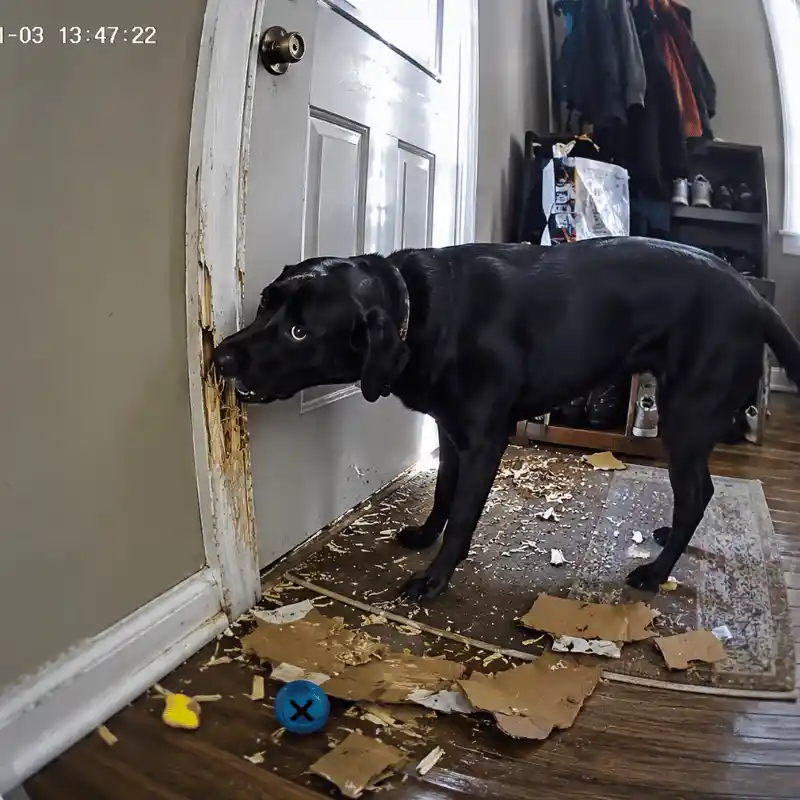
- Destructive chewing: particularly near exits (doors, windows, doorframes)
- Excessive barking or howling shortly after you leave, often reported by neighbors
- House soiling in a dog that is otherwise reliably house-trained
- Escape attempts: scratching at doors, digging under fences, breaking out of crates
- Pacing and restlessness visible on home cameras
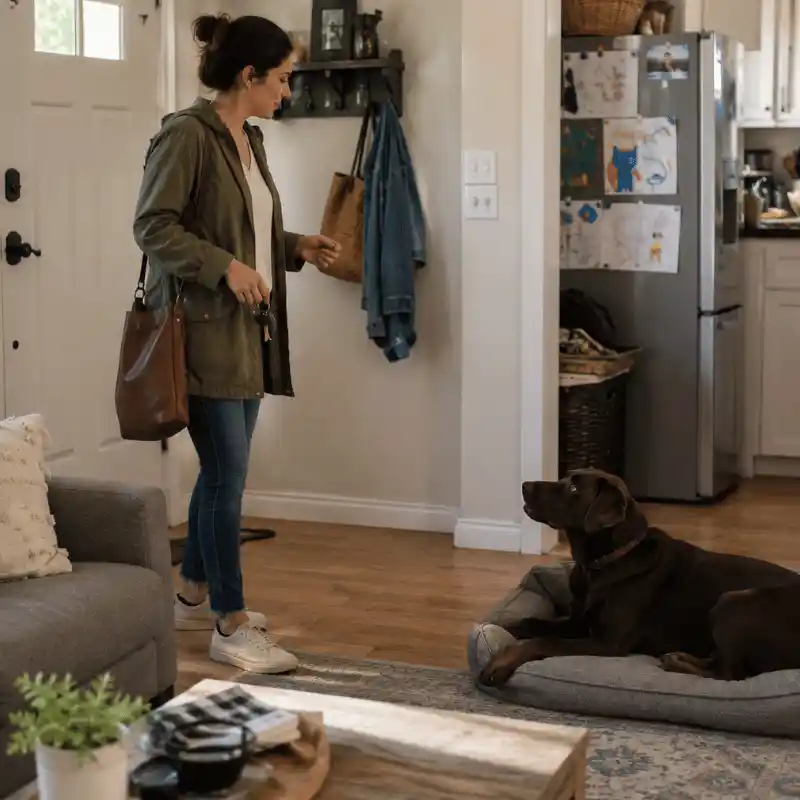
- Pre-departure anxiety: your Lab becomes clingy, trembling, or follows you obsessively when you pick up your keys or put on your shoes
- Over-the-top greeting: jumping, crying, and inability to calm down when you return
- Drooling and panting even when it’s not hot
- Self-injury in severe cases from crate escape attempts
Tip: Set up a camera (a simple phone or a pet cam like Furbo) to watch your dog after you leave. Many owners are surprised to find their Lab starts panicking within 5 minutes of their departure.
Mild vs. severe separation anxiety: how to tell the difference
Not all separation anxiety is the same. Knowing the severity of your Lab’s case will help you choose the right approach.
| Severity | Signs | Typical approach |
|---|---|---|
| Mild | Whining for 5-10 min then settling, occasional accidents, light chewing | Enrichment, calm departures, calming products |
| Moderate | Barking or howling for 30+ min, regular accidents, notable chewing | Desensitization training + calming products |
| Severe | Non-stop distress for hours, self-injury, complete inability to settle | Veterinary consultation: medication may be needed alongside training |
Step-by-step: how to treat Labrador separation anxiety
There’s no overnight fix for separation anxiety. But with consistent effort over 2-6 weeks, most Labs show significant improvement. Here’s the proven protocol.
Step 1: Desensitization to departure cues
Your Lab has learned that certain actions (picking up keys, putting on shoes, grabbing your bag) mean you’re about to leave. These “pre-departure cues” trigger anxiety before you’ve even walked out the door.
To break this association, practice the cues without actually leaving:
- Pick up your keys, walk around the house, put them down. Repeat 10 times per session.
- Put on your coat, sit back down on the couch. Repeat.
- Open the front door, close it, go sit down. Repeat.
- Step outside for 5 seconds, come back in, don’t make a fuss.
Do this multiple times a day. Over time, these cues stop predicting your departure and your Lab’s pre-departure anxiety diminishes.
Step 2: Graduated absences
The goal is to build your dog’s tolerance for alone time gradually, starting from the point where they can succeed.
- Start at the threshold where your dog shows no anxiety (this might be 30 seconds for severe cases, 5 minutes for mild).
- Leave for that amount of time. Return calmly before your dog becomes distressed.
- Repeat 5-10 times per session.
- Very slowly extend the duration, by 30-second or 1-minute increments.
- If your dog shows distress, drop back to a shorter duration and rebuild.
Important: During this training period, avoid leaving your dog alone for longer than they can handle. Ask a friend to dog-sit, use a doggy daycare, or hire a dog walker. Every time your Lab panics alone, it reinforces the anxiety pattern.
Step 3: Reduce hyper-attachment
Labs often become so bonded to one person that even moving to another room causes distress. To gently reduce this:
- Practice “settle” commands: teach your dog to stay on their bed while you move around the house.
- Don’t respond to every demand for attention. Wait for calm behavior, then reward it.
- Practice brief “out of sight” separations inside the house using baby gates or closed doors.
Step 4: Physical and mental exercise
A tired Labrador is a calmer Labrador. Labs need significant exercise: at minimum 60-90 minutes per day of vigorous activity. Before you leave for work, try to get in:
- A 30-45 minute brisk walk or off-leash run
- A 10-minute training session (sit, down, stay, recall): mental effort tires Labs as much as physical exercise
- A puzzle feeder or Kong stuffed with frozen peanut butter to occupy them as you leave
Step 5: Create a calm, safe space
Some Labs feel more secure in a confined, den-like area when alone. A crate or a small room can help, if your dog has been properly crate-trained and doesn’t panic inside it. Signs that crating is not working: scratched doors, broken crate wire, injury to paws or mouth.
For crate-resistant Labs, try:
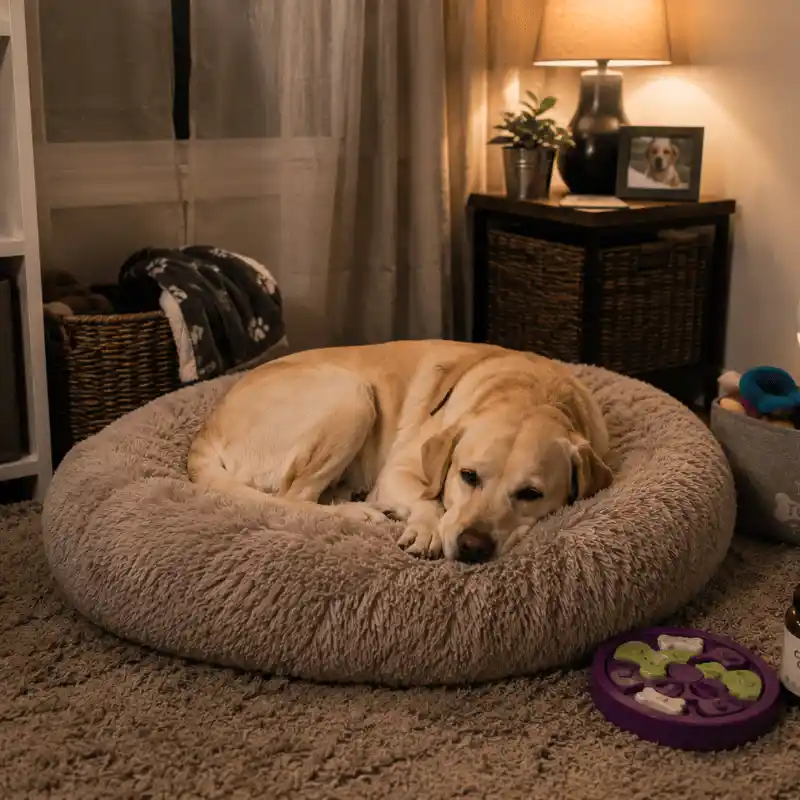
- A comfortable, calming dog bed (orthopedic, high-sided “nest” style) with your worn t-shirt inside
- A white noise machine or calming music (Through a Dog’s Ear is a research-backed playlist)
- A pheromone diffuser (DAP/Adaptil) plugged in near their resting area
Best calming products for Labradors with separation anxiety
Products won’t fix separation anxiety on their own, but they can take the edge off enough to make training easier and more effective. These are the options best suited to Labradors:
Calming chews
Evidence for calming supplements in dogs is limited and varies by ingredient and formulation. Research on an ingredient does not establish that a particular chew treats separation anxiety, and effects cannot be assumed for this breed. Ask your veterinarian whether a supplement is appropriate, including possible side effects and interactions. Supplements do not replace an individualized behavior plan.
For a full comparison, see our guide: Calming chews vs CBD for dogs: which works better?
Adaptil pheromone diffuser
Adaptil releases a synthetic version of the calming pheromone mother dogs produce when nursing. Multiple clinical studies support its use for separation anxiety. Use the plug-in diffuser in the room where your Lab spends most of their time alone. Allow 2-4 weeks for full effect.
Anxiety wraps (ThunderShirt)
The ThunderShirt applies gentle, constant pressure across the torso, similar to swaddling. It works well for some Labs, not at all for others. Worth trying given the relatively low cost. Put it on 15-20 minutes before you leave, not at the last second.
Calming dog beds
High-sided, donut-style calming beds give Labs a sense of enclosure and security. Labs are medium-to-large dogs, so make sure to size up (look for XL options if your Lab is 60 lbs+). Our full review: Best anti-anxiety dog beds.
CBD oil for dogs
Evidence that CBD treats anxiety in dogs remains limited. A product marketed for pets or accompanied by a certificate of analysis is not a guarantee of safety or effectiveness. Discuss CBD with your veterinarian before use, particularly if your dog takes medication; this guide does not recommend a dose or timing schedule. Related resources: Calming chews vs CBD for dogs
When to see a vet
If your Labrador has severe separation anxiety (non-stop distress, self-injury, or no improvement after 4-6 weeks of consistent training), it’s time to consult your veterinarian or a board-certified veterinary behaviorist.
Your vet may prescribe:
- Clomipramine (Clomicalm): a veterinary prescription option used with behavior modification, if your veterinarian considers it appropriate.
- Fluoxetine (Reconcile): a veterinary prescription option used with behavior modification. Approval of Reconcile should not be generalized to every generic or compounded formulation.
- Trazodone or alprazolam: for situational, short-term use
Medication alone doesn’t cure separation anxiety: it reduces the anxiety threshold enough to make behavioral training effective. Think of it as a tool that makes training possible, not a substitute for it.
Common mistakes Labrador owners make
- Punishing your dog after the fact. Your Lab cannot connect your anger to something that happened an hour ago. Punishment after the fact only adds more anxiety: it doesn’t reduce it.
- Making departures and arrivals dramatic. Long, emotional goodbyes tell your dog that your leaving is a big deal. Keep departures quiet and matter-of-fact.
- Getting a second dog to “keep the Lab company.” A second dog may or may not help. Some Labs bond with a companion and calm down, while others simply have two anxious dogs instead of one. It doesn’t address the root cause.
- Using the crate as punishment. If your Lab already associates the crate with stress, forcing them in will make anxiety worse.
- Expecting quick results. Separation anxiety in Labs typically requires 4-8 weeks of consistent work before you see major improvement. Stick with it.
Frequently asked questions
Do Labradors grow out of separation anxiety?
Not on their own. Without intervention, separation anxiety tends to stay the same or get worse over time. The good news is that with proper training, the vast majority of Labs improve significantly, even older dogs.
Can I leave my Labrador alone all day?
An adult Lab with no separation anxiety can generally handle 4-6 hours alone. Beyond that, most Labs struggle, regardless of whether they have clinical separation anxiety. If you work full-time, consider a dog walker, doggy daycare, or a pet sitter to break up the day.
Are yellow, black, and chocolate Labs equally prone to separation anxiety?
Color doesn’t determine anxiety levels. All Labrador colors (yellow, black, chocolate) and types (English vs. American/field) can develop separation anxiety. Field-bred Labs bred for high drive may be more intense in their anxiety responses due to higher overall energy levels.
How long does it take to treat Labrador separation anxiety?
Mild cases: 2-4 weeks of consistent desensitization training. Moderate cases: 4-8 weeks, especially with calming products. Severe cases: 3-6 months, often requiring veterinary support. Progress isn’t always linear: expect good weeks and setback weeks.
Is Labrador separation anxiety the same as boredom?
Not exactly, though they overlap. A bored Lab chews things when alone because they have nothing to do, but settles reasonably well and doesn’t show panic. A Lab with separation anxiety chews near exits, vocalizes excessively, and shows clear distress signs on camera. Boredom is addressed with enrichment, while separation anxiety requires a more structured behavioral approach.
Conclusion
Labrador separation anxiety is one of the most common, and most treatable, behavioral issues in dogs. Because Labs are so people-oriented, they feel your absence intensely. But that same responsiveness to humans is exactly what makes them so trainable.
The key steps: start desensitization training early, avoid leaving your Lab alone beyond their current threshold, use calming products to reduce the baseline anxiety, and consult your vet if things are severe. With patience and consistency, most Labs can learn to feel safe and calm when alone.
For a broader overview of separation anxiety across all breeds, see our complete guide: Complete guide to dog separation anxiety.