🐾 Does your dog panic when you leave? → Get the Free 7-Day Starter Plan

How to Kennel Train a Dog With Separation Anxiety (Step by Step)
Most SA training advice is wrong. This protocol covers threshold training and desensitization - the same approach used by certified behaviorists.

📌 This post contains affiliate links. We may earn a small commission if you buy through our links, at no extra cost to you.
To kennel train a dog with separation anxiety, make the kennel a calm place first, then lengthen the time alone in very small steps.
Most owners try to kennel train a dog with separation anxiety the same way they’d crate train any other dog, and that’s exactly where it goes wrong. Knowing how to kennel train a dog with separation anxiety means addressing the anxiety first. Here’s the full step-by-step protocol, kennel training included.
Most training advice for separation anxiety is wrong. Here’s what actually works.
The most common advice you’ll find online: tire your dog out before you leave, give them a Kong, don’t make a big deal of departures. None of that addresses what’s actually happening: a fear response that’s running independently of how full the Kong is or how calm your goodbye was.
Separation anxiety training is a specific, structured process. It’s slow by design. And when it’s done right, it’s the only intervention that produces lasting results. This is that process.
This guide is the tactical, step-by-step walkthrough. If you want the reasoning behind why standard training fails first, see our explainer on dog training for separation anxiety. If your dog’s anxiety isn’t just about being left alone, see our broader guide to training an anxious dog.
📥 Download the free Calm Dog Checklist: a printable one-page protocol tracker to guide you through every step. Get it here →
→ Full context: Dog Separation Anxiety: Complete Owner’s Guide (2026)
Is it separation anxiety or boredom? Know before you train
The protocol below is designed for a fear response. It won’t fix boredom, and boredom fixes (more exercise, puzzle toys) won’t touch panic. Confirm which you’re dealing with first.
Boredom looks like: dog settles within 30–60 minutes of departure, destruction is general, not exit-focused, incidents are intermittent, correlated with under-exercise.
Separation anxiety looks like: distress starts before you leave (pacing, panting, following you room to room), continuous or escalating vocalization or destruction throughout the entire absence, damage concentrated near doors and windows, frantic, sustained greeting on return that doesn’t settle for 20+ minutes.
Set up a camera and watch 20 minutes of footage from a real absence before doing anything else. A bored dog settles. An anxious dog doesn’t. Proceed with the protocol below.
One thing that trips people up: a dog who panics when left loose but not when crated (or vice versa) isn’t necessarily separation anxiety: it may be confinement distress. Test both conditions on camera.
What is the threshold concept and why does it matter?
Everything in separation anxiety training comes back to one idea: threshold.
Your dog’s threshold is the point at which anxiety tips into panic. Below that point, the dog is uncomfortable but manageable. Above it, the nervous system floods with stress hormones and learning becomes neurologically impossible.
The entire training protocol is built around one rule: never let your dog cross threshold during a practice session.
This sounds simple. It isn’t. Most owners push too fast, their dog panics, and the training stalls or reverses. Each panic episode teaches the dog that being alone is as dangerous as they suspected. Slow is not the cautious option. Slow is the effective option.
How do you train a dog with separation anxiety step by step?
Step 1: Establish your baseline
Before any training starts, you need to know your dog’s actual threshold, not what you assume it is.
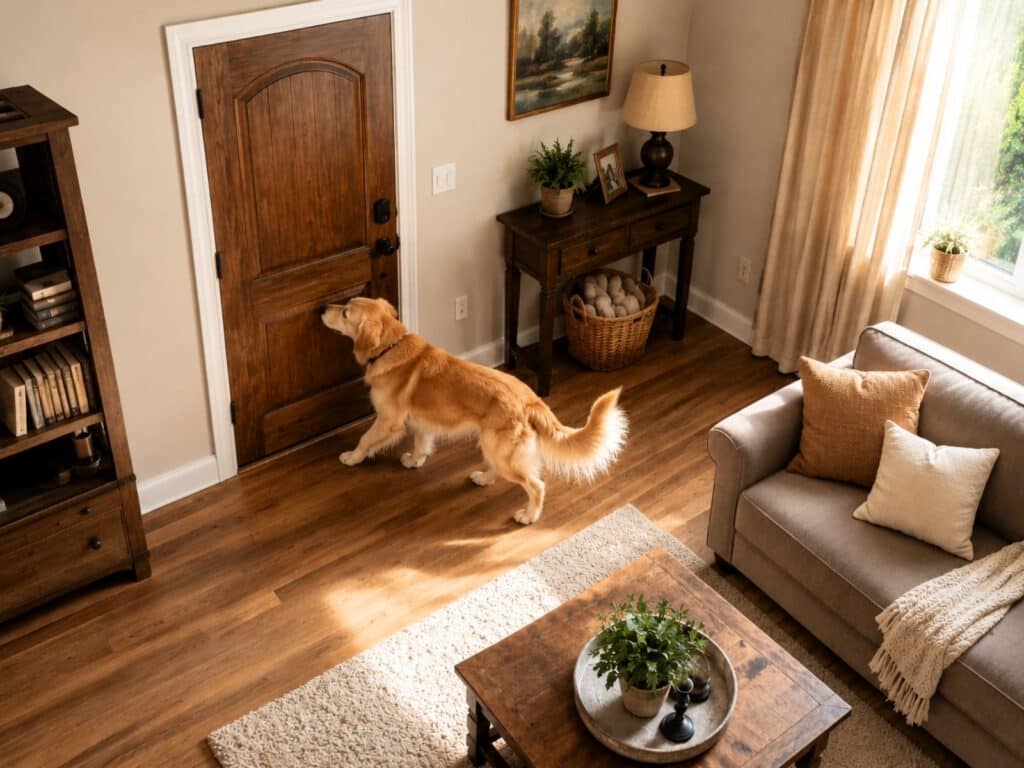
Set up a camera that covers the area where your dog stays when you’re gone. Leave for a real absence and watch the footage afterward. Note when the first stress signal appears (panting, pacing, vocalization, fixating on the door), how long after departure, and whether it escalates or plateaus.
For some dogs the threshold is 20 minutes. For severe cases it’s 10 seconds. You cannot design a protocol without this number.
Step 2: Neutralize pre-departure cues first
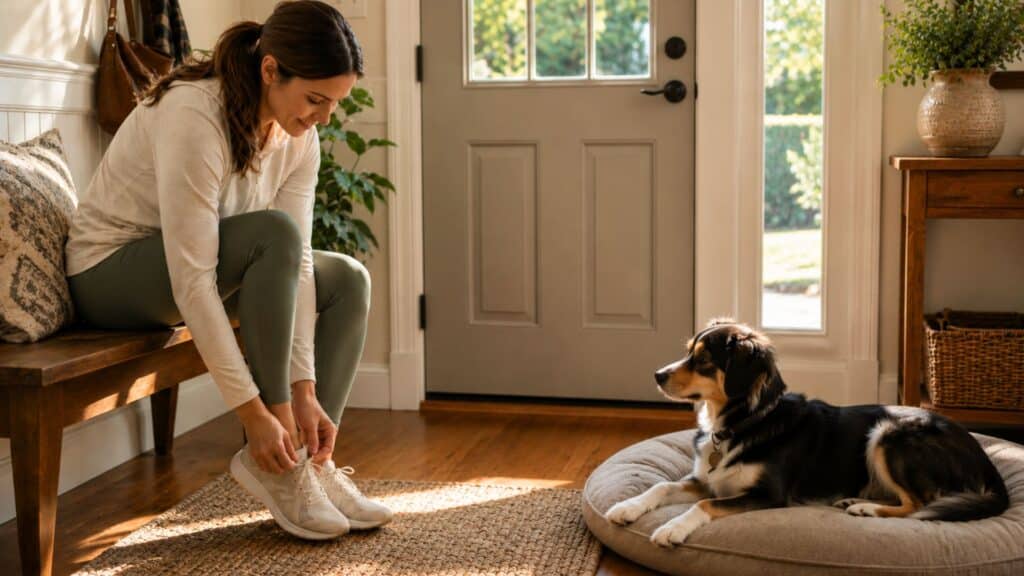
Most owners jump straight to practicing absences. But dogs with separation anxiety often start panicking before you’ve even left, triggered by departure cues like picking up keys, putting on shoes, or reaching for a coat.
If your dog is already activated before you walk out the door, your practice sessions start at a disadvantage. Fix this first.
Cue dilution: Pick up your keys 20 times a day without leaving. Put on your shoes, sit on the couch, take them off. Go to the door, open it, close it, walk back to the kitchen. Repeat until these actions stop producing a stress response. This process takes days to a week for most dogs. Don’t skip it.
Step 3: practice absences below threshold
Once departure cues are neutralized, start practicing actual absences, but keep them well below your dog’s threshold.
If your dog’s threshold is 2 minutes, start with 20-second absences. Exit, wait, return. No big hello, no drawn-out goodbye. Neutral entries and exits: you’re teaching your dog that departures are unremarkable, not that they’re an event.
Run 3–5 practice sessions per day, each with 5–10 repetitions. Start at 20–30% of threshold and increase only when your dog is consistently calm (loose body, able to settle, no stress signals) at the current duration.
For a dog with a 2-minute threshold, the first week might look like this:
| Day | Practice Duration |
|---|---|
| 1–2 | 20–30 seconds |
| 3–4 | 45 seconds |
| 5–6 | 60 seconds |
| 7 | 75–90 seconds |
That’s not a typo. One week to go from 20 seconds to 90 seconds. This is what appropriate pacing looks like.
Step 4: extend duration gradually
Once your dog is reliably calm at a duration, extend it in small increments, typically 10–20% at a time, never more than 30%.
Variability matters. Don’t always increase. Mix shorter sessions in with longer ones. A session might go: 60 sec, 90 sec, 45 sec, 90 sec, 75 sec. Predictable escalation can create anticipatory anxiety.
One variable at a time. Don’t increase duration and change location on the same day.
Setbacks are information, not failure. If your dog panics, you moved too fast. Drop back to the last duration where they were consistently calm and rebuild. No punishment, just recalibrate.
Step 5: Generalize across contexts
Once your dog can handle longer absences at home, they still may not generalize that calm to new scenarios. A dog who tolerates 30 minutes when you leave through the front door may panic when you leave through the garage.
Generalize one variable at a time: different exit points, different times of day, different pre-departure routines, different clothing or bags. Each new variable is a new training challenge. Budget time for it.
What does a realistic week-by-week training schedule look like?
| Period | Focus | What it looks like |
|---|---|---|
| Week 1–2 | Pre-departure cue desensitization only | No absences at all. Daily 10-min sessions: pick up keys, do nothing, put them down. Put on shoes, watch TV, take them off. Repeat until zero stress response to each cue. |
| Week 3–4 | Sub-threshold absences begin | 3–5 sessions per day. Each session: 5–10 reps at 20–30% of your dog’s threshold. Camera running every session. Goal: many reps, zero distress. |
| Month 2 | Gradual duration increase | Extend in 10–20% increments only. Mix shorter sessions in: predictable escalation creates anticipatory anxiety. Dog starts settling faster after departures. |
| Month 3+ | Functional absences + generalization | Generalize one variable at a time: different exit, different time of day, different bag. Each new variable is a new training challenge. Budget time for it. |
Non-negotiable during training: avoid full-panic real absences. Every unmanaged panic episode reinforces the fear response you’re trying to undo. Arrange a pet sitter, daycare, or remote work option for absences longer than the dog’s current threshold. This isn’t the cautious approach. It’s the effective one.
Pre-session timing matters: cortisol from a stressful event stays elevated in a dog’s system for 48–72 hours. Don’t train right after a vet visit, a scary noise event, or an absence where the dog panicked. Give 24–48 hours of decompression. A 20-minute sniff walk (where the dog sets the pace and follows their nose) measurably lowers cortisol and improves training session quality.
What to do when training progress stalls
The dog is fine until 20 minutes, then falls apart. This is a recognizable pattern: the dog has a specific time point where they stop expecting you to return and escalate into panic. Fix it by running many sessions at 15–18 minutes until the window widens before pushing further.
Sessions go fine but real departures don’t. Check whether your exit ritual is identical for both. Dogs pick up on differences: same door, same bag, same chew every single time. Real departures are a new context if the ritual varies even slightly.
The dog stops engaging with the Kong within 30 seconds. Food refusal is the clearest threshold signal. Shorten the duration back to where the dog was reliably eating and rebuild from there.
Getting a second dog won’t solve it. Some dogs improve with a companion, but most don’t: their anxiety is specifically about human absence, not company in general. Resolve the anxiety through training before adding another animal to the household.
Which tools actually support the training protocol?
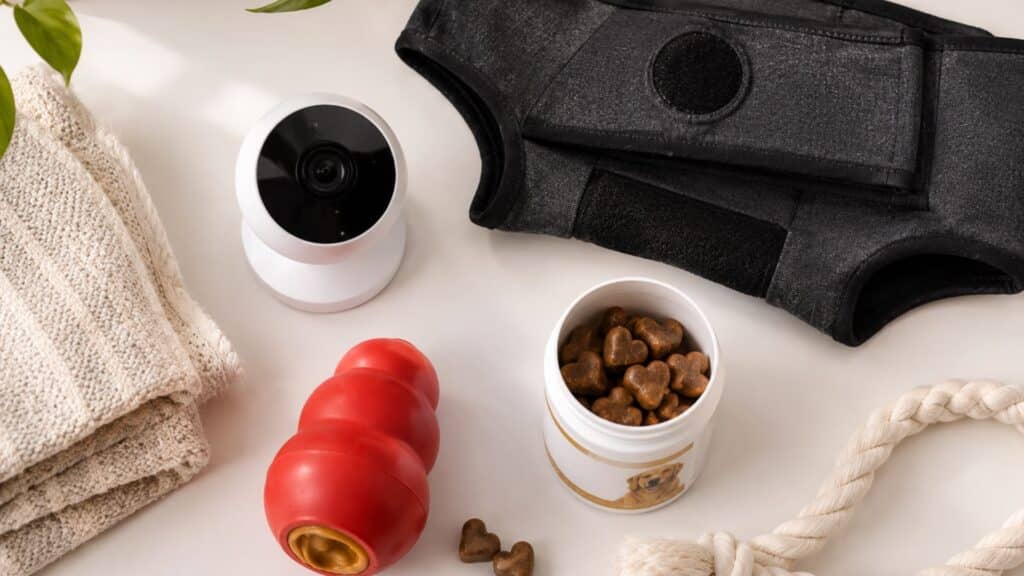
Training is the backbone. These tools make it more effective, but they don’t replace it.
Pet camera with live view: Essential for monitoring in real time. Being able to see your dog and return before they cross threshold is the difference between a productive session and a setback. The Furbo and Wyze Cam are popular options.
Anxiety crate (for crate-comfortable dogs): A heavy-duty, escape-proof crate can serve as a calming den during training, but only for dogs already comfortable with confinement. Never introduce a crate mid-protocol for an anxious dog. → See: Best Anxiety Dog Crates (2026)
Anxiety vest: Gentle pressure wraps like the Thundershirt can lower baseline arousal during practice sessions. Most effective in early phases of training. → See: Best Dog Anxiety Vests (2026)
Calming supplements: Can lower baseline arousal enough to make practice sessions more productive for mild-to-moderate cases. Useful adjunct, not a substitute. → See: Best Calming Supplements for Dogs (2026)
CBD oil: Gaining traction as a complementary tool for anxious dogs. Look for third-party tested, research-backed-formulated products. → See: Best CBD for Dog Anxiety (2026)
Frozen Kongs and long-duration chews: Useful for mild-to-moderate cases to build positive associations with alone time. Not effective for severe cases: the dog is too anxious to engage.
What management rules are non-negotiable during training?
Real-world absences where the dog panics actively work against the training. Every unmanaged panic episode reinforces the fear response you’re trying to undo.
During the active training period, real absences longer than the dog’s current threshold need to be managed: a pet sitter, trusted neighbor, doggy daycare, or working from home when possible. This isn’t optional for serious cases: it’s a core part of the protocol.
If none of those options are realistic, a certified separation anxiety trainer (CSAT) can help you design a protocol that fits your real-life constraints. Find one at iaabc.org/csat.
What are the most common mistakes to avoid during training?
Starting with real-world absences before sub-threshold practice. Real departures where the dog panics undo training progress. Practice sessions and real life need to be managed in parallel.
Punishing anxious behavior. Barking, destruction, and accidents during alone time are symptoms of fear, not disobedience. Punishment adds fear on top of fear and consistently worsens outcomes.
Relying on exercise alone. A tired dog with separation anxiety is a tired panicking dog. Exercise is beneficial for dogs generally, but it doesn’t address the fear response.
Skipping the camera. Training without knowing what your dog is actually doing is guesswork. A live-view camera is not optional for serious cases.
Going it alone when it’s not working. If you’ve been consistent for 6–8 weeks and the threshold hasn’t moved, either the protocol needs adjustment or medication should be part of the plan. → See: Best Anxiety Medication for Dogs (2026)
FAQ
What is the best way to train a dog with separation anxiety?
The most effective method is systematic desensitization: establish your dog’s distress threshold, then practice absences well below that point, increasing duration gradually over weeks. Combine this with departure cue neutralization and management of real absences during the training period.
How long does separation anxiety training take?
Mild cases: 4–8 weeks of consistent work. Moderate cases: 3–6 months. Severe cases: 6 months to over a year, usually alongside medication. Progress is nonlinear: expect plateaus and occasional setbacks.
Can I do separation anxiety training while still going to work?
It’s difficult. Real-world absences where the dog panics actively work against training. If possible, arrange a pet sitter or daycare during working hours. A certified separation anxiety trainer (CSAT) can help design a protocol around your actual schedule.
Should I use a crate during separation anxiety training?
Only if your dog was already comfortable with a crate before the anxiety developed. For most dogs with separation anxiety, a crate becomes a trap and they injure themselves trying to escape. A dog-proofed room is usually more appropriate.
How do I know if my dog is making progress in training?
Progress is measured by threshold extension: the point at which distress begins is getting later and later. Track it with camera footage: note the first stress signal timestamp each session. If that number is moving forward week over week, training is working.
Should I comfort my dog when they show anxiety?
Yes. The old belief that comforting a scared dog “reinforces the fear” is not supported by behavioral science. Fear is an emotional state, not a behavior: you cannot reinforce it with calm reassurance. If your dog seeks comfort during stress, provide it. What to avoid: reinforcing specific anxiety-driven behaviors like jumping or demand-barking with excited, high-energy attention.
At what age do dogs develop separation anxiety?
At any age, but two windows are most common: puppies around 8–12 weeks (before they’ve learned that being alone is safe) and dogs aged 6–9 years as they become more dependent. Life changes (a move, a new work schedule, the loss of a companion animal) can trigger it in adult dogs with no prior history.
Why is my dog doing well in training but seems worse after stressful days?
Cortisol from a stressful event stays elevated in a dog’s system for 48–72 hours. A dog who panicked on Monday is still running at a lower threshold on Wednesday. Don’t train during these windows: give 24–48 hours of decompression (calm environment, sniff walks) before resuming sessions. Progress will resume once cortisol normalizes.
Where to go from here
The process to train dog with separation anxiety is slow, requires consistency, and often feels like nothing is happening, right up until it is. The protocol works. The failure mode is almost always moving too fast or not monitoring closely enough to catch setbacks early.
Start with the camera. Find your dog’s threshold. Practice below it, every day, without rushing.
If you’ve been consistent for 2 months without movement, talk to your vet about whether medication belongs in the picture. It often does for moderate-to-severe cases, and adding it often unsticks training that has been plateauing.
📥 Download the free Calm Dog Checklist: your week-by-week protocol tracker. Get it here →
→ Read: Dog Separation Anxiety: Complete Owner’s Guide (2026)
→ See: Best Anxiety Medication for Dogs (2026)
→ See: Best Anxiety Dog Crates (2026)
→ See: Best Dog Anxiety Vests (2026)
→ See: Best Calming Supplements for Dogs (2026)