🐾 Does your dog panic when you leave? → Get the Free 7-Day Starter Plan

How to train an anxious dog: step-by-step guide
Training an anxious dog means changing the conditions, not the techniques. Find the threshold, lower the stress load, use high-value food, keep sessions short. Here's how it works in practice.

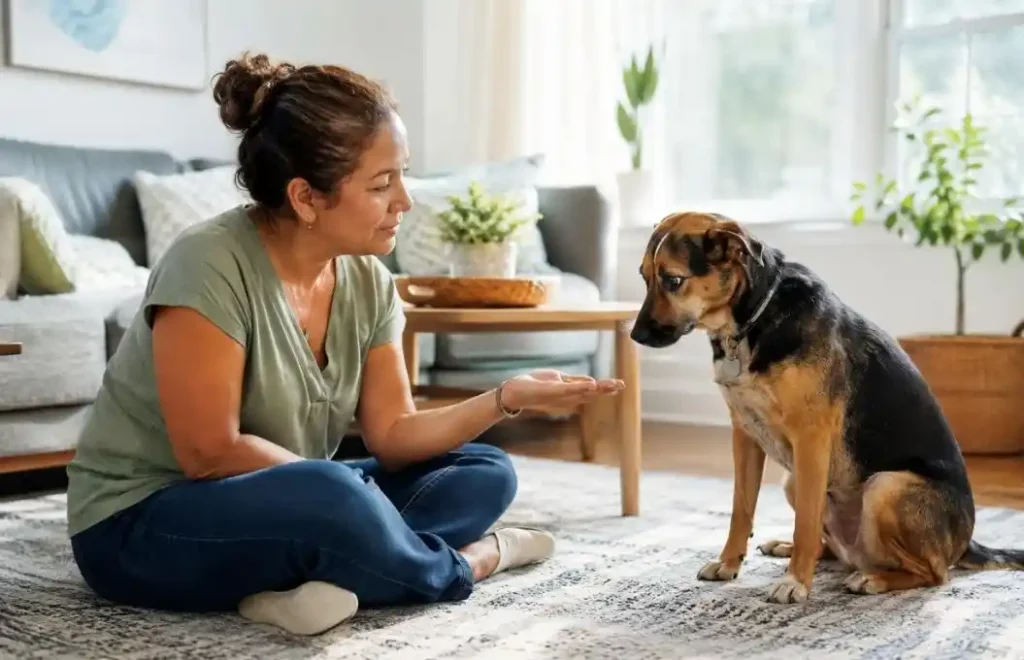
To train an anxious dog, build a predictable routine, reward calm behavior, and expose your dog to triggers slowly, always below the point where fear begins.
Training an anxious dog isn’t harder than training a calm dog. It’s just different. The rules change when fear is involved.
This guide covers anxiety more broadly: strangers, loud noises, cars, vet visits, and other specific fears, not just being left alone. If your dog’s anxiety is specifically about being alone, our dog training for separation anxiety guide and its step-by-step protocol will be more directly useful.
Table of Contents
Learning how to train an anxious dog takes patience, and progress varies widely from dog to dog. What usually helps most is an approach built around your dog’s specific triggers and comfort level.
Standard obedience training assumes a dog who is mentally available, relaxed enough to pay attention, motivated by treats, willing to try. An anxious dog is often none of these things. When stress is high, the learning brain goes offline. You can repeat a command 50 times and get nothing, not because the dog is stubborn, but because a highly stressed dog may not be able to focus on it right now.
This guide covers how to adapt training for dogs who are operating under chronic stress: the adjustments that make standard techniques actually land.
[→ If the anxiety is specifically about being left alone: Dog training for separation anxiety: the complete guide]
Why standard training fails anxious dogs
The problem isn’t the techniques: positive reinforcement, marker training, and shaping all work when you know how to train an anxious dog properly. The problem is the conditions under which you’re trying to use them.
Fear activates the sympathetic nervous system: heart rate increases, cortisol rises, digestion slows. In this state, a dog’s ability to learn new behaviors drops significantly. They may refuse food even when hungry. They may “know” a behavior in calm settings but lose access to it entirely when stressed.
This is why anxious dogs seem inconsistent. They’re not being defiant. They’re working with a brain that’s been hijacked by stress chemistry.
When should you start training an anxious dog?
There’s no universal waiting period after adoption, or after you notice your dog’s anxiety. Training doesn’t have to mean formal sessions. It can start with simple, voluntary interactions in a place where your dog already feels safe: rewarding your dog for coming over to you, sniffing out a treat on the floor, or settling on a bed.
Your dog is probably comfortable enough for short, easy practice when they:
- approach and join in voluntarily, without needing to be coaxed or held;
- look loose overall: soft eyes, relaxed mouth and tail, normal movement;
- can walk away freely and come back on their own;
- notice a small distraction, like a noise or movement, and recover quickly, going back to sniffing, eating, or engaging with you.
If those signs aren’t there yet, keep things low-pressure: let your dog observe, offer food without asking for anything, and try again another day. Never force interactions to get training started. Waiting isn’t a plan either when there are bigger problems: if your dog isn’t eating, seems to be in pain, can’t rest, panics, or growls or snaps, talk to your veterinarian now rather than waiting weeks for things to settle. For newly adopted dogs, our guide to helping a scared rescue dog covers the first days at home.
The first step: find the dog’s threshold
The first skill in learning how to train an anxious dog is recognizing its threshold: the point at which a dog crosses from “aware of the trigger” to “reactive to the trigger.” Below threshold, the dog can function: observe calmly, take treats, respond to cues. Above threshold, the dog is in fight-or-flight mode and training is essentially impossible.
Every dog’s threshold is different. Some dogs lose it when they see another dog at 20 feet. Others can handle 5 feet without reacting. Distance, volume, movement, and familiarity all affect where the threshold sits.
Your job in the first few training sessions isn’t to make progress. It’s to find the threshold: to identify exactly where the dog starts showing stress signals. Then you’ll work consistently below it.
Early stress signals to watch for: lip licking, yawning, turning away, whale eye (showing whites of eyes), ears pinned back, tail lowered, rapid sniffing of the ground. These appear before barking or lunging: they’re the early warning system.
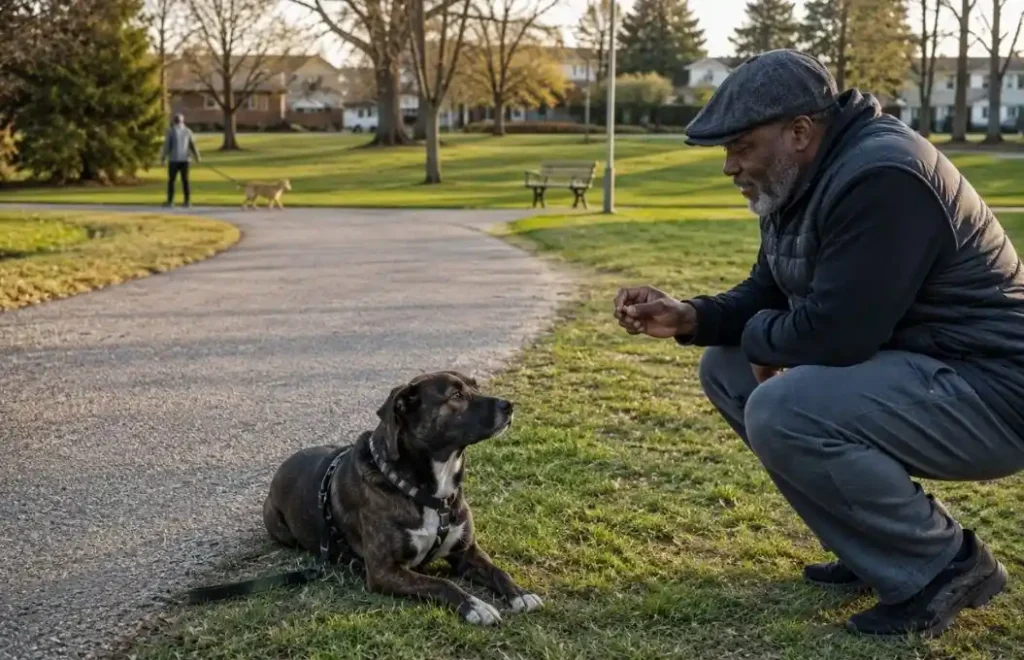
Reduce the stress load before you start training
A frightening experience can leave some dogs more sensitive for a while afterward. You may notice a lower threshold, weaker interest in food, or a dog who startles more easily, sometimes into the next day or longer. How long this lasts varies between dogs and situations, so watch your dog rather than the clock.
Practical implications: don’t schedule training sessions right after stressful events or when the dog has been overstimulated (a busy park, a vet visit, a loud household). After anything scary, keep the next sessions very easy, or skip them until your dog’s usual appetite, play, and body language are back.
Also: a very anxious dog doesn’t need to be pushed into long walks. If the street itself is frightening, a walk can add to the stress load instead of reducing it. Calmer alternatives include simple scent games at home, scattering part of a meal in the grass or on a snuffle mat, quiet chewing or licking activities, short outings at your dog’s pace, and letting your dog explore a quiet area on their own terms. Many owners find that sniffing helps their dog settle, but responses vary, so judge it by how your dog looks afterward rather than expecting a specific effect.
Use higher-value food than you think you need
Dry kibble works fine for training a calm dog. It doesn’t work for an anxious one near a trigger. Stress often reduces a dog’s interest in food, and low-value food may stop working altogether near a trigger.
For anxious dogs working near triggers, use food that’s genuinely high value: real meat (chicken, beef, turkey), cheese, hot dogs, or commercial high-value treats. The food needs to be motivating enough to compete with the anxiety response.
A useful check: offer a piece of food near the trigger. Calm, eager acceptance usually suggests your dog is coping. Sniffing and walking away, taking it slowly, or snatching it hard can mean your dog is at or near their limit. But food refusal isn’t proof on its own: your dog may not be hungry, may have an upset stomach, or may simply not be food-motivated in that setting. Read it together with body language.
Food motivation varies between dogs and from day to day. Very rich treats aren’t right for every dog either: if your dog has a sensitive stomach, food allergies, a prescription diet, or another dietary restriction, ask your veterinarian which rewards are safe, and keep pieces small. When your dog won’t take food, make the exercise easier (more distance, a quieter place, a simpler task), try a suitable reward your dog does enjoy, or switch to another activity they like.
Play can work as a reward too. For some dogs, a few seconds of tugging a familiar toy, a short game the dog starts on their own, or a quick “find it” sniffing game is more motivating than food in that moment. Keep it brief and low-key so it doesn’t tip your dog into overexcitement. Play is a useful training tool, not a treatment for anxiety on its own and not a substitute for veterinary care. For more play-based ideas, see how to build confidence in a dog through play.
Short sessions, more often
When you train an anxious dog, session length matters: anxious dogs have shorter attention windows than calm ones, especially near triggers. Long training sessions push them toward threshold and reduce the quality of learning. Many anxious dogs do better with several short sessions spread through the day than with one long one. A few minutes is a common starting point, but there’s no fixed rule: the right length is whatever your dog can handle while staying relaxed and engaged. For some dogs that’s under a minute; for others it’s longer.
End each session before the dog shows stress. This is the critical rule most owners break: they keep going because things were going well, and they push past the point of productive learning. Stop while the dog is still engaged and under threshold. The session ends on a success, and the dog’s last emotional memory of the training is positive.
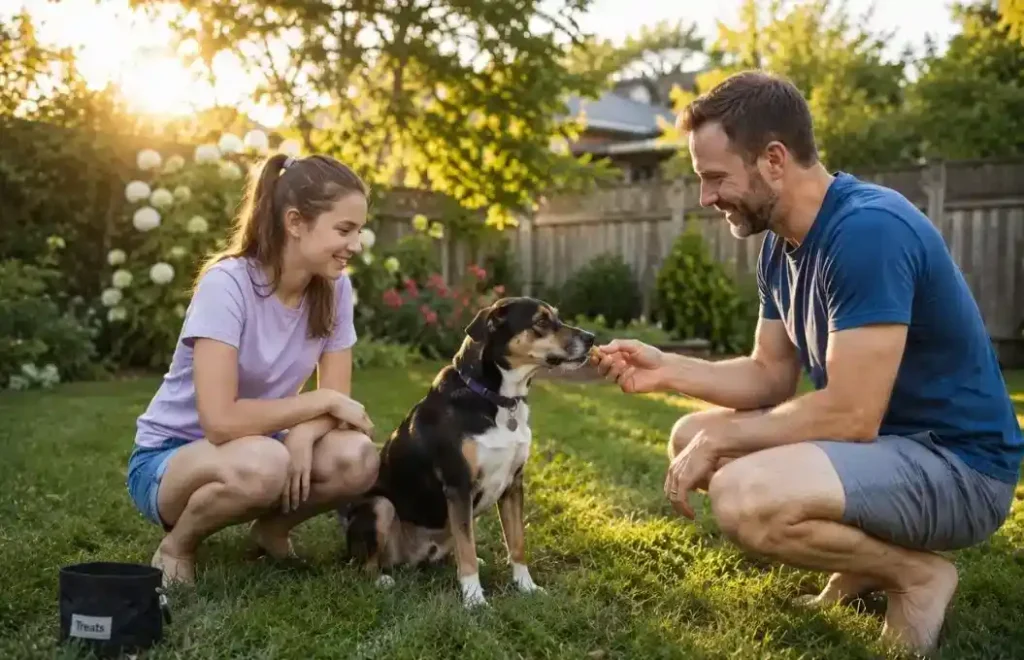
When group training is too stressful for your dog
Many owners notice that a dog who sits, lies down, and comes reliably at home freezes, sniffs nonstop, ignores cues, or can’t participate at all in a group class. That isn’t automatically a sign of anxiety. A new place, intense smells, other dogs, tiredness, or simply never having practiced in a busy setting can all play a part. Still, a group class asks a lot of a sensitive dog.
Possible signs your dog is struggling include freezing or shutting down, trying to leave or hide behind you, constant scanning, lip licking or yawning, refusing food they usually love, barking or lunging, and a lowered body or tucked tail. Look at the overall picture rather than a single signal.
Ways to make it easier:
- Increase distance. Ask for a spot at the edge of the room, or behind a barrier or visual screen.
- Reduce distractions. Arrive early, take breaks outside, and practice easier versions of each exercise.
- Ask the trainer for adaptations, such as letting your dog watch at first or skipping exercises that involve close contact with other dogs or people.
- Consider private lessons at home or in a quiet setting until your dog is ready for a group.
Watch the methods as well as the setting. Intimidation, leash jerks, physical manipulation, and tools such as prong or shock collars are red flags according to Cornell’s Riney Canine Health Center, and the American Veterinary Society of Animal Behavior recommends reward-based methods for all dog training, including fear and anxiety. If a class relies on corrections or painful tools, it’s fine to leave.
Build a default calm behavior
One of the most reliable ways to train an anxious dog is to give it a clear behavioral alternative to anxiety. The most useful one to teach is a relaxed “settle” on a mat: a cue that means “lie down on your mat and relax.” Once this is solid, you can use it to help the dog find calm in situations that previously triggered anxiety.
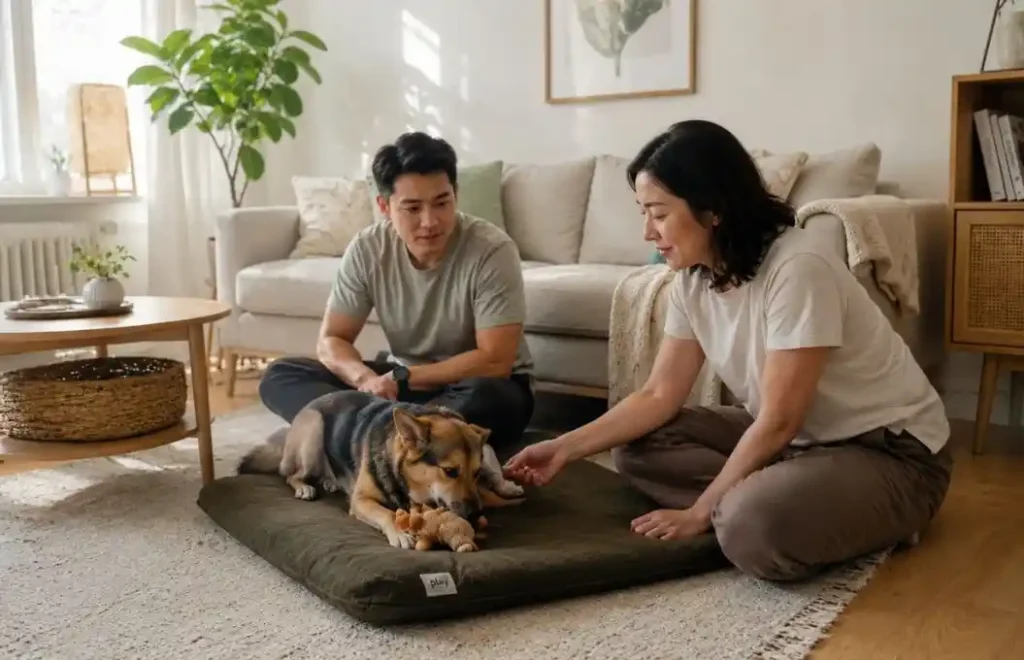
Start by rewarding any calm behavior that happens naturally. Dog lies down? Treat and quiet praise. Dog makes eye contact calmly? Mark and treat. You’re reinforcing the physical and emotional state of calm, which becomes a behavior the dog can offer deliberately.
Over time, pair the mat with good things: feeding meals on the mat, stuffed Kongs on the mat, calm petting while the dog is on the mat. The mat becomes a conditioned location for relaxation. In stressful situations, you can redirect to the mat and leverage the existing association.
Desensitization and counterconditioning for specific fears
For dogs with specific triggers (strangers, other dogs, loud noises, cars), desensitization and counterconditioning are the most effective approaches.
In short, your dog meets a mild version of the trigger (farther away, quieter, or briefer) while something good happens, and the intensity only increases when your dog stays relaxed at the current level. The details matter: how to set up each session, how to measure progress, and what to do when it stalls. Our guide to dog training for fear and anxiety walks through the full desensitization and counterconditioning protocol step by step.
What if your anxious dog is afraid of doorways?
Some anxious dogs hesitate at a threshold: a doorway, a set of stairs, or a shiny or unfamiliar floor. Start by checking the space itself. Slippery surfaces, a narrow gap, a door that swings or bangs, a dark entrance, clutter, or a person standing in the way can all make a dog stop. A rug or runner can make a slick floor easier to cross.
Then break it into small, voluntary steps. Reward your dog for looking at the doorway, then for stepping closer, then for putting a paw across. Toss a treat a short distance onto the easy side so your dog can choose whether to approach. If your dog crosses on their own, reward that initiative generously. Always leave room for your dog to back away, and never drag, push, or pull on the collar to get them through.
Daily needs can’t always wait for training. If the fear keeps your dog from going outside to eliminate, use another exit or route in the meantime, and contact your veterinarian if your dog is holding urine or stool for long periods. Hesitation that appears suddenly, or comes with limping, stiffness, trouble on stairs, or vision changes, also deserves a prompt vet visit, since pain or another medical problem may be involved.
What to do when the dog goes over threshold
It will happen. The trigger appears suddenly, the distance closes too fast, something startles the dog. The dog is over threshold: barking, lunging, shutdown, or frozen.
The right response: calmly increase distance. Don’t jerk the leash, don’t correct, don’t try to force the dog past the trigger. Quietly move away until the dog’s body language relaxes. Taking food again is one helpful sign that your dog is recovering, but not the only one: also look for loose movement, normal breathing, and renewed interest in sniffing or in you. Then decide whether to continue at a much easier level or end the session there. After a big reaction, ending early is often the kinder choice.
What not to do: push through the reaction hoping the dog will “get used to it.” Flooding (forcing exposure to the feared thing) can make fear worse rather than better. It doesn’t build confidence. It can erode trust and make future training sessions harder.
If your dog growls: a growl is a signal that your dog is uncomfortable and a warning that they may escalate if the pressure continues. Don’t punish it. As Fear Free guidance published on dvm360 explains, punishing a growl doesn’t change how the dog feels and can reduce the warning signs a dog gives before a bite. Avoid confrontations, staring contests, or squeezing past your dog in a tight space. Instead, manage the space safely: add distance, use another route through the house, close a door or put up a baby gate, and if your dog guards a resting spot in a busy area, move their bed somewhere quieter when you can do so without reaching over or handling them. If your dog threatens to bite, has bitten, or growls repeatedly, ask your veterinarian for an exam and a referral to a qualified behavior professional.
Consistency is the most important variable
Consistency matters as much as technique when you train an anxious dog. Anxious dogs need predictability. Inconsistent rules, unpredictable routines, and mixed signals from different family members all elevate baseline stress. The dog can’t relax because they can’t predict what comes next.
Consistent rules (the same behaviors are always rewarded and never rewarded) and a predictable daily routine (feeding, walks, and sleep at consistent times) reduce anxiety independently of training. They create a stable environment in which the dog can start to feel safe, and a safer-feeling dog is a more trainable dog.
How to tell if training is working
Progress with an anxious dog rarely follows a calendar. Instead of counting weeks, check every so often whether your dog:
- joins training sessions voluntarily;
- seems more relaxed in a familiar situation that used to worry them;
- can respond to a simple cue despite a mild distraction;
- recovers more easily after an interruption or a surprise;
- is gradually willing to practice in new places.
If some of these are moving in the right direction, training is working, even when it feels slow, and setbacks along the way are normal. If nothing changes after a reasonable stretch of consistent work, or things get worse, that’s a reason to get help.
When training isn’t enough
Even once you know how to train an anxious dog, some anxiety is severe enough that behavior modification alone doesn’t make meaningful progress. If a dog’s baseline stress is chronically elevated, the nervous system is too activated to learn effectively regardless of technique.
In those cases, a consultation with a veterinary behaviorist is worth having. Anti-anxiety medication doesn’t replace training, but it can lower baseline arousal enough that training starts working. Some dogs simply can’t access the learning state without pharmaceutical support for a period.
Signs that warrant a vet conversation: the dog is distressed most of the day regardless of triggers, there’s self-harming behavior, the anxiety is worsening despite consistent training, or the dog’s quality of life is visibly poor.
Where to go next
Once you understand how to train an anxious dog using the steps above, these related guides go deeper on specific situations:
- Dog training for separation anxiety: the complete guide: if the anxiety is specifically about being left alone
- Dog training for fear and anxiety: what actually works: deeper protocol for specific fear triggers
- Best anxiety wraps for dogs (2026): tools that lower baseline arousal during training
- Dog crates for separation anxiety: should you use one?: whether a crate suits your dog during training