🐾 Does your dog panic when you leave? → Get the Free 7-Day Starter Plan

Dog Separation Anxiety: Signs, Causes & How to Help
Dog separation anxiety: learn the signs, causes, and gentle training steps, plus when to discuss medications and professional help with your vet.


Does your dog bark, panic, or become destructive whenever you leave home? These behaviors can be signs of separation-related distress, not simply bad behavior.
Your dog isn’t being difficult on purpose. With gradual training, patience, and sometimes veterinary support, many dogs can learn to feel more comfortable when left alone.
This guide explains how to recognize the signs, understand possible causes, and build a training plan that fits your dog’s needs.
Table of Contents
- What Is Dog Separation Anxiety?
- Why Dogs Develop Separation Anxiety
- When Does Separation Anxiety Start? Age Matters More Than You Think
- Recognizing the Signs: Separation Anxiety Symptoms
- The 4-Phase SA Protocol: A Step-by-Step Framework
- Separation Anxiety Treatment Options: What Actually Works
- Best Tools for Dogs with Separation Anxiety
- Common Mistakes That Make Separation Anxiety Worse
- Your Dog Can Get Better
- Frequently Asked Questions
- Key Takeaways
Separation problems are common, but estimates vary with how they are defined. In a survey of about 13,700 Finnish pet dogs, around 5% showed frequent separation-related behavior under the authors’ definition (Salonen et al., 2020). The authors note that earlier studies reported higher figures, and that their own may be lower because they counted only dogs with frequent signs. Yet most owners don’t realize their dog has it until the damage is done: chewed furniture, broken blinds, noise complaints, and a dog who’s visibly distressed every single day.
Here is what makes this so frustrating: leaving is hard on you too, and a long, emotional goodbye can feel like the kind thing to do. Many veterinary behaviorists suggest a calm, predictable routine instead, which some dogs find easier. You do not have to be cold, and what works varies from dog to dog. Watch how your dog responds and adjust with your vet or behavior professional.
This guide changes that. You’ll get a step-by-step framework, the 4-Phase SA Protocol, built on the gradual desensitization methods that veterinary behaviorists recommend. We cover causes, symptoms, training strategies, and the tools that actually work, because managing dog separation anxiety well takes more than one trick.
The 4-Phase SA Protocol is PetCalmZone’s educational framework for organizing the training steps. It is not a clinically validated protocol, so adapt it with your vet or behavior professional.
What Is Dog Separation Anxiety?
Dog separation anxiety (SA) is a behavioral disorder in which a dog experiences extreme stress when left alone or separated from a specific person. It goes beyond normal restlessness or boredom. It’s a fear response: the dog’s nervous system believes it’s in genuine danger.
The condition exists on a spectrum:
The table below is an illustration, not a diagnostic scale. Only a vet or certified behavior professional can assess your dog.
| Severity Level | Description |
|---|---|
| Mild | Whining, pacing, following owner from room to room |
| Moderate | Barking, destructive chewing, inappropriate elimination |
| Severe | Self-injury (scratching doors, breaking teeth), full panic response |
Separation anxiety is not the same as boredom. A bored dog chews a toy. An anxious dog chews through a door. It is also distinct from isolation distress, where the dog is fine with any human company but panics when left completely alone.
Why Dogs Develop Separation Anxiety
Understanding the root cause is the first step toward fixing it. Age plays a role too — separation anxiety can appear at any age, from puppyhood through the senior years. The most common triggers include:
1. Over-attachment to one person
When a dog bonds exclusively to one person and that person becomes their primary source of security, any separation from that person triggers panic, not just being home alone.
2. Sudden schedule changes
A big change in routine can trigger or worsen separation problems, for example when an owner returns to the office after months at home. Both the ASPCA and Ohio State’s veterinary behavior team have warned about this.
3. Traumatic history
Dogs adopted from shelters are over-represented in veterinary behavior cases. The reason is not fully known, and a stressful early life may be part of it.
4. Genetics and breed predisposition
Breed seems to play a role, but no breed is immune. In a large Finnish survey, separation-related behavior was most common in mixed-breed dogs and Soft-Coated Wheaten Terriers (Salonen et al., 2020). The authors suggest that a difficult early life, common in rescue dogs, may be part of the reason. Our breed guides cover Vizslas, Toy Poodles, Chihuahuas and Bichon Frises.
5. Insufficient early socialization
Dogs who weren’t exposed to being alone as puppies often never learn that alone-time is safe.
When Does Separation Anxiety Start? Age Matters More Than You Think
Separation anxiety can appear at any age, but the timing shapes how it develops and how quickly a dog responds to training. Understanding the age windows helps you spot early signs and intervene before the anxiety becomes entrenched.
Puppies: The First Fear Window (8 to 11 Weeks)
Between 8 and 11 weeks, puppies go through a developmental fear period where they are more sensitive to frightening experiences. A puppy who has repeated panic-level experiences of being alone during this window can form an early association between solitude and danger.
This does not mean you should never leave a young puppy alone. It means the exposures should be short, calm, and gradually increasing. Behaviorists recommend starting separation practice from day one, even at 8 weeks, but keeping sessions brief. At this age, most puppies cannot hold their bladder for more than about 2 hours, and the general rule is 1 hour per month of age plus 1 when the puppy is at rest.
What owners on forums report: Many puppy owners describe crying and whining that lasts 2 to 3 weeks of consistent crate training before it stops. Several report a sudden improvement around 5 to 6 months where the puppy simply stops reacting to departures. Others find that distraction tools like lick mats and frozen Kongs help delay the anxiety response but do not eliminate it — meaning the puppy is calm only until the treat runs out.
One important distinction that many new owners miss: a puppy that whines for 20 minutes and then falls asleep is showing normal adjustment behavior. A puppy that screams, pants, drools, tries to escape, or refuses food for the entire absence is showing something more serious that warrants early intervention.
Adolescence: The Second Vulnerability Window (6 to 18 Months)
Adolescent dogs go through a second period of neurological reorganization. A dog who was calm alone at 4 months may start showing anxiety at 8 months. This is not regression — it is a normal part of development that creates a temporary window of increased vulnerability.
This window often coincides with real-life changes: the owner goes back to work, the puppy starts being left alone for longer stretches, or the novelty of a new home wears off and the dog becomes more aware of departures. The combination of developmental sensitivity and routine change is what tips many dogs into anxiety.
Adult Onset: Triggered by Life Events
Many dogs develop separation anxiety in adulthood, not as a developmental issue but as a response to a specific change. The most common triggers include a sudden schedule change after months of constant presence (such as returning to the office after working from home), loss of a companion animal or person, rehoming or adoption, a traumatic event that generalizes into broader anxiety, or extended 24/7 togetherness followed by an abrupt return to normal separation.
What experienced owners report: Getting a second dog is frequently suggested as a fix, but many owners who tried it report that it did not resolve the anxiety and sometimes added stress. One approach that shows up repeatedly in success stories is a combination of medication (such as Clomicalm for 4 to 6 months) paired with consistent desensitization training, then gradually weaning off the medication once the dog is stable.
Senior Dogs: New Anxiety in Later Life
Anxiety that appears or worsens in an older dog warrants a veterinary evaluation before behavioral work begins. Canine Cognitive Dysfunction (CCD), similar to dementia in humans, can cause increased anxiety, nighttime restlessness, and confusion about being alone. Pain from arthritis or other conditions can also raise anxiety levels because the dog associates movement and position changes with discomfort.
A dog showing new anxiety symptoms at 10 or 12 years old is more likely experiencing a medical or cognitive change than a purely behavioral problem. The vet visit should come first.
How Fast Do Dogs Improve?
Recovery speed varies by age and severity. Puppies and adolescents tend to respond fastest because the association between solitude and panic has not had years to become entrenched. Most owners who follow a consistent protocol see meaningful progress within 2 to 4 weeks, though severe cases can take months. Dogs whose anxiety appeared later in life, especially after a triggering event, may need a slower pace and more repetitions at each stage.
The single most cited piece of advice from owners who succeeded: start early, be consistent, and do not rush the timeline. A book frequently recommended by experienced owners is Julie Naismith’s Be Right Back, written specifically for owners working through separation anxiety at home.
Recognizing the Signs: Separation Anxiety Symptoms
Signs often begin within minutes of your departure, and most within about 30 minutes. A key clue: the behavior happens when your dog is alone, or when your dog senses you are about to leave.
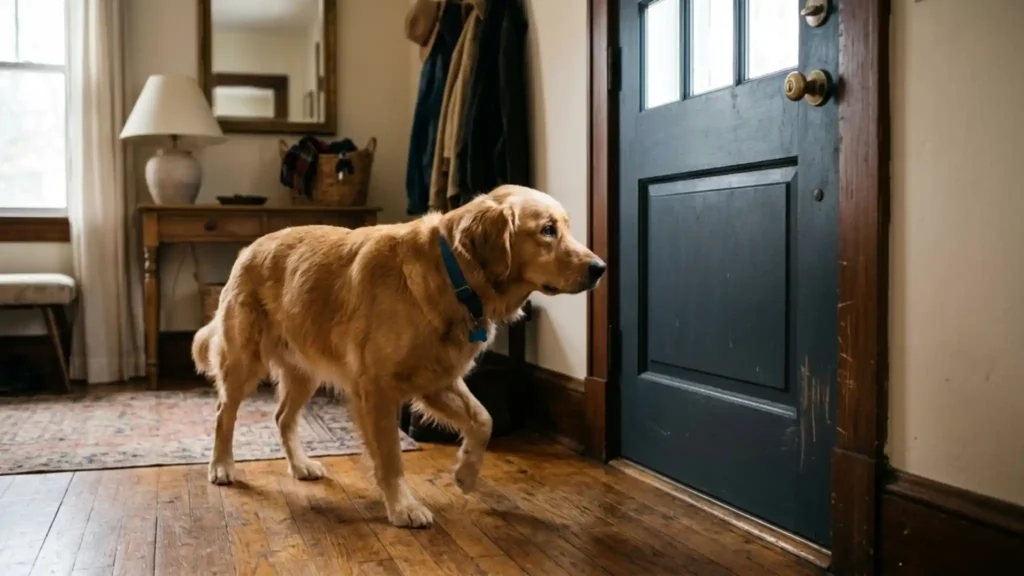
Primary signs:
- Excessive barking, howling, or whining after departure
- Destructive behavior (chewing doors, window frames, furniture)
- Inappropriate urination or defecation
- Pacing, circling, or inability to settle
- Attempts to escape, sometimes causing self-injury
Pre-departure anxiety (common but missed):
- Shadowing you as you prepare to leave
- Trembling or panting when you pick up keys/bag
- Refusing to eat before you leave
📹 Pro tip: Set up a camera to record what happens after you leave. Many owners are shocked by what they see. Video footage is also useful if you work with a certified behavior consultant.
Watch a real absence
If you already have to leave for a short errand, film that absence to see how your dog really behaves. Do not stretch it out or create a longer absence just to film. Look beyond barking: pacing, drooling, panting, trembling, scratching at doors, hiding, or freezing in place. A quiet dog is not always a calm dog, because some anxious dogs go still or refuse food. If your dog uses a crate, ask your vet or behavior professional how to compare the reaction in and out of it, and do not leave your dog loose if there is any risk of injury or escape. Show the footage to your vet.
→ Best Dog Cameras for Separation Anxiety | What to Record for Your Vet
The 4-Phase SA Protocol: A Step-by-Step Framework
This is the core of this guide’s advice. The 4-Phase SA Protocol draws on systematic desensitization, the same principle used by human therapists for phobias. You gradually expose your dog to the feared stimulus (your absence) at a level low enough to avoid triggering panic, then slowly increase duration as your dog’s threshold rises.
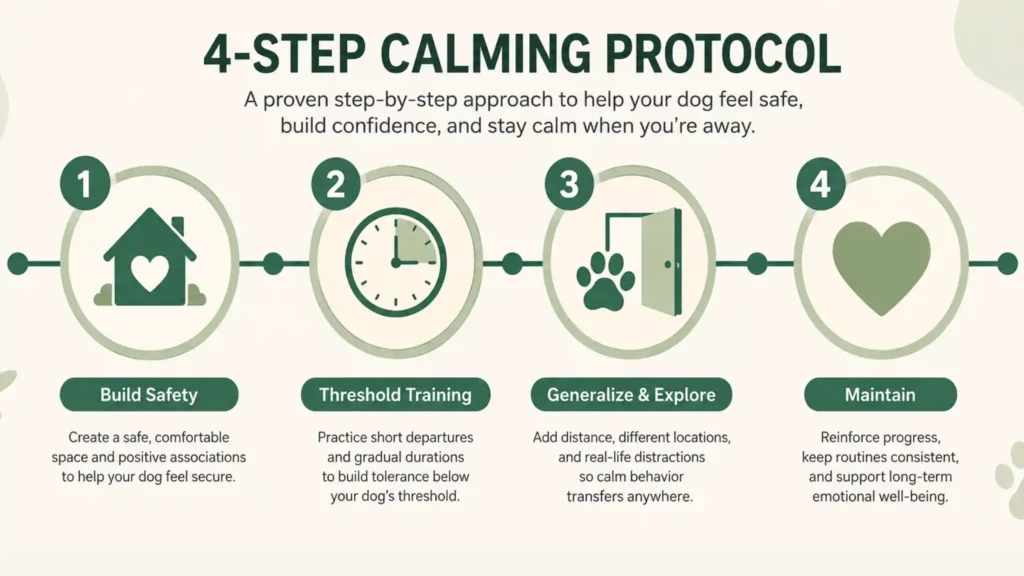
Phase 1: Build Baseline Safety
Goal: Establish that alone-time is survivable.
- Departure cue practice: If your dog reacts to cues like keys or a coat, pick them up without leaving, then put them down and sit. Do a few repetitions at a time and stop if your dog gets tense. Repeat over several days until your dog barely reacts.
- Practice mini absences inside the home: Ask your dog to stay in one room while you go to another. Start with 10 seconds. Build to 5 minutes over several days.
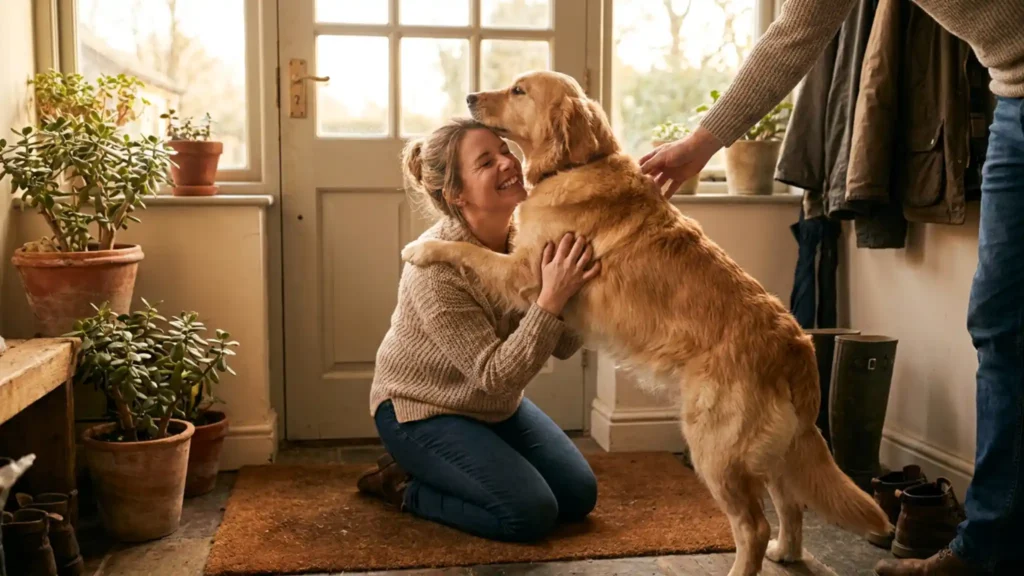
- Keep goodbyes low-key: A brief, calm and predictable routine suits many dogs. Warm contact is fine. What matters is that departures and returns feel the same each time, so they do not turn into a big event.
Tools that may help in Phase 1: A crate or pen, only if your dog already rests there calmly → Dog Crates for Separation Anxiety: Should You Use One? | A comfortable bed → Best Anti-Anxiety Dog Beds | Calming music → Calming Music for Dogs
Phase 2: Threshold Training
Goal: Systematically increase the duration of absences without triggering panic.
The core rule: keep each absence shorter than the point where your dog starts to show distress. That point is not fixed. It can change with the day, your schedule, illness, noise or recent stress, so stay at an easier level when in doubt. Watch for quiet signs too, such as freezing, drooling, panting or ignoring food. Some dogs cannot cope with even a few seconds alone. If that is your dog, pause real absences where you can and ask your vet or a certified behavior professional for a plan.
- Begin actual departures at a length your dog handles calmly, sometimes just a few seconds.
- Use a sub-threshold tracking sheet: log every session’s duration and your dog’s response (calm / mild stress / panic).
- Increase duration gradually and unevenly. Mix shorter and longer sessions, and go back to an easier step if your dog shows any distress.
- Vary durations: sometimes do shorter sessions to prevent anticipation anxiety.
Tools that may help in Phase 2: Calming supplements (ask your vet first) → Best Calming Supplements for Dogs (2026): 6 Options Compared | Anxiety wraps → Best Anxiety Wraps for Dogs
When you have to leave for work
Many owners cannot stop leaving, and that makes this harder. While you build up absences, try to avoid long stretches alone that push your dog past their limit. Options include a trusted friend or family member, a pet sitter, a calm daycare your dog already likes, taking your dog to work if allowed, or splitting your day with remote work. If none of this is possible, talk to your vet or a certified behavior professional soon, because medication or a tailored plan may be needed. A plan that keeps absences short is better than one that relies on your dog coping.
Phase 3: Generalization & Independence
Goal: Your dog handles alone-time reliably across contexts.
- Vary departure locations: Leave from the front door, back door, garage. Dogs are hyper-contextual.
- Introduce variability: Leave at different times of day to prevent anticipatory anxiety.
- Strengthen independent behaviors: Teach “go to your place” and reward voluntary disengagement.
- Try food puzzles: A stuffed toy can help some dogs, but dogs in panic often refuse food. If yours ignores it, go back to an easier step. Check peanut butter labels for xylitol, which is toxic to dogs.
→ Dog Training for Separation Anxiety: Why Standard Methods Fail
Phase 4: Maintenance & Long-Term Management (Ongoing)
Goal: Sustain progress and prevent relapse.
- Continue periodic sub-threshold sessions 2–3x per week even when your dog is doing well.
- Monitor for regression triggers: illness, schedule changes, moves, new pets.
- Maintain your toolkit: don’t pull calming tools away just because things are going well.
- Consult your vet annually for reassessment of medications or supplements.
If your dog slides backward
Setbacks are common and do not mean the training failed. Illness, a new schedule, a move, a new person or pet, or a stressful event can all set a dog back. Return to the last step your dog handled calmly, keep sessions short, and ask your vet to rule out pain or illness. If setbacks keep happening or your dog panics, ask your behavior professional to adjust the plan.
Separation Anxiety Treatment Options: What Actually Works
Behavior Modification (First-line treatment)
The four sections above organize this guide’s advice. They are not a clinically validated protocol. Gradual desensitization should be tailored to your dog’s response, with professional guidance when needed.
Medication for Separation Anxiety
In moderate-to-severe cases, veterinary medication can lower your dog’s anxiety baseline enough to make behavior modification effective.
- Fluoxetine (Reconcile®): FDA-approved for canine separation anxiety, used together with a behavior modification plan. The US label notes that some dogs may improve within 1 to 2 weeks, but your vet decides how long to continue before judging the response, and follow-up visits are part of treatment. It is not suitable for dogs with a history of seizures.
- Clomipramine (Clomicalm®): Also FDA-approved. Works on serotonin and norepinephrine pathways.
- Situational medications (trazodone, alprazolam): For acute events such as vet visits, storms or the first days of longer absences.
- Tasipimidine (Tessie®): approved by the FDA on May 6, 2026 as the first drug for both noise aversion and separation anxiety in dogs (FDA announcement). It is a prescription product given by mouth about one hour before you leave, and it is used alongside behavior training. The manufacturer expects it to reach the US market in mid-2027, so ask your vet what is available now.
⚠️ Medication is a support tool, not a cure. Always combine with behavior training.
→ Dog Anxiety Medication: Options, Evidence and Safety
Natural Remedies
- Adaptil (dog-appeasing pheromone) diffuser: A synthetic copy of a pheromone released by nursing mothers. Evidence is mixed, and a 2021 evidence review found weak support for using it to reduce anxiety in adult dogs.
- Melatonin: Used for sleep and situational stress, with little controlled evidence in dogs. Avoid products that contain xylitol.
- L-theanine: An amino acid found in tea. Studies in dogs are small, so the benefit is uncertain.
- Valerian root: Common in calming products, but there are no controlled studies showing benefit in dogs.
→ Natural Remedies for Dog Anxiety: What Studies Show
Professional Help: Finding a Dog Trainer for Separation Anxiety
If your dog panics, gets hurt, or you are not seeing progress after a few weeks of steady work, it is time to find a dog trainer for separation anxiety or a certified behaviorist. Do not wait if your dog is injuring themselves, and ask your vet to rule out medical causes first:
- Certified Separation Anxiety Trainer (CSAT): A specialist credential created by Malena DeMartini.
- Veterinary Behaviorist (DACVB): The highest level of care for complex cases.
- Certified Applied Animal Behaviorist (CAAB): A PhD-level behavior specialist.
🔗 Learn about working with a CSAT: malenademartini.com
→ Dog Trainer for Separation Anxiety: How to Choose the Right Professional
Best Tools for Dogs with Separation Anxiety
Products don’t replace training. But the right tools make training dramatically more effective and make day-to-day management easier. For our full comparison, see the best products for dogs with separation anxiety.
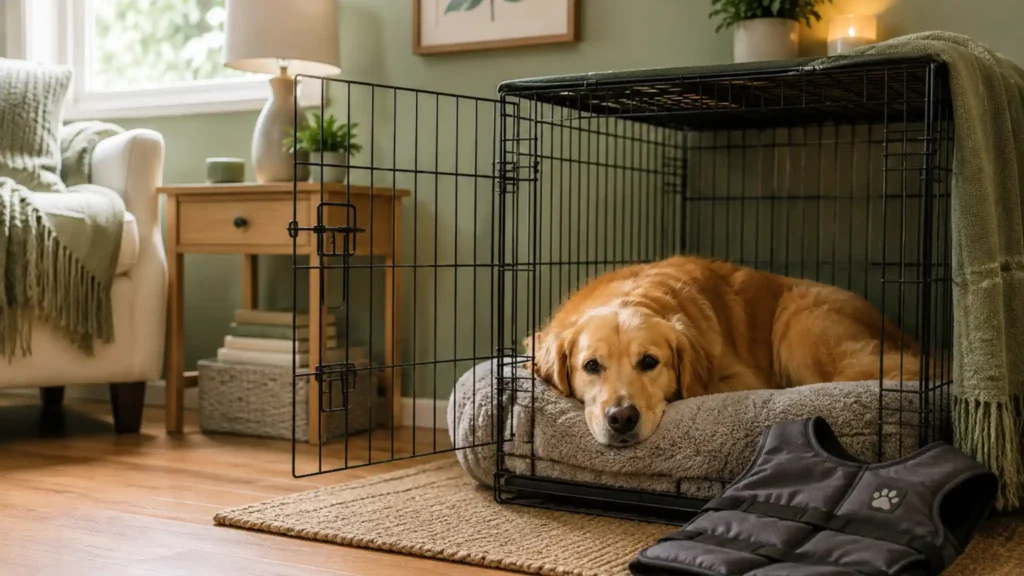
Crates & Safe Spaces
Some dogs rest happily in a crate. Others panic when confined, and a crate can make separation anxiety worse. A crate does not treat the anxiety. Only use one if your dog already rests there calmly while you are home, and ask your vet or a behavior professional how to check how your dog really reacts when alone. → Dog Crates for Separation Anxiety: Should You Use One?
Calming Beds
A comfortable bed gives your dog a clear place to rest. Some dogs like raised edges, but there is no solid evidence that one bed shape reduces anxiety, and a bed does not replace training. → Best Anti-Anxiety Dog Beds: 6 Picks That Actually Calm (2026)
Anxiety Vests
Pressure wraps such as the Thundershirt seem to help some dogs, but the evidence is limited. A 2024 systematic review found weak support for wraps in reducing anxiety, and no wrap treats separation anxiety on its own. If you try one, introduce it while you are home and remove it if your dog seems more stressed. → Best Anxiety Wraps for Dogs That Actually Work (2026)
Calming Supplements
Calming supplements have limited evidence in dogs, and products vary widely. Talk to your vet before giving one, especially if your dog takes medication, and check labels for xylitol, which is toxic to dogs. → Best Calming Supplements for Dogs (2026): 6 Options Compared
CBD for Dogs
A 2025 study by Cornell University researchers in eight healthy beagles found that CBDA was absorbed better than CBD, and that both were well tolerated over one week at a low dose. The study looked at absorption and safety, not at anxiety, so it does not show that CBD helps with separation anxiety. Talk to your vet before trying it. (Source: Frontiers in Veterinary Science, 2025) Quality matters enormously. Look for third-party tested, research-backed-formulated products. → CBD for Dogs With Anxiety: What the Research Says
AI Monitoring & Smart Collars
A new generation of AI-powered tools can help you track anxiety in real time. Smart pet cameras use AI to detect pacing, barking, and destructive behavior, sending instant alerts and letting you talk to your dog remotely. Some collars track activity and heart rate. They can add information, but they cannot diagnose anxiety, so share any readings with your vet.
When treats, toys or calming products do not work
If your dog ignores a stuffed toy or treats when you leave, that tells you something. Dogs in panic often refuse food and then eat as soon as you return. Do not add more treats or leave for longer. Go back to an easier step, practice while you are still home, and tell your vet. Calming tools such as wraps, supplements or pheromones may take the edge off for some dogs, but none of them treats separation anxiety on its own.
Common Mistakes That Make Separation Anxiety Worse
- Punishing anxious behaviors: Your dog isn’t being spiteful. Punishment increases fear and makes SA dramatically worse.
- Getting another dog as a companion: A second dog often does not fix separation anxiety and can add stress to the household.
- Leaving your dog alone for long stretches and hoping they get used to it: This can make panic and anxiety worse.
- Relying on exercise alone: A tired anxious dog is still an anxious dog.
- Long, emotional goodbyes: For some dogs they make leaving feel like a big event. A short, familiar routine is often easier, and you can stay warm and kind.
- Giving up too early: Separation anxiety training takes weeks to months. Consistency is the entire game.
Your Dog Can Get Better
Dog separation anxiety feels overwhelming, but it is not a permanent sentence for you or your dog. The 4-Phase SA Protocol offers a structured starting point to discuss with a qualified professional. An individualized plan, practical support and consistent monitoring can help guide next steps. Progress varies by dog.
Your next steps:
- 🛋️ Set up your dog’s safe space → How to Kennel Train a Dog With Separation Anxiety
- 📋 Learn the training in detail → Dog Training for Separation Anxiety
- 💊 Explore medication options → Dog Anxiety Medication: Options, Evidence and Safety
- 🌿 Explore natural options → Natural Remedies for Dog Anxiety
- 🐾 Check the signs → Signs of Separation Anxiety in Dogs at Night
Your dog isn’t giving up on you. Don’t give up on them.
Frequently Asked Questions
How long does it take to treat dog separation anxiety?
There is no fixed timeline. Some dogs with mild signs improve within a few weeks, many need several months of steady work, and some need long-term management. Progress depends on how severe the anxiety is, how consistently you train, and whether your vet has found another factor, such as pain or noise fear. Medication, when prescribed, supports training but does not replace it.
Can separation anxiety be cured completely?
Many dogs improve dramatically and reach a point where they’re comfortable being alone for normal durations. SA is better thought of as a manageable chronic condition. Many owners who follow a structured plan see real progress. Results vary, and some dogs need long-term management with help from a professional.
Should I crate my dog with separation anxiety?
Not always. Many dogs with separation anxiety also have confinement distress, and a crate can make the panic worse. Use a crate only if your dog already rests there calmly while you are home. Ask your vet or a behavior professional for help if your dog tries to escape, soils the crate or gets hurt.
What breeds are most prone to separation anxiety?
Studies disagree on which breeds are most at risk. A large Finnish survey found separation-related behavior most often in mixed-breed dogs and Soft-Coated Wheaten Terriers, and some studies also point to Cocker Spaniels. A dog of any breed or age can develop it, so watch your own dog’s behavior rather than the breed label.
Should I try medication for my dog’s separation anxiety?
If your dog’s anxiety is moderate or severe, consult your vet. Fluoxetine and clomipramine are both FDA-approved for canine separation anxiety. Medication doesn’t replace training. It makes training possible for dogs whose anxiety is too high to learn otherwise.
How do I know if my dog has separation anxiety or is just bored?
Separation anxiety behaviors happen specifically when you’re absent, often within the first few minutes, and most within about 30 minutes. Boredom behaviors happen whenever the dog is under-stimulated, including when you’re home. Set up a camera and watch the footage.
Can separation anxiety suddenly appear in an older dog?
Yes. A major life change — a move, losing a companion, a change in the owner’s schedule, or even a medical issue like pain or cognitive decline — can trigger separation anxiety in a dog that was previously fine alone. Senior dogs are especially susceptible because cognitive changes lower their ability to cope with stress.
Is separation anxiety a sign of dementia in dogs?
Not always, but it can be. Canine Cognitive Dysfunction (CCD) often presents with increased anxiety, nighttime restlessness, and disorientation — symptoms that overlap with separation anxiety. If an older dog suddenly develops anxiety when alone, a veterinary evaluation is the first step to rule out CCD and other medical causes before starting a behavioral protocol.
Should I see a vet before starting separation anxiety training for my senior dog?
Absolutely. In senior dogs, new anxiety is more likely to have a medical or cognitive component than a purely behavioral one. Pain from arthritis, vision or hearing loss, thyroid issues, and cognitive decline can all increase anxiety. A vet visit rules these out or identifies them so they can be treated alongside the behavioral work, which leads to faster and more lasting improvement.
Key Takeaways
- Dog separation anxiety is a fear response, not bad behavior or spite
- The 4-Phase SA Protocol organizes this guide’s advice on desensitization and counter-conditioning. It is not a clinically validated protocol
- Never progress training faster than your dog’s threshold allows
- Medication, supplements, and calming tools support behavior modification. They don’t replace it
- A calm, predictable routine can help many dogs
- Most dogs with SA can reach a point where they’re genuinely comfortable being alone