🐾 Does your dog panic when you leave? → Get the Free 7-Day Starter Plan

Dog Anxiety When Left Alone: Why It Happens and How to Fix It
Dog anxiety when left alone causing barking, chewing, or accidents the moment you leave? It's not spite, it's stress. Here are 5 proven steps to calm it fast.

Affiliate disclosure: This article and its sidebar contain affiliate links. If you buy through these links, PetCalmZone may earn a commission at no extra cost to you.
Dog anxiety when left alone comes from separation anxiety, boredom, or fear, and it usually appears within minutes of you leaving.
Your dog is fine when you’re home. The moment you leave, everything falls apart. Barking, destruction, accidents, sometimes all three, starting within minutes of you walking out the door. You’re not imagining it, and it’s not spite. This is what dog anxiety when left alone looks like, and there’s a specific way to address it. Left unmanaged, dog anxiety when left alone tends to escalate rather than fade on its own.
Table of Contents
- Why dogs develop anxiety when left alone
- What dog anxiety when left alone actually looks like
- How to fix dog anxiety when left alone
- What doesn’t work
- When to get professional help
- FAQ
- Bottom line
Why dogs develop anxiety when left alone
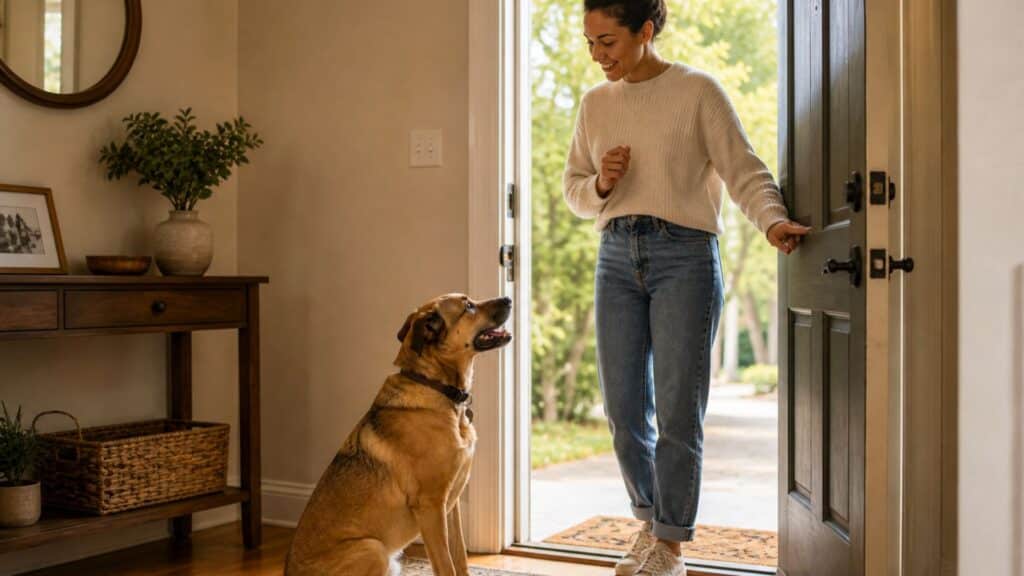
Dogs are social animals. For most of their evolutionary history, being alone meant being in danger. The anxiety response when separated from the group, or from their primary attachment figure, is the survival instinct doing its job. For some dogs, that instinct is calibrated far too high.
Separation anxiety specifically describes distress that occurs when a dog is left alone or separated from the person they’re most attached to. It’s distinct from boredom (which is a different, milder problem) and from generalized anxiety (which is present with the owner home too). The defining feature is that the behavior happens in your absence and stops when you return, the same pattern the ASPCA uses to define true separation anxiety.
Several factors make dogs more prone to it. Genetics matter: some lines and breeds are more anxious by temperament. Early life experience matters: dogs who had unstable puppy environments, were separated from their mother too early, or had multiple homes tend to show higher rates. Pandemic-era dogs who spent months with their owners present constantly, then had schedules suddenly change, developed separation anxiety at unusually high rates as a result.
It can also develop after a significant life change: a new move, the loss of another pet in the household, a change in the owner’s schedule. Dogs are creatures of routine, and disruptions to that routine can destabilize a previously stable dog.
What dog anxiety when left alone actually looks like
Most owners have no idea what happens after they leave. They come home to evidence: shredded furniture, neighbors complaining, a stressed dog, but don’t see what the first hour actually looked like. Setting up a camera changes everything.
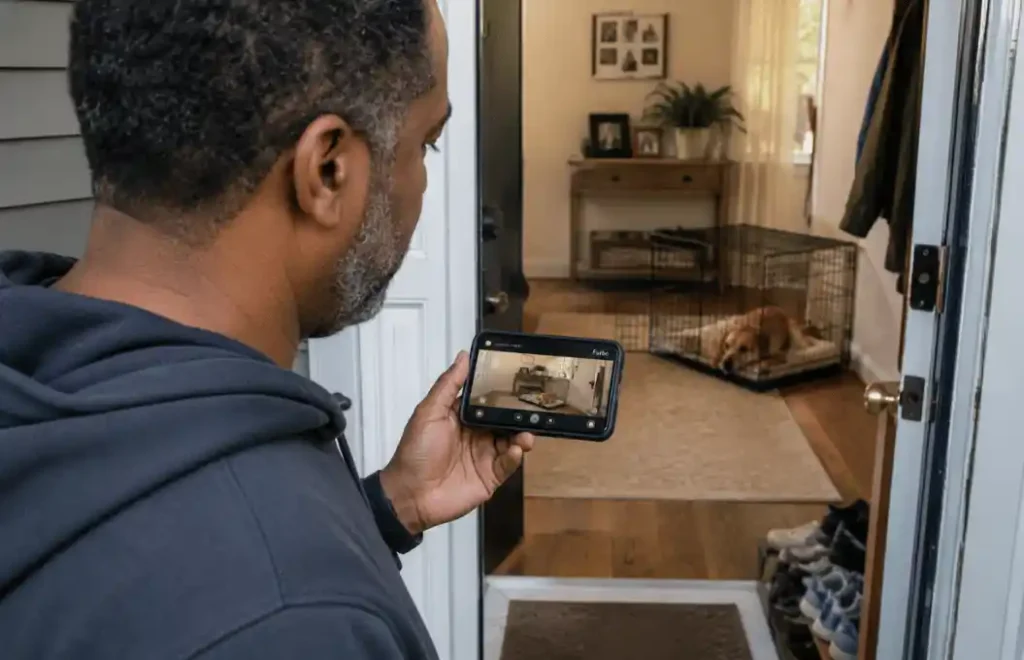
What cameras typically show: the dog becomes alert as you begin departure preparations (grabbing keys, putting on shoes). Anxiety builds before you’re even out the door. For the first 15–30 minutes after departure, the dog paces, vocalizes, and attempts to get to exits: door frames, windows, gates. Many dogs settle after exhausting themselves, but some remain distressed for hours.
The behavioral signs concentrated around your absence include vocalization starting shortly after departure, destructive behavior focused on exits (chewed door frames, scratched windows, destroyed baby gates), house accidents in a fully trained dog, and in severe cases self-injury from escape attempts. Physical signs include panting, drooling, and visible trembling when you prepare to leave.
Pre-departure anxiety is particularly telling. If your dog watches you like a hawk when you pick up your keys or put on your coat, starts pacing, panting, or showing stress before you’ve even left: that’s the anxiety starting in anticipation.
How to fix dog anxiety when left alone
Step 1: Confirm the camera footage
Before starting any training program, watch what actually happens. A cheap pet camera or even a phone propped up on a shelf will do. You need to know: when does the anxiety start (immediately, or after a delay)? How severe is it (mild vocalization, or frantic destruction)? Does it subside, and if so, when? That information calibrates the training plan.
Step 2: Work on pre-departure cues
If your dog reacts to departure cues before you leave, start there. Pick up your keys 20 times a day and don’t leave. Put your shoes on, then sit down on the couch. Coat on, coat off. The goal is to break the association between those cues and your departure so the anxiety doesn’t start before you’re even out the door.
Step 3: Practice absences below the anxiety threshold
This is the core of evidence-based separation anxiety treatment: departure desensitization. You leave for an amount of time shorter than what triggers anxiety, often just seconds or a few minutes, and return before the dog reaches their anxiety threshold. The dog learns that departures are not a crisis because they always end quickly.
Gradually, over days and weeks, you increase the duration, but only as fast as your dog can handle without tipping into anxiety. The rule is: if your dog is anxious, the absence was too long. Go back to a duration that worked and build from there more slowly.
This process takes longer than most owners expect, but it’s the only approach with strong clinical evidence. For a full step-by-step protocol: comprehensive separation anxiety treatment guide →
Step 4: Add calming support to lower the baseline
Behavioral training is the foundation. Calming aids help by lowering your dog’s anxiety baseline, making the threshold higher and training more effective. Some of these may take time to show any effect, so it helps to start them before you need them.
ThunderEase Diffuser Refill (powered by ADAPTIL) is a pheromone refill that requires a compatible plug-in diffuser, sold separately. Check compatibility before ordering. Place the diffuser near where your dog spends time while you’re gone. Results vary from dog to dog, so judge it over time and alongside training. → Check the ThunderEase refill on Amazon
Purina Pro Plan Calming Care is a probiotic supplement (Bifidobacterium longum BL999). A conference abstract (not a full article) from Purina’s own researchers describes a placebo-controlled crossover study in 24 anxious Labradors, with 6 weeks per treatment, that reported fewer anxious behaviors. These preliminary findings do not establish that the supplement treats separation anxiety or predict an individual dog’s response.
Zesty Paws Calming Bites are a calming supplement. Response varies between dogs. A calming supplement should not replace a separation-anxiety treatment plan. Discuss supplements with your veterinarian. → Check Zesty Paws on Amazon
Step 5: Set up the environment for success
A dog who has a safe, comfortable place to go when stressed handles absences better than one who doesn’t. If your dog is crate trained and the crate is their safe space, use it. If they associate the crate with confinement and stress, don’t. An anxious dog locked in a crate can injure themselves badly. A crate that works needs to have been built up gradually as a positive experience. Best crates for anxious dogs
Background sound helps many dogs: a TV or radio (calm, not exciting programming), or a white noise machine. Not because dogs understand words, but because an auditory baseline reduces alertness to outside sounds that might trigger barking or vigilance. Purpose-selected calming music for dogs can work even better than generic background noise: research shows classical and reggae music specifically lower stress behaviors in kennelled and home-alone dogs.
What doesn’t work
Getting another dog: sometimes this helps, sometimes it doesn’t. A dog with true separation anxiety attached to a person is often equally anxious with another dog present. It depends on the individual dog and the nature of the attachment. Worth trying if you were planning to get a second dog anyway. Not worth doing purely as a fix for anxiety.
Punishing the dog when you get home. Ineffective regardless of what you find. The behavior happened 5 hours ago. The dog doesn’t connect your current anger to their earlier destruction, and even if they did, they weren’t destroying things out of choice. The anxiety did it.
Extended crating without crate training. Putting an anxious dog in a crate they’re not comfortable with and leaving for 8 hours doesn’t reduce anxiety. It often makes it worse, and adds injury risk.
Dramatic departures and reunions. Long goodbye rituals and highly emotional greetings when you return signal to your dog that arrivals and departures are high-stakes events. Keep departures and returns low-key. Ignoring your dog for a few minutes before you leave and after you return feels odd but helps reduce the emotional spike.
When to get professional help
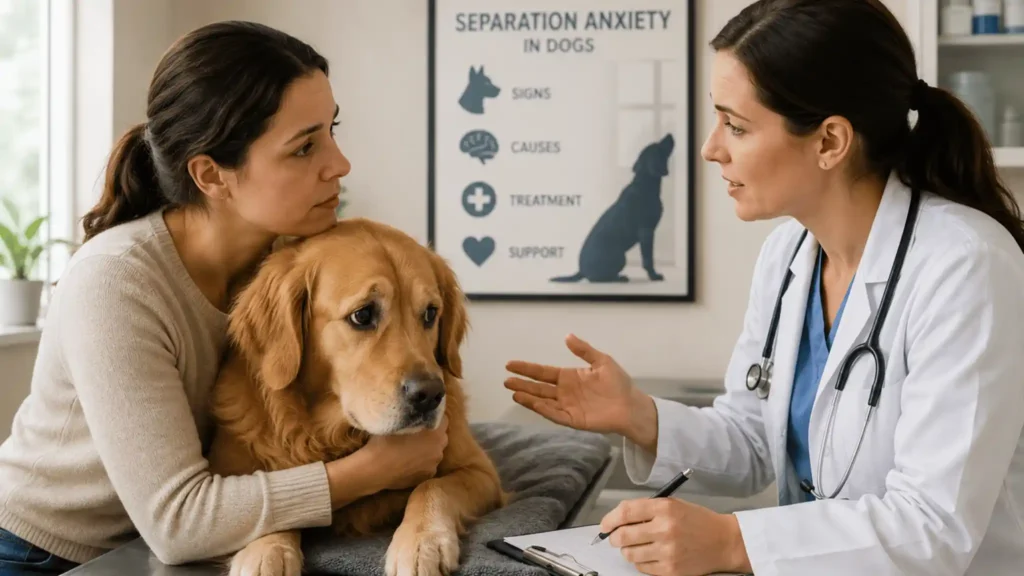
Consider a Certified Separation Anxiety Trainer (CSAT) if: you’ve been doing desensitization consistently for 4+ weeks without progress, the anxiety is severe (self-injury, complete inability to function), or you’re struggling to stay below the anxiety threshold in your daily life. CSATs specialize specifically in this and can provide a structured, monitored plan.
For severe cases, a veterinary behaviorist or vet-prescribed medication (fluoxetine, clomipramine) can help reach a functional baseline where behavioral work can succeed. Medication and behavioral training together outperform either approach alone in severe cases.
FAQ
How long can I leave a dog with separation anxiety?
During training, the answer depends on your individual dog’s threshold, determined through camera observation. Many dogs with moderate-to-severe separation anxiety are distressed within 5-10 minutes. During intensive treatment, a dog walker, daycare, or another person staying with the dog may be necessary.
Does ignoring your dog before leaving help with anxiety?
Keeping departures low-key helps because highly emotional rituals make departures feel high-stakes. A calm, matter-of-fact goodbye lowers the emotional significance of the event for your dog compared to a prolonged, guilt-laden farewell.
Can leaving a dog alone all day make anxiety worse?
Yes. Repeated long absences that exceed the dog’s threshold reinforce the anxiety response. Every panicked absence is a rehearsal of the panic. Keeping absences below the anxiety threshold during treatment is essential, even if it requires significant lifestyle adjustments.
Is it okay to crate a dog with separation anxiety?
It depends on the individual dog’s relationship with the crate. A dog who is properly crate trained and finds it comforting can benefit. A dog who sees the crate as confinement and becomes more anxious inside should not be crated during treatment.
How long does it take to fix separation anxiety?
Mild cases often improve in 4-8 weeks with consistent training. Moderate cases take 3-6 months. Severe cases can take longer and benefit from veterinary support alongside behavioral work. Most dogs can reach a functional level of independence with a consistent approach.
Bottom line
Dog anxiety when left alone is one of the most common and most treatable anxiety problems in dogs. It’s also one that tends to get worse without intervention, not better. The good news: the process for addressing it is well-established, and most dogs respond to consistent departure desensitization over time.
Start with a camera. Know what’s actually happening. Then build a plan based on your specific dog’s threshold. Calming aids help, but they don’t replace the behavioral work.
→ Full separation anxiety treatment protocol → | → Check the ThunderEase refill on Amazon