🐾 Does your dog panic when you leave? → Get the Free 7-Day

Dog Separation Anxiety Treatment: What Actually Works

📌 This post contains affiliate links. We may earn a small commission if you buy through our links, at no extra cost to you.
Most owners searching for treatment are past the “try a Kong” stage. Their dog is destroying the door frame, waking the neighbors, or hurting themselves trying to escape the crate. And the advice they keep finding hasn’t helped.
That’s because most dog separation anxiety treatment advice skips the most important step: matching the treatment to the severity. A dog in mild distress needs something very different from a dog in full panic. Giving a moderate-to-severe dog a calming chew and calling it done is why so many owners feel stuck.
This guide covers every evidence-based option — behavior training, calming tools, supplements, and medication — and how to combine them based on where your dog actually lands on the severity scale.
→ Full context: Dog Separation Anxiety: Complete Owner’s Guide (2026)
How do you know which treatment your dog needs?
Before picking a treatment, assess severity. The right protocol for a dog who whines for 15 minutes looks nothing like the right one for a dog who has been howling for 4 hours and chewed through drywall.
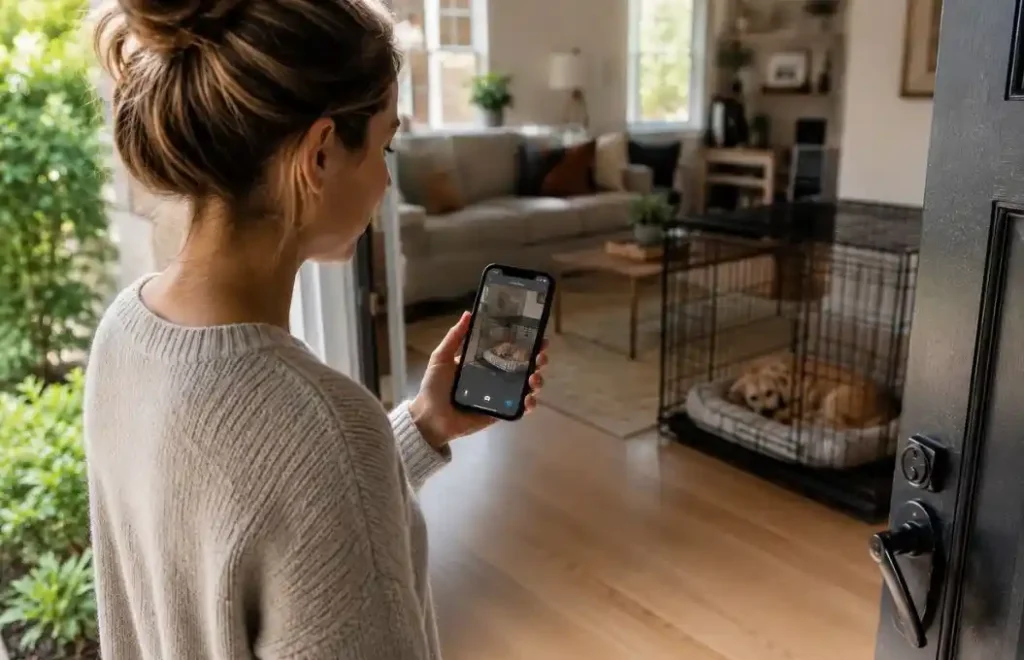
Set up a camera and watch a real absence. You cannot assess what you have not seen. A pet camera with live view (Furbo, Wyze, Blink) shows you what actually happens after you leave — not what you imagine is happening.
Mild — Dog shows stress signals (panting, pacing, whining) but settles within 20–30 minutes. May have isolated incidents of destruction. Gets through absences under 1–2 hours.
Moderate — Distress is sustained throughout most of the absence. Vocalization is continuous or escalating. Destruction is focused on exit points. Dog does not settle regardless of how long you are gone.
Severe — Panic starts before you leave, triggered by departure cues like picking up keys. Self-injury attempts, extreme escape behavior, no functional absences. May refuse food and water when alone.
Your severity level determines which treatments belong in your plan.
→ Does My Dog Have Separation Anxiety? (Quick Self-Test)
Behavior modification: the only thing that changes the underlying problem
Everything else on this list manages symptoms. Behavior modification is the only intervention that changes the fear response itself. It belongs in every treatment plan, mild or severe.
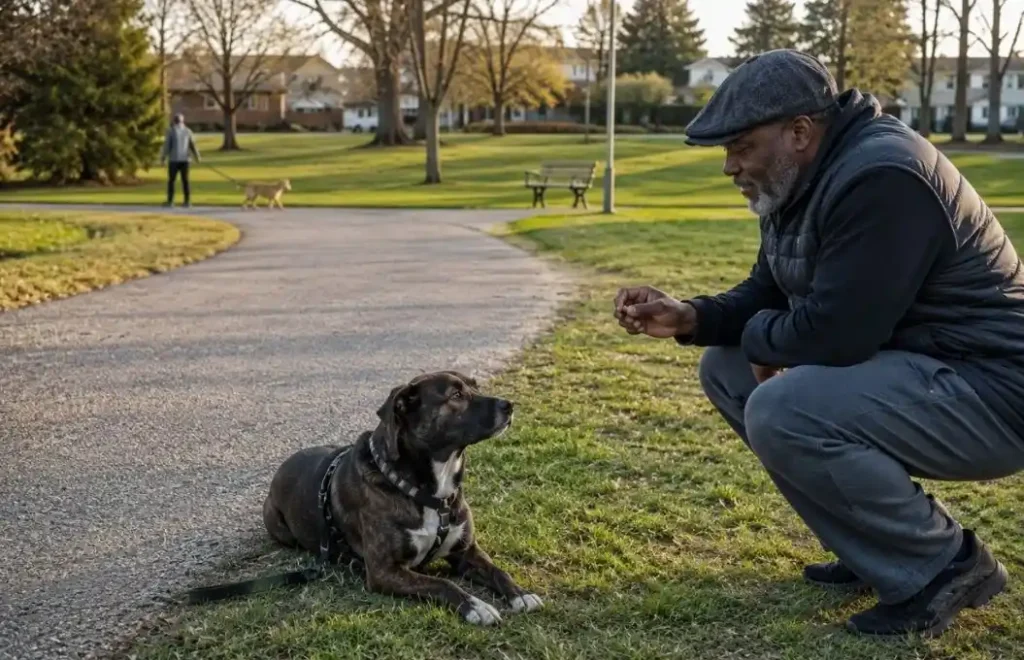
The method with the strongest evidence base is systematic desensitization: exposing your dog to being alone in tiny, graduated steps that stay below the point where panic kicks in.
Your dog has a distress threshold — the point at which discomfort tips into panic. Below it, learning is possible. Above it, the nervous system floods with stress hormones and nothing sticks. The whole protocol runs on one rule: never let the dog go over threshold during a practice session.
What this looks like in practice: if your dog’s threshold is 5 minutes, you start with 30-second absences. Not 4 minutes. Thirty seconds. Leave, return before any stress signal appears, repeat 8–10 times. You are building one association — your departure predicts your return, not abandonment.
Increments go up by 10–20% at a time, with some variability mixed in rather than a straight climb. A session might go: 45 sec, 70 sec, 50 sec, 80 sec. Predictable escalation creates anticipatory anxiety, which is the opposite of what you want.
One thing most people skip: pre-departure cue neutralization. If your dog is already activated before you walk out (following you room to room, panting at the sight of your coat), practice sessions start at a disadvantage. Spend 1–2 weeks picking up your keys 20 times a day without leaving. Put your shoes on, sit on the couch, take them off. Drain those cues of their predictive power before practicing absences.
Realistic timelines: mild cases take 4–8 weeks of consistent work. Moderate cases, 3–6 months. Severe cases, 6 months to over a year — and almost always alongside medication.
→ Full step-by-step training protocol: How to Train a Dog with Separation Anxiety
Calming tools that support treatment

These tools do not fix separation anxiety. What they can do is lower your dog’s baseline arousal enough to make training sessions more productive, and make real-world absences more manageable while the training takes hold.
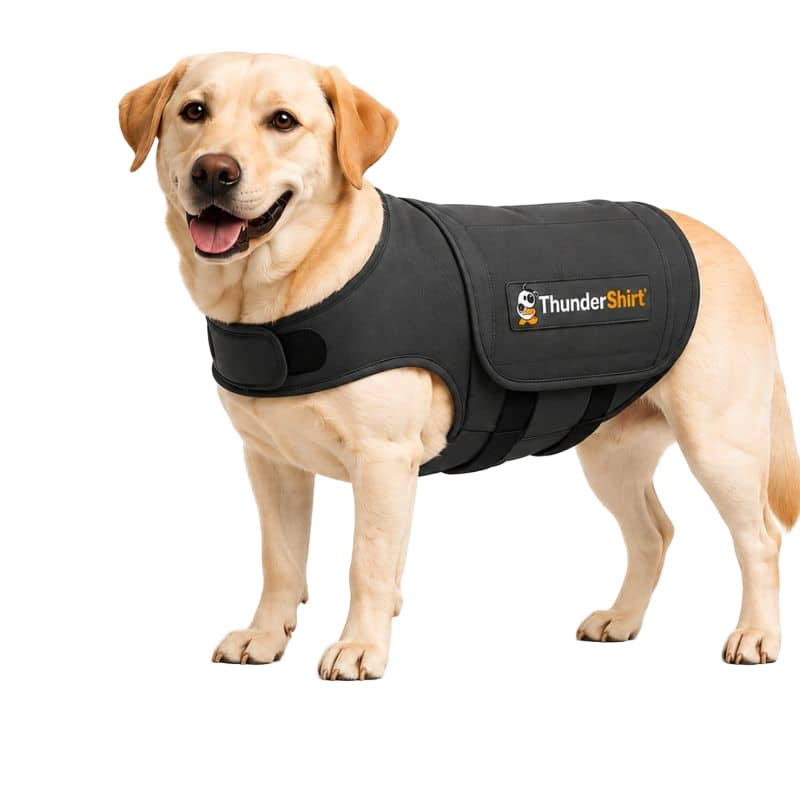
ThunderShirt
ThunderShirt applies gentle, constant pressure across the torso. The compression activates the parasympathetic nervous system — the calming side of the autonomic nervous system — and works within 15–20 minutes. Most useful for mild-to-moderate cases.
One thing most owners get wrong: it has to be snug. You should barely be able to slide two fingers under the chest strap. A loosely worn ThunderShirt does nothing.
Use it before departures, not after distress is already running. A dog in full panic will not respond to a pressure vest — that window has passed.
→ Check ThunderShirt on Amazon | Starting at ~$45
Adaptil collar
Adaptil is a synthetic version of the appeasing pheromone mother dogs release while nursing. Dogs pick it up and associate it with safety — not a conscious process, but a neurochemical one. Studies show measurable reductions in anxiety-related behaviors after 30 days of continuous wear.
The collar releases pheromones for about 30 days in any environment. More useful than the diffuser for dogs whose anxiety follows them outside the home.
Give it a full 30-day cycle before deciding whether it’s working. It builds over time, not overnight.
→ Check Adaptil Collar on Amazon | Starting at ~$22
→ Full comparison: Adaptil vs ThunderShirt — which one is right for your dog?
Calming supplements
For mild-to-moderate cases, the right supplement can lower baseline anxiety enough to make training sessions more productive.
L-theanine (Suntheanine form) promotes calm alertness without sedation. Best for daytime use. Zesty Paws Calming Bites combine it with chamomile and melatonin.
→ Check Zesty Paws Calming Bites on Amazon | Starting at ~$28
Bifidobacterium longum (Purina Pro Plan Calming Care) is a probiotic strain with clinical evidence for reducing anxious behaviors through the gut-brain axis. Takes 4–6 weeks to build, but produces more consistent results than herb-based formulas for ongoing, daily anxiety.
→ Check Purina Pro Plan Calming Care on Amazon | Starting at ~$35
For dogs who haven’t responded to standard supplements, or for moderate-to-severe cases, ElleVet Sciences CBD+CBDA Oil has the most clinical backing of any CBD product for dogs, including a Cornell University study.
→ Check ElleVet Sciences on ElleVet.com | Starting at ~$60
→ See also: CBD oil vs calming chews — which format works better?
When to add medication
Medication is not a last resort. For moderate-to-severe cases, it’s often what makes behavior modification possible in the first place. A dog in constant panic cannot learn. Medication brings arousal down to a level where training can actually take hold.
This is a conversation to have with your vet or a veterinary behaviorist. But knowing what’s available helps you ask better questions.
Daily medications (requires prescription):
Fluoxetine (Reconcile / Prozac) is the most commonly prescribed SSRI for canine separation anxiety. FDA-approved under the brand name Reconcile. Takes 4–6 weeks to reach therapeutic effect. Used daily, not situationally.
Clomipramine (Clomicalm) is a tricyclic antidepressant, also FDA-approved for canine separation anxiety. Similar timeline to fluoxetine. Often used when fluoxetine isn’t a good fit.
Situational medications (for specific high-stress events):
Trazodone works within 1–2 hours and is used for specific high-stress days — vet visits, travel, or high-pressure departure days during training. Commonly paired with a daily SSRI.
Gabapentin has both anti-anxiety and pain-modulating effects. Sometimes used for dogs where anxiety has a physical discomfort component.
Signs that medication clearly belongs in the plan: distress starts before you leave; self-injury or extreme escape attempts; no measurable progress after 6–8 weeks of consistent training; severity prevents any productive practice sessions at all.
Medication plus behavior modification consistently outperforms either approach alone for moderate and severe cases. That’s not marketing — it’s what the research on canine separation anxiety shows.
→ Best Anxiety Medication for Dogs: Complete Vet’s Guide
Treatment plans by severity
Mild
Settles within 30 minutes, isolated incidents, gets through 1–2 hour absences.
Start systematic desensitization, staying well below threshold. Add a ThunderShirt for departures. Consider an Adaptil collar for background support throughout the day. Calming supplements on high-stress days.
Management: limit real absences to what the dog can currently handle. No need for a pet sitter for every outing at this level. Timeline: 4–8 weeks with daily practice.
Moderate
Distress sustained throughout absences, continuous vocalization, destruction focused on exit points.
Run systematic desensitization with strict threshold monitoring and a camera running every session. Wear the Adaptil collar continuously. Add Purina Calming Care daily for long-term support and Zesty Paws on acute days. ThunderShirt for all practice sessions and real departures. If the threshold hasn’t moved after 6 weeks, bring up fluoxetine or clomipramine with your vet.
Management: real absences over the dog’s current threshold need coverage — pet sitter, daycare, or remote work. Every unmanaged panic episode works against the training. Timeline: 3–6 months for meaningful improvement.
Severe
Pre-departure anxiety, self-injury, panic from the moment you leave, no functional absences.
Start with a vet or veterinary behaviorist — medication is almost always part of this protocol. Allow 4–6 weeks for fluoxetine or clomipramine to stabilize baseline arousal before beginning systematic desensitization. Use trazodone for acute high-stress days during the training period. Full management of all real absences while training is underway — no exceptions.
Timeline: 6 months to over a year. Progress is not linear. Plateaus happen, especially after stressful events — cortisol stays elevated for 48–72 hours after a panic episode and sets the threshold temporarily lower.
To find a certified separation anxiety trainer (CSAT): iaabc.org/csat
FAQ
What is the most effective treatment for dog separation anxiety?
Systematic desensitization — structured absence practice kept below the dog’s distress threshold — is the only intervention that produces lasting change. For moderate and severe cases, combining it with daily medication consistently outperforms either approach alone.
Can separation anxiety be cured, or only managed?
Mild-to-moderate cases often resolve fully with consistent behavior modification. Severe cases are usually managed rather than cured, though many dogs reach a point where real-world absences become functional again. The goal is threshold extension — getting the dog to tolerate progressively longer absences without panic.
How long does dog separation anxiety treatment take?
Mild: 4–8 weeks. Moderate: 3–6 months. Severe: 6 months to over a year. Progress is not linear — expect plateaus and setbacks, particularly after stressful events.
Are calming chews effective for separation anxiety?
For mild cases, supplements like L-theanine or Bifidobacterium longum can reduce baseline anxiety enough to support training. They don’t work as standalone treatments for moderate or severe cases — the fear response is too strong for supplements to touch on their own.
Can I treat my dog’s separation anxiety without a vet?
For mild cases, yes — systematic desensitization can be done at home with camera monitoring. For moderate cases, a CSAT can provide remote coaching. For severe cases, a vet or veterinary behaviorist is needed to assess whether medication is appropriate.
What is the fastest way to help a dog with separation anxiety?
There is no fast fix. ThunderShirt works within 15–20 minutes and is the quickest setup option. Trazodone can help for acute high-stress days. Lasting improvement only comes from systematic desensitization done consistently over weeks and months — rushing the protocol is the most common reason treatment stalls.
What natural remedies help with dog separation anxiety?
The most evidence-backed natural options are L-theanine (Suntheanine form), Bifidobacterium longum (Purina Calming Care), chamomile, and CBD oil from a third-party tested source. None of these replace behavior modification for moderate or severe cases, but they can meaningfully lower baseline arousal when used alongside training.
→ Natural Remedies for Dog Anxiety: What Works
The bottom line
Dog separation anxiety treatment is a protocol, not a product. The right combination of behavior work, calming support, and when necessary, medication depends on severity — and severity requires a camera, not a guess.
For mild cases: start desensitization today, add an Adaptil collar, stay consistent. For moderate cases: bring medication into the conversation if the threshold is not moving after 6 weeks. For severe cases: medication first, desensitization second.
The training works. The failure mode is almost always moving too fast, skipping the camera, or expecting a tool to do the work that training has to do.
→ Check ThunderShirt on Amazon — fastest setup for departures
→ Check Adaptil Collar on Amazon — continuous pheromone support
→ Check Zesty Paws Calming Bites on Amazon — daily supplement for mild-moderate cases
→ Check ElleVet CBD Oil — best-evidenced CBD for moderate-severe anxiety
→ Step-by-step training protocol: How to Train a Dog with Separation Anxiety
→ Best crates for dogs with separation anxiety
→ The complete guide to dog separation anxiety (2026)
