🐾 Does your dog panic when you leave? → Get the Free 7-Day

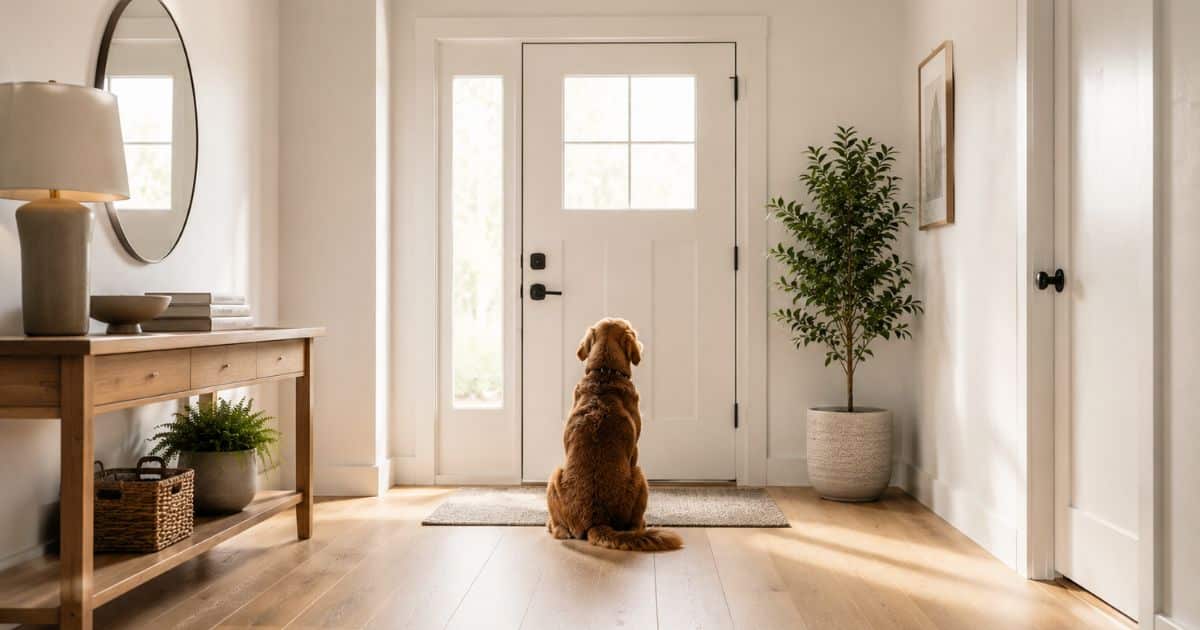
Does my dog have separation anxiety? (here’s how to tell)
Not sure if your dog has separation anxiety or is just bored? Here are the signs that actually distinguish real SA — and what to do next.

Your dog barks when you leave. Chews the couch. Maybe has accidents even though he’s been house-trained for years. So you search: “does my dog have separation anxiety?” And then you spend 20 minutes reading vague lists that describe half of all dogs ever.
Here’s the clearer version.
Does My Dog Have Separation Anxiety?
Your dog likely has separation anxiety if the problem behaviors – barking, destruction, house soiling – happen specifically when they’re left alone or separated from you, start within 30 minutes of your departure, and don’t occur when you’re home. The key marker is the pattern: triggered by your absence, not by boredom, under-stimulation, or lack of training.
5 Signs That Point to Separation Anxiety (Not Just Bad Behavior)

1. The Behavior Starts Before You Even Leave
This one surprises people. If your dog starts pacing, drooling, or shaking the moment you pick up your keys – before you’ve gone anywhere – that’s separation anxiety. The anticipation of being alone triggers the response, not the being alone itself.
Bored dogs don’t care about your keys.
2. Destruction Targets Exit Points
Random chewing is often boredom. Separation anxiety destruction is specific: door frames, windowsills, the area near the front door. Dogs with SA are trying to escape and follow you – they’re not bored, they’re in a panic.
Check where the damage is. Location tells you a lot.
3. House Soiling Despite Full House-Training
If your dog never has accidents when you’re home but regularly does when you’re gone, that’s not a training failure. A dog in genuine distress loses bladder control the same way a stressed human might feel sick. The body overrides the training.
4. Neighbors Mention the Noise (Before You Do)
Most owners don’t know their dog vocalizes because they’re not there to hear it. If a neighbor has complained – or if you’ve left a camera running and watched the footage – and your dog is howling or barking non-stop from the moment you leave until you return, that’s separation anxiety. Bored dogs bark too, but they take breaks. Anxious dogs often don’t.
5. The Greeting Is Off the Charts
Yes, all dogs are happy when you come home. But a dog with separation anxiety often takes 10-15 minutes to calm down after your return – frantic jumping, crying, panting, shadowing. If you can’t sit down without your dog climbing on you for a quarter hour, that level of relief signals genuine distress, not just excitement.
What It’s NOT: Ruling Out Boredom and Lack of Training
Separation anxiety gets blamed for a lot of regular dog behavior problems. Before assuming SA, ask:
- Does the behavior happen when you’re home but not paying attention? (Boredom, not SA)
- Is it a puppy, and is the chewing random? (Normal puppy behavior)
- Is the dog new to your home within the last few weeks? (Adjustment period – wait and watch)
- Does the behavior only happen in the crate? (Could be confinement anxiety specifically, not full separation anxiety)
True separation anxiety is about your absence. If the bad behavior happens regardless of whether you’re there, that’s a different problem – and a different solution.
A Simple At-Home Test
Set up a camera or use your phone and leave the house completely for 20-30 minutes. Watch the footage.
- Does your dog settle within 5-10 minutes? Probably not SA.
- Does your dog pace, vocalize, or show distress the whole time? That’s a strong signal.
- Does your dog try to scratch through the door or crate? Likely SA or confinement anxiety.
This recording test is the closest thing to a real diagnostic you can do without a vet or behaviorist.
Quick Takeaway
- SA behaviors are tied to your departure – they start before you leave and stop when you return
- Target destruction (near exits), frantic greetings, and non-stop vocalization are the clearest signs
- Boredom and lack of training look similar but happen regardless of your presence
- A camera test at home gives you real data in 30 minutes
→ Read: Dog Separation Anxiety: The Complete Owner’s Guide (2026)
Frequently Asked Questions
How do I know if it’s separation anxiety or just boredom?
Boredom behavior happens whether you’re home or not. Separation anxiety behavior is tied specifically to your absence. Bored dogs chew randomly; anxious dogs chew the door frame. Set up a camera during a real absence to confirm.
Can puppies have separation anxiety?
Yes, but it can also be normal adjustment behavior. If a puppy shows extreme distress every single time they’re alone, even after several weeks in the home, it’s worth addressing early. Early intervention is much easier than treating established separation anxiety.
Should I go to the vet if I think my dog has separation anxiety?
It’s a good first step. Some medical conditions like thyroid issues or pain can cause or worsen anxiety-like behavior. Your vet can also discuss medication options for severe cases. A veterinary behaviorist (DACVB) is the gold standard for serious situations.
What is the fastest way to test if my dog has separation anxiety?
Set up a camera and leave the house completely for 20–30 minutes. Watch the footage. If your dog settles within 5–10 minutes, it’s probably not separation anxiety. If they pace, vocalize, or show distress the entire time, that’s a strong signal of SA.
If what you’ve read here sounds like your dog, the next step is understanding how the treatment actually works. Download our free 5-Day Separation Anxiety Starter Guide – a research-backed PDF that walks you through the first week of training, step by step, with no fluff.
📘 Download the Free 5-Day Starter Guide →
This article is for informational purposes and does not replace professional veterinary advice. If your dog is showing signs of acute distress or self-injury, contact your research-backed.
How Severe Is Your Dog’s Separation Anxiety?
Not all separation anxiety looks the same. Once you’ve confirmed your dog is genuinely distressed when left alone, the next step is figuring out how serious it is — because the right approach depends on where your dog falls on the spectrum.
Mild: Your dog whines or barks for a few minutes after you leave, then settles down on their own within 10 to 15 minutes. There’s no destruction, no accidents, and they greet you normally when you return. This level can feel easy to dismiss — but don’t. Mild SA has a way of escalating if it’s not addressed, especially after a change in your schedule or a stressful event like a move or a new pet.
Moderate: Distress lasts more than 30 minutes and doesn’t fully resolve before you return. You may find chewed furniture, overturned water bowls, or toileting accidents — even in a dog that’s been reliably house-trained for years. The behavior is consistent, not occasional. Dogs at this level are genuinely struggling, not acting out. Treatment at this stage is very effective, but it requires a structured approach.
Severe: Your dog never settles. Frantic escape attempts, destruction of door frames or crates, non-stop vocalizing, and in some cases self-injury like broken nails or worn-down teeth from chewing through barriers. If you’ve seen your dog bloody from trying to escape a crate, or if neighbors report hours of howling every single day, that’s severe SA. This level requires professional support — going it alone with YouTube tutorials is unlikely to help and could make things worse.
Even if your dog is only showing mild signs right now, early intervention is almost always easier and faster than waiting until things escalate. The sooner you start, the less your dog has to unlearn.
What to Do Next If Your Dog Has Separation Anxiety
Here’s the good news: separation anxiety is one of the most treatable behavioral conditions in dogs. It takes consistency and patience, but dogs improve — even severe cases — with the right plan. Here’s where to start based on what you’re seeing.
If your dog’s SA is mild, you’re in the best possible position. Start with a structured desensitization program — short, repeated practice departures that gradually build your dog’s tolerance for being alone. The goal is to keep your dog under their anxiety threshold while slowly raising it. You can get a step-by-step framework in our guide to dog training for separation anxiety.
If your dog’s SA is moderate, training alone will help, but adding calming support can make the process faster and more humane. Think puzzle feeders, calming chews, compression wraps, or white noise — tools that take the edge off the anxiety while you work on the underlying issue. Our roundup of the best products for dogs with separation anxiety covers what’s actually worth trying versus what’s mostly marketing.
If your dog’s SA is severe, please don’t wait on professional help. A veterinary behaviorist (board-certified, not just a trainer) can assess your dog and discuss whether medication makes sense as part of the treatment plan. For severe cases, medication isn’t a crutch — it lowers the anxiety enough that behavioral training can actually stick. Our guide to the best anxiety medication for dogs explains the options your vet may bring up.
For all levels, it helps to understand the full picture — what causes SA, how treatment works, what realistic timelines look like, and how to avoid common mistakes that accidentally reinforce the anxiety. Our complete guide to dog separation anxiety covers all of it in one place. It’s the best next read after this article.
Whatever severity you’re dealing with, the most important thing is to start. Dogs don’t grow out of separation anxiety on their own — but they absolutely can get better with your help.
