🐾 Does your dog panic when you leave? → Get the Free 7-Day Starter Plan

Dog Anxiety Medication: Options, Evidence and Safety
Learn about prescription options for dog anxiety, evidence limits, side effects and questions to discuss with your veterinarian.


There is no single best anxiety medication for every dog. A veterinarian first checks for pain, illness and other causes of behavior changes, then considers the type of anxiety, other medicines and the dog’s response. Medication may be used alongside a behavior plan; some options can cause drowsiness or other adverse effects.
This guide explains options to discuss with your veterinarian. It does not provide a dosing schedule. Do not start, combine, increase, taper or stop a medicine using an online guide.
This page includes commercial recommendations and affiliate links in the article and/or sidebar. If you buy through a qualifying link, PetCalmZone may earn a commission at no extra cost to you. This does not establish that a product is effective or suitable for your dog. See our Affiliate Disclosure.

Anxiety Medicines and Support Products: Discussion Points
| Option | Discussion points |
|---|---|
| Fluoxetine (Reconcile) | Veterinarian-selected prescription option; indication, timing and monitoring depend on the individual dog. |
| Clomicalm (Clomipramine) | Veterinarian-selected prescription option; indication, timing and monitoring depend on the individual dog. |
| Trazodone | Veterinarian-selected prescription option; indication, timing and monitoring depend on the individual dog. |
| Gabapentin | Veterinarian-selected prescription option; indication, timing and monitoring depend on the individual dog. |
| Sileo | Veterinarian-selected prescription option; indication, timing and monitoring depend on the individual dog. |
| Zylkene | Non-prescription support product; evidence and suitability depend on the specific formulation. Not a substitute for diagnosis or treatment. |
| Purina Calming Care | Non-prescription support product; evidence and suitability depend on the specific formulation. Not a substitute for diagnosis or treatment. |
| Composure Pro | Non-prescription support product; evidence and suitability depend on the specific formulation. Not a substitute for diagnosis or treatment. |
| Adaptil | Non-prescription support product; evidence and suitability depend on the specific formulation. Not a substitute for diagnosis or treatment. |
| CBD | Non-prescription support product; evidence and suitability depend on the specific formulation. Not a substitute for diagnosis or treatment. |
Why Medication Matters, and When It Needs to Come First
There is no single best anxiety medication for every dog. A veterinarian first checks for pain, illness and other causes of behavior changes, then considers the type of anxiety, other medicines and the dog’s response. Medication may be used alongside a behavior plan; some options can cause drowsiness or other adverse effects.
This guide explains options to discuss with your veterinarian. It does not provide a dosing schedule. Do not start, combine, increase, taper or stop a medicine using an online guide.
Related resources: → Read: Dog Separation Anxiety: Complete Owner’s Guide (2026) · ThunderShirt Classic · Best Calming Supplements for Dogs · Best Anxiety Wraps for Dogs.
Which Prescription Anxiety Medications Do Vets Use for Dogs?
Prescription medicines require a veterinary assessment. The diagnosis, health history, other medicines and response determine which option is appropriate.
Trazodone
Trazodone and gabapentin may be used off-label in veterinary behavior care. A weight chart alone cannot determine a safe regimen. Human liquid formulations can contain ingredients unsuitable for dogs; have the veterinarian check the exact product before use.

Fluoxetine (Reconcile)
Reconcile contains fluoxetine, an SSRI approved for canine separation anxiety in conjunction with behavior modification. The prescribing veterinarian determines suitability, monitoring and the reassessment schedule.
Clomicalm (Clomipramine): FDA-Approved for Separation Anxiety
Clomicalm (clomipramine) and Reconcile (fluoxetine) are FDA-approved products for canine separation anxiety when used with behavior modification under veterinary direction. Their indications and precautions are product-specific. Fluoxetine is an SSRI; clomipramine is a tricyclic antidepressant. They should not be described as interchangeable or suitable for every dog.
Read the FDA information on clomipramine, Reconcile product information and the FDA discussion of CBD, including use in animals.
Gabapentin
Trazodone and gabapentin may be used off-label in veterinary behavior care. A weight chart alone cannot determine a safe regimen. Human liquid formulations can contain ingredients unsuitable for dogs; have the veterinarian check the exact product before use.
Sileo (Dexmedetomidine): For Noise-Triggered Panic
Sileo’s labeled indication concerns noise aversion. Discuss its product-specific precautions with your veterinarian; it is not a routine treatment for every type of anxiety.
Questions to Ask About a Prescription
Ask your veterinarian which medicine is appropriate, what exact formulation to use, how and when to give it, what response to expect, and which adverse effects require a call. Bring a list of all medicines, supplements and health conditions.
Trazodone and gabapentin may be used off-label in veterinary behavior care. A weight chart alone cannot determine a safe regimen. Human liquid formulations can contain ingredients unsuitable for dogs; have the veterinarian check the exact product before use.
Are There Over-the-Counter Supplements for Dog Anxiety?
Non-prescription support products are different from prescription anxiety medicines. Evidence and suitability depend on the exact formulation; they are not a substitute for diagnosis or treatment.
Zylkene
Studies of a particular ingredient or commercial formulation do not establish that every product containing it is effective. Ask your veterinarian whether this product fits your dog’s health history and current treatment. Non-prescription availability does not mean that adverse effects or interactions are impossible.

Purina Pro Plan Calming Care
Studies of a particular ingredient or commercial formulation do not establish that every product containing it is effective. Ask your veterinarian whether this product fits your dog’s health history and current treatment. Non-prescription availability does not mean that adverse effects or interactions are impossible.
Composure Pro (Vetriscience)
Studies of a particular ingredient or commercial formulation do not establish that every product containing it is effective. Ask your veterinarian whether this product fits your dog’s health history and current treatment. Non-prescription availability does not mean that adverse effects or interactions are impossible.
Adaptil (DAP Pheromone)
Pheromone products may be considered as an adjunct. Responses vary, and the evidence does not support a universal guarantee of benefit. Follow the product instructions and stop using a product if your dog appears uncomfortable. A diffuser or spray does not replace veterinary assessment or a behavior plan.
CBD: Evidence and Precautions
CBD has not been approved by the FDA for use in animals. Research in dogs is product- and situation-specific and does not establish a reliable treatment for separation anxiety. Adverse effects, interactions and variable product quality remain concerns.
Do not use a dose from this article. Ask your veterinarian about evidence, interactions and local requirements. A certificate of analysis describes the tested sample; it does not prove effectiveness or establish that a THC threshold is safe for a particular dog.
Related resources: → See: Best CBD for Dog Anxiety (2026).
Questions About Car and Travel Distress
Travel distress can involve fear, motion sickness or both. Ask your veterinarian to assess the cause before choosing a product. Sileo’s labeled indication concerns noise aversion; it should not be presented as a routine travel medicine. If a veterinarian prescribes a travel regimen, follow the individualized directions and discuss any trial before the journey.
ThunderEase Calming Spray
Pheromone products may be considered as an adjunct. Responses vary, and the evidence does not support a universal guarantee of benefit. Follow the product instructions and stop using a product if your dog appears uncomfortable. A diffuser or spray does not replace veterinary assessment or a behavior plan.
Related resources: → Check current price for ThunderEase Calming Spray on Amazon.
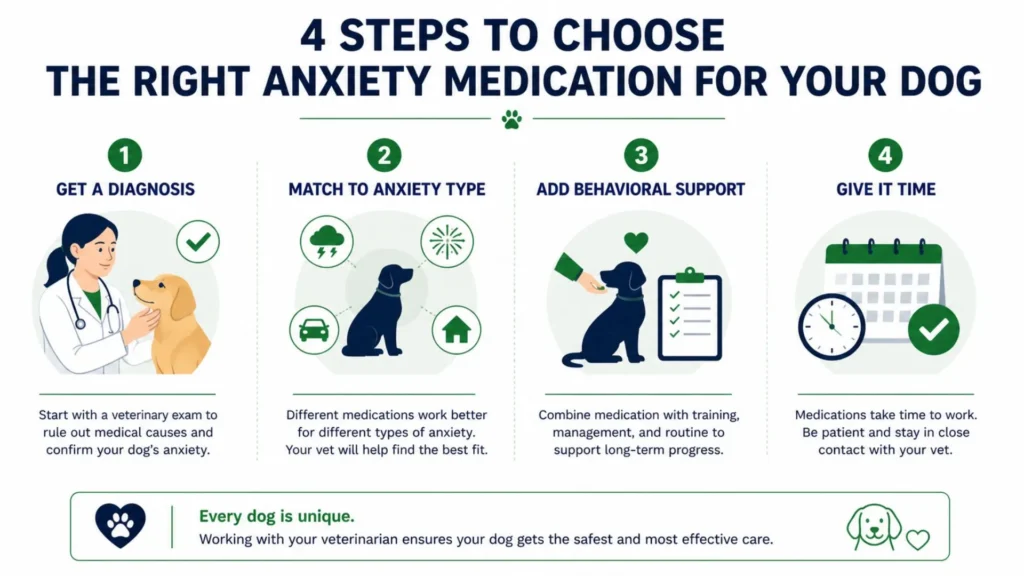
How to Choose the Right Anxiety Medication for Your Dog
There is no single best anxiety medication for every dog. A veterinarian first checks for pain, illness and other causes of behavior changes, then considers the type of anxiety, other medicines and the dog’s response. Medication may be used alongside a behavior plan; some options can cause drowsiness or other adverse effects.
Ask your veterinarian which medicine is appropriate, what exact formulation to use, how and when to give it, what response to expect, and which adverse effects require a call. Bring a list of all medicines, supplements and health conditions.
How to Bring It Up With Your Vet
Tell your veterinarian what happens, the triggers and how long distress lasts. Bring videos recorded during ordinary routines, a list of medicines and supplements, and your questions about a behavior plan. Ask whether referral to a veterinary behaviorist would help.
Mistakes Worth Avoiding
This guide explains options to discuss with your veterinarian. It does not provide a dosing schedule. Do not start, combine, increase, taper or stop a medicine using an online guide.
FAQ
What is the best anxiety medication for dogs?
There is no single best choice. A veterinarian selects treatment according to the type of anxiety, health, other medicines and response, usually alongside behavior modification.
What OTC anxiety medication works for dogs?
Supplements and pheromone products are not equivalent to prescription anxiety medicines. Evidence varies by formulation and situation. Ask your veterinarian before choosing or combining them.
How long does anxiety medication take to work in dogs?
Timing depends on the medicine, the dog and the treatment plan. Ask the prescribing veterinarian what to expect and when to reassess; do not repeat or increase a dose because an effect seems delayed.
How long do dogs stay on anxiety medication?
Duration is individualized. Review progress with the veterinarian and follow their tapering or stopping instructions.
Is long-term anxiety medication safe for dogs?
Benefits and risks must be reviewed for the individual dog. The veterinarian decides the monitoring schedule and checks adverse effects and interactions.
Can I give my dog Benadryl for anxiety?
Diphenhydramine may cause drowsiness, but drowsiness does not establish relief of anxiety. Do not give it as a home anxiety treatment; ask a veterinarian about the exact product and whether it is appropriate.
Is CBD good for dog anxiety?
The FDA has not approved CBD for animals. Available findings do not establish a dependable treatment for canine anxiety. Product quality, adverse effects and interactions require veterinary discussion.
What is the right dosage of trazodone or gabapentin for my dog?
Only the prescribing veterinarian can set the regimen. This article does not provide a dosing chart. Do not use another dog’s prescription or change the prescribed amount.
What can I give my dog for car or travel anxiety?
First ask your veterinarian whether fear, nausea or another condition is involved. A suitable plan may include gradual training, environmental changes and an individually prescribed medicine.
Bottom Line
The useful next step is a veterinary assessment and an individualized behavior plan. Prescription medicines and non-prescription products have different evidence, indications and risks. Monitor how your dog feels and behaves, and review progress with the treating veterinarian.
Related resources: → Read: Dog Separation Anxiety: Complete Owner’s Guide (2026) · → Read: How to Train a Dog With Separation Anxiety · → See: Best CBD for Dog Anxiety (2026) · → See: Best Calming Supplements for Dogs (2026) · → See: Best Anxiety Dog Crates (2026).