🐾 Does your dog panic when you leave? → Get the Free 7-Day

Dog Anxiety Symptoms: How to Tell If Your Dog Is Anxious

Most dogs can’t tell you they’re anxious. They show you — but the signals are easy to misread, dismiss, or confuse with something else entirely. An anxious dog might look like a “bad” dog, a sick dog, or just a dog who needs more exercise. Getting the diagnosis right matters, because the fix depends on it.
Here’s what dog anxiety actually looks like — the behavioral signs, the physical signs, and the ones owners most often miss.

Behavioral symptoms of dog anxiety
These are the signs owners notice first — and most often misattribute to disobedience or insufficient training.
Destructive behavior near exits
Chewed door frames, scratched windows, ripped blinds — if the damage concentrates around exits, it’s almost always anxiety. A bored dog chews whatever’s appealing (shoes, furniture, toys). An anxious dog chews the door. The location is the tell.
Excessive vocalization
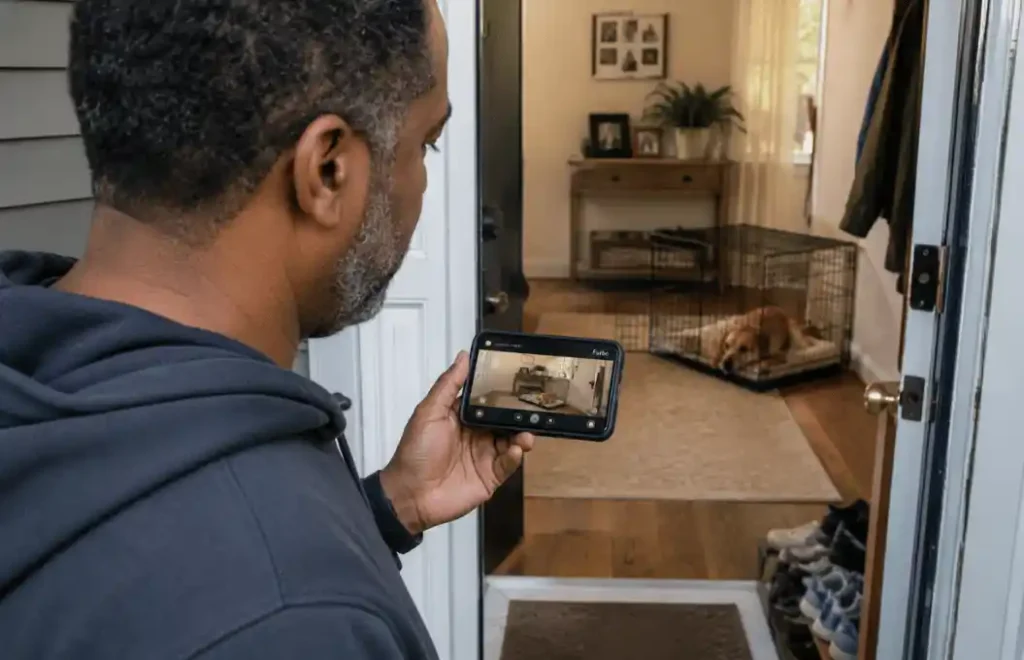
Barking or howling that starts shortly after you leave and continues for extended periods. Your neighbors hear this before you do. If you haven’t already, set up a camera or ask a neighbor — many owners are shocked by how quickly and how intensely the vocalization starts.
House accidents in trained dogs
A fully house-trained dog having accidents indoors is not reverting to puppyhood or being spiteful. Anxiety overrides learned behavior. The stress response can trigger urination or defecation — it’s physiological, not a choice. If it only happens when you’re gone (or when a trigger is present), anxiety is the likely explanation.
Pacing and inability to settle
An anxious dog can’t relax. They pace the same path repeatedly, circle, change positions constantly, or can’t hold still even in a calm environment. It’s not just restlessness — it’s a nervous system that won’t downregulate.
Hyper-attachment and following behavior
The dog who follows you room to room, sits outside the bathroom door, and panics visibly when you leave eyesight. This isn’t affection — it’s monitoring. Anxious dogs track their person’s location constantly because separation is genuinely distressing to them.
Escape attempts
Dogs who dig under fences, break out of crates, or hurt themselves getting through barriers are in a panic state. This is some of the clearest evidence of severe anxiety, and it’s also where injuries happen. Broken teeth from crate bar chewing, bloody paws from scratching — these need veterinary attention alongside behavioral intervention.
Reactivity or unusual aggression
Anxiety and aggression look very different, but they share roots. A dog in a fearful state may snap, growl, or lunge not out of dominance but because they feel cornered. If a dog who wasn’t previously aggressive starts reacting this way in specific contexts (strangers, loud noises, being confined), anxiety is worth investigating.
Physical symptoms of dog anxiety
Physical signs are often overlooked because owners aren’t looking for them. But the body shows stress before the behavior does.
Panting without heat or exertion
Dogs pant to regulate body temperature. When a dog pants heavily in a cool room without having exercised, it’s almost always stress. This is one of the most reliable physical indicators — and it’s easy to check against context. Cool day, quiet house, resting dog who’s panting heavily? That’s not thermoregulation.
Yawning in a calm context
Dogs yawn when tired, same as humans. They also yawn as a stress signal. A dog who keeps yawning during a vet visit, during training, or when strangers approach isn’t bored — they’re communicating discomfort. Repeated yawning without an obvious sleepiness context is worth noting.
Lip licking without food nearby
A quick, repeated lip lick — not related to food or smelling something interesting — is a calming signal. Dog behaviorists classify it as an appeasement behavior, something dogs do when stressed or trying to communicate that they mean no harm. Easy to miss, but once you see it, you see it everywhere.
Pinned ears, tucked tail, lowered posture
Classic fear posture. Ears flat against the head, tail tucked under the body, body lowered or crouched. The dog is making themselves smaller. Some anxious dogs hold this posture chronically in certain environments; others only in response to specific triggers.
Dilated pupils
Stress triggers adrenaline, which dilates the pupils. A dog with wide, dilated pupils in normal lighting is in an aroused or fearful state. Combine this with panting and you’re looking at genuine physiological stress.
Trembling or shaking
Obvious when severe, easy to miss when mild. Some anxious dogs tremble constantly in certain contexts — being held, fireworks, vet office — while appearing “fine” the rest of the time. It’s also worth ruling out cold and pain as causes, especially in senior dogs.
Excessive drooling or foaming
Seen most often in dogs with travel anxiety or severe situational stress. Drool soaking the carrier on a car ride isn’t motion sickness alone — it’s usually anxiety. Worth addressing before it becomes an aversion to the car.
Shedding spikes
Stress accelerates shedding. If your dog leaves a notable amount of hair during specific situations — vet visits, thunderstorms, being around strangers — that’s another data point. Many owners notice this at the groomer or vet and don’t connect it.
When the symptoms appear matters as much as what they are
Timing and context tell you which type of anxiety you’re dealing with.
Symptoms that start within 30 minutes of you leaving and stop when you return point to separation anxiety. Set up a camera and watch the recording — the pattern is usually obvious once you see it. This is the most common type, and there’s a clear separation anxiety treatment protocol for it.
Symptoms triggered by specific sounds — thunder, fireworks, loud vehicles — indicate noise anxiety. These dogs are often fine otherwise and fall apart during storms or holidays.
Symptoms that appear around strangers or unfamiliar dogs, and settle when those triggers leave, point to social anxiety — usually rooted in inadequate socialization during the puppy window.
A dog who seems anxious all the time with no clear trigger pattern may have generalized anxiety disorder, which typically has a stronger genetic or neurological component and usually needs veterinary support alongside behavioral work.
What dog anxiety is not
A few common misreadings are worth naming directly.
Spite or revenge is not a thing dogs do. A dog who destroys your couch while you’re gone is not punishing you for leaving. Dogs don’t plan delayed retaliation. If damage happens during your absence, it’s stress.
Dominance is not the explanation for anxious behavior. A reactive, snapping dog isn’t asserting control — they’re scared. Treating fear aggression as a dominance issue makes it worse.
Boredom looks like anxiety but isn’t. Boredom destruction is mild, random, and tends to involve appealing objects (socks, remote controls, pillows). Anxiety destruction is intense, repetitive, and focused on exits. Bored dogs don’t pant and drool and shake — anxious ones do.
Calming aids that help with anxiety symptoms
Behavioral modification is the foundation of anxiety treatment, but calming aids can lower the baseline enough to make training work faster. These are the ones worth trying.
ThunderShirt uses constant, gentle pressure across the torso. Works within minutes and is most effective for noise anxiety and situational stress. Around 80% of dogs show some reduction in anxiety behaviors. → Check ThunderShirt on Amazon
Adaptil is a synthetic dog-appeasing pheromone that mimics what nursing mothers produce. It builds up over 2–4 weeks and works well for home-based anxiety. → Check Adaptil on Amazon
Zesty Paws Calming Bites are L-theanine and chamomile chews — useful 30–60 minutes before a known stressor. → Check Zesty Paws on Amazon
For a deeper look at the most effective options: full guide to dog anxiety treatment →
When to see a vet
See a vet if your dog is injuring themselves during anxiety episodes, if symptoms appeared suddenly in an adult dog who was previously calm, if anxiety is severe enough to prevent normal eating, sleeping, or functioning, or if consistent behavioral work over several weeks isn’t making a dent. Sudden-onset anxiety in an older dog should always be evaluated medically first — conditions like hypothyroidism, pain, and cognitive dysfunction all produce anxiety-like behavior.

FAQ
What are the first signs of anxiety in dogs?
The earliest signs are often subtle — yawning in calm contexts, lip licking, increased clinginess, or mild panting without heat or exercise. Behavioral changes like following you more than usual or hypervigilance at departures can predate more obvious symptoms by weeks.
Can a dog show anxiety symptoms without a known trigger?
Yes. Generalized anxiety disorder in dogs presents as chronic, low-level anxiety without a single identifiable cause. These dogs are hypervigilant, easily startled, and can’t fully relax even in environments they know well. A vet visit is the right first step if you can’t identify a clear trigger.
Are certain breeds more prone to anxiety symptoms?
Border Collies, German Shepherds, Vizslas, and most toy breeds show higher anxiety rates in veterinary research. Breed tendency is real but not deterministic — individual genetics, early socialization, and life history matter more than breed alone.
Do dogs grow out of anxiety symptoms?
Very young puppies sometimes settle as they mature. Adult dogs with established anxiety almost never do without intervention. Untreated anxiety usually worsens rather than stabilizes — the nervous system becomes more sensitized, not less.
How do I know if my dog’s symptoms are anxiety or a medical issue?
Context is the first clue: if symptoms appear in specific situations (being alone, thunderstorms, strangers) and resolve when those triggers leave, anxiety is likely. If symptoms are constant and unprovoked, or appeared suddenly in a dog who was previously calm, a vet visit to rule out medical causes comes first. Pain, thyroid disorders, and neurological issues all produce anxiety-like behavior.
Bottom line
Anxiety symptoms are a communication. Your dog isn’t acting out, breaking rules, or being difficult — they’re telling you something is wrong. The physical signs are often quieter and easier to miss than the behavioral ones, but together they paint a clear picture once you know what you’re looking at.
The next step after identifying symptoms is figuring out the type and severity. That determines which intervention — behavioral training, calming aids, or veterinary support — makes the most sense. Full guide to types and treatment →
