🐾 Does your dog panic when you leave? → Get the Free 7-Day Starter Plan

Signs of Separation Anxiety in Dogs at Night
Signs of separation anxiety in dogs at night: what to look for at bedtime, why these clues are not a diagnosis, what to note, and when to see your vet.

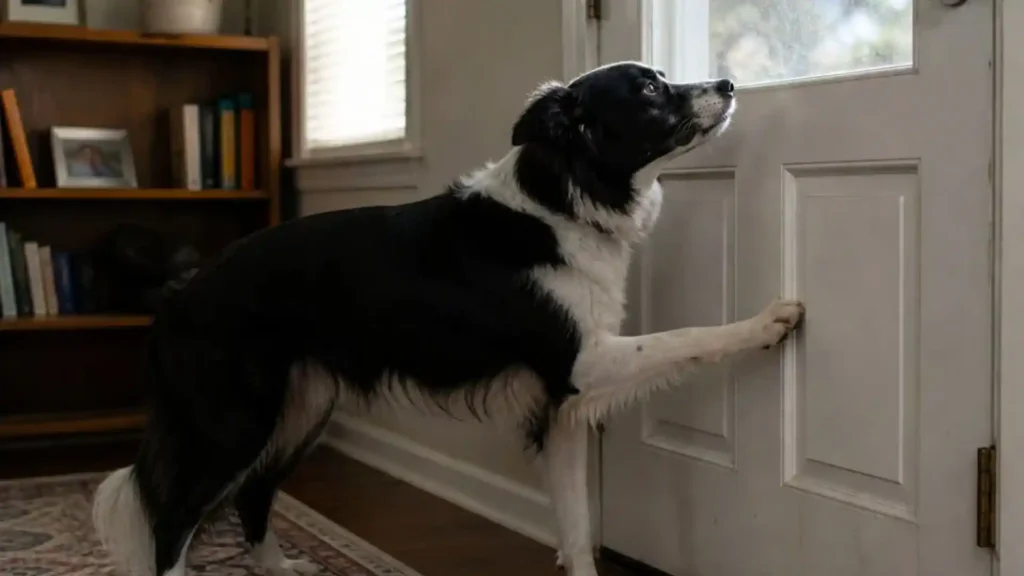
When a dog struggles to settle at night, it can be hard to know whether they are simply unsettled or genuinely distressed at being apart from you. This guide describes the signs that may point to separation-related distress around bedtime, and the observations worth sharing with your veterinarian.
These are clues, not a diagnosis. For the wider causes of nighttime restlessness and the calming measures that can help, see our companion guide to dog anxiety at night.
Table of Contents
What “Separation Difficulty at Night” Means
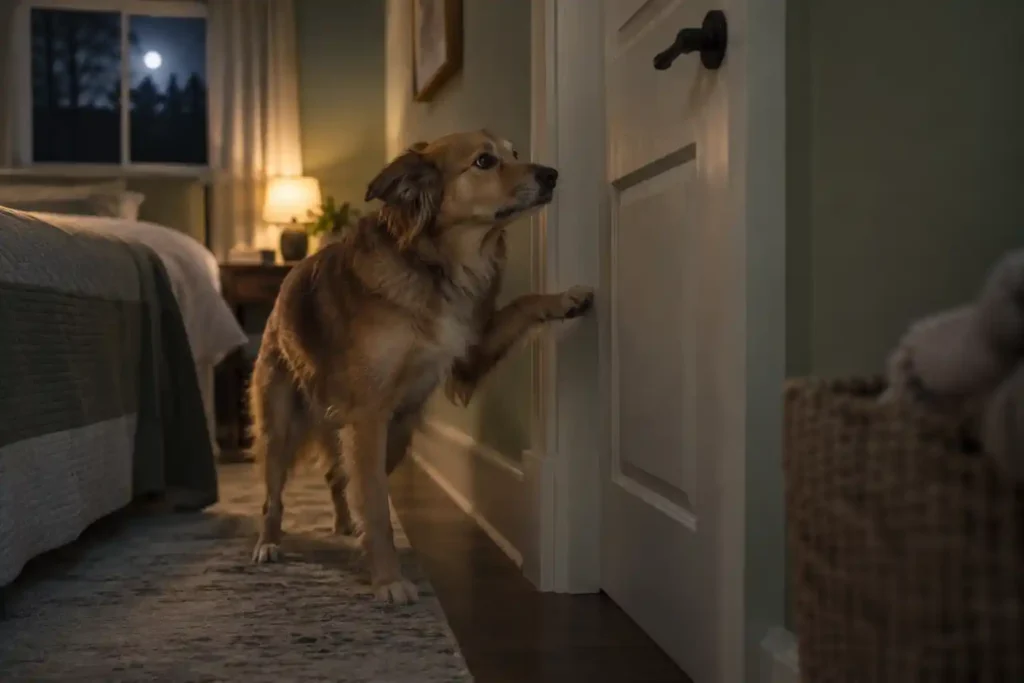
Separation-related distress is upset that comes from being apart from the people a dog is attached to. The ASPCA and VCA Animal Hospitals describe it mainly around departures, but for some dogs the same feeling appears at night, when the household settles and the dog is left in a separate space or senses that the day’s company has ended.
At night this can look like a dog who cannot relax once everyone has gone to bed, who wants to stay close to a particular person, or who becomes unsettled when shut out of the bedroom. Whether that is separation-related or something else is exactly what the rest of this guide helps you observe.
Possible Signs at Bedtime
The following can be seen when a dog finds the night-time separation hard. Any one of them has other explanations too, so treat them as things to notice rather than proof.
- Unsettled when you move away. Becoming restless as you head to bed, or when you move to a room the dog cannot follow you into.
- Vocalizing behind a door. Whining, barking, or howling once a door is closed between you, particularly if it eases when the dog is near you again.
- Trouble settling. Pacing, repeatedly changing position, or being unable to lie down and rest after lights-out, when the day has otherwise been normal.
- Trying to reach someone. Scratching or pawing at a door, or persistently trying to get to a particular person rather than simply wanting to go outside.
- Staying close. Needing to be touching or right beside a person to settle, and waking or becoming anxious if that person moves.
What the night looks like as a whole matters more than any single moment: a dog who settles once beside you, but not when shut away, is giving you useful information.
Why These Signs Are Not Enough on Their Own
Many things disturb a dog’s night, and several can look just like separation distress. Before assuming it is separation-related, consider:
- Pain or discomfort. Aching joints, an upset stomach, or any source of pain can make a dog restless at night. The Merck Veterinary Manual notes that medical problems should be ruled out when behavior changes.
- A need to toilet. A dog asking to go out, especially a puppy or an older dog, may be read as anxiety when it is a genuine need.
- Noises and the environment. Sounds outside, a too-warm or too-cold room, a new bed, or an uncomfortable spot can all keep a dog awake.
- Puppy adjustment. A young puppy settling into a new home is still learning to cope with quiet and dark, which is normal adjustment rather than a disorder.
- Changes in an older dog. New night-time restlessness, pacing, or confusion in a senior dog can be linked to pain or to age-related cognitive changes, which the Merck manual describes, and deserves a veterinary check. Our guide to senior dog anxiety looks at this.
Because the same behavior can have very different causes, our guide to separation anxiety vs. normal behavior can help you weigh what you are seeing.
How to Note the Circumstances Without Causing Distress
You can gather useful information simply by paying attention over a few nights, without setting up a test that leaves your dog alone to see how they react. Note:
- Where your dog sleeps. The room, the bedding, and how close they are to people.
- The degree of separation. Whether a door is closed, whether they can see or reach anyone, and whether that changes the behavior.
- What came before. The day’s exercise, the last meal and toilet break, and anything unusual such as a stressful event or a change in routine.
- Other behaviors. Panting, drooling, trembling, toileting indoors, or seeking a particular person, and how your dog greets you in the morning.
- What helps. Whether the dog settles when nearer to you, or when something in the environment changes.
If you want to see what happens when you are asleep, a camera can record the night so you can review it later, without deliberately leaving your dog distressed to observe them.
When to See a Vet and What to Bring
Speak to your veterinarian if the night-time behavior is new, getting worse, or comes with other changes, and in particular if:
- Your dog seems to be in pain, is restless in a new way, or the behavior started suddenly.
- There are other changes in health or behavior, such as appetite, drinking, toileting, movement, or confusion.
- Your dog is older and the night-time restlessness is new.
- Your dog is injuring themselves, for example scratching hard at a door.
- The nights are affecting your dog’s wellbeing, or your household, and you are not sure why.
Bring what you noted above: when it happens, what seems to trigger it, how your dog behaves and recovers, and any video you have. These observations help your vet rule out medical causes and decide what kind of support fits. Any decision about medication is a medical one for your veterinarian.
First Comfort Measures
While you work out what is going on, a few gentle steps can make the night easier, and none of them involves leaving a distressed dog to “cry it out,” which the RSPCA advises against:
- Keep a calm, predictable bedtime routine, with a toilet break and suitable activity earlier in the evening.
- Offer a comfortable, familiar sleeping place, and consider letting your dog sleep closer to you if being shut away is the trigger.
- Reduce night-time disturbances such as noise, light, or an uncomfortable temperature.
- Respond calmly to genuine needs, such as a toilet break, rather than ignoring them.
For the full set of causes and calming measures for a dog who is unsettled at night, see our guide to dog anxiety at night. For separation-related distress more broadly, our complete guide to dog separation anxiety and our guide to training for separation anxiety explain the longer-term approaches.
Frequently Asked Questions
Can a dog have separation anxiety only at night?
Some dogs are most unsettled at night, when the household quiets down and they are left in a separate space or sense that company has ended. Whether it is truly separation-related depends on the whole picture, including whether the dog settles when near you, so it is worth noting the circumstances and discussing them with your vet.
My dog whines at night when shut out of the bedroom. Is that separation anxiety?
It can be, especially if the whining eases when your dog is near you again. But it can also be a request to toilet, a reaction to noise, or discomfort. Look at the wider pattern and rule out those causes before assuming it is separation-related.
Should I let my dog sleep in my room?
For many dogs, sleeping closer to their people helps them settle, and there is no harm in it if it suits your household. If being shut away seems to be the trigger, allowing your dog nearer to you is a reasonable first step while you work out what is going on.
Is my puppy’s night-time whining separation anxiety?
Often it is normal adjustment. A young puppy is still learning to cope with quiet and dark in a new home, and a little night-time whining is common. Meet genuine needs such as toileting, keep nights calm and predictable, and speak to your vet if you are worried or it does not settle.
My older dog has started being restless at night. What could it be?
New night-time restlessness in a senior dog is worth a veterinary visit. Age-related changes, including pain and cognitive decline, can affect sleep and behavior, and your vet can check for a medical cause before it is treated as anxiety.
Sources