🐾 Does your dog panic when you leave? → Get the Free 7-Day Starter Plan

Dog Training at Home for Beginners: The Complete Guide
New to dog training? This complete guide to dog training at home for beginners covers essential commands, tools, schedules, and tips to build a well-behaved dog.

Affiliate disclosure: This article and its sidebar contain affiliate links. If you buy through these links, PetCalmZone may earn a commission at no extra cost to you.
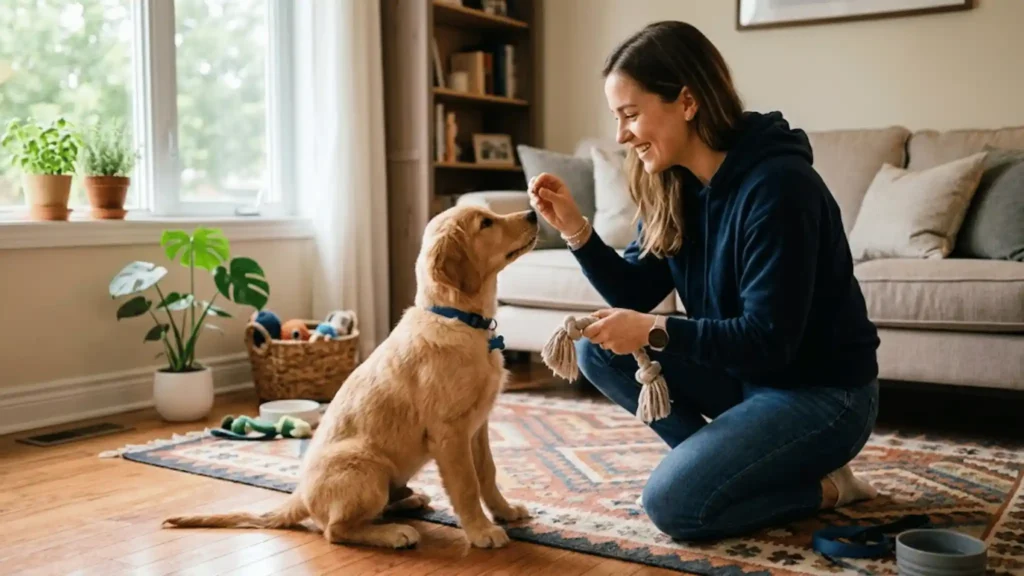
If you’ve been searching for a straightforward guide to dog training at home for beginners, you’re in exactly the right place. Training your dog at home is completely doable. You don’t need a professional trainer, a fancy facility, or years of experience. What you do need is a solid plan, the right tools, and a basic understanding of how dogs learn. This guide gives you all three, in plain language, with step-by-step direction you can start using today.
Whether you have a brand-new puppy or an adult dog who never had formal training, the principles here apply equally. Dogs of all ages can learn new behaviors when you use the right approach, and the right approach, as you’ll see, is a lot more fun than you might expect.
Why Train Your Dog at Home?
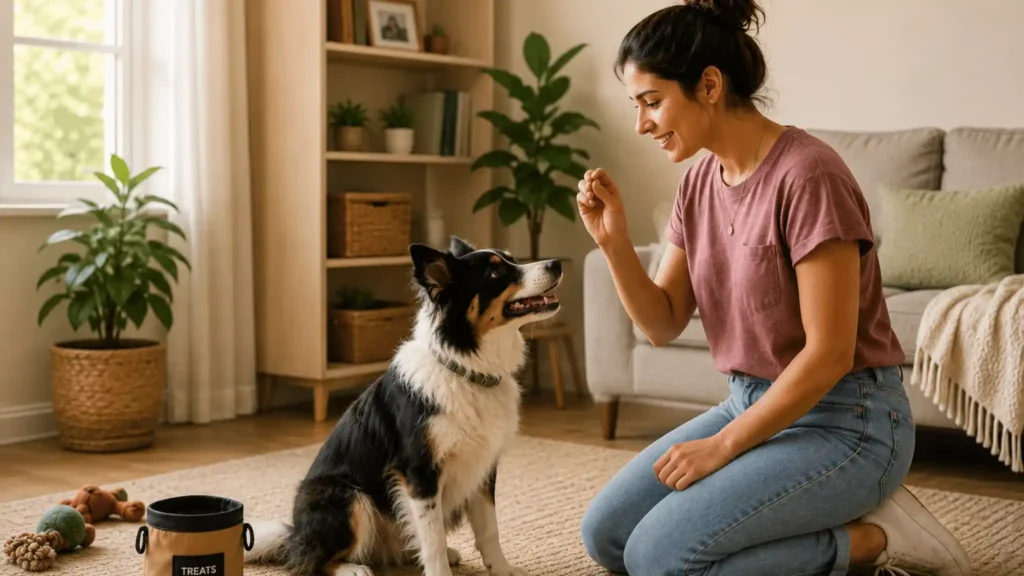
Group classes and professional trainers are great, but home training has unique advantages that are easy to overlook. When you train your dog at home, you’re in your dog’s actual environment, the place where most behavior problems actually happen. A dog that behaves perfectly in a training class but ignores you in the kitchen hasn’t really learned the behavior yet. They’ve just learned it in one specific context.
Training at home also means you can work in short, frequent sessions that fit into your actual day. Five minutes while the coffee brews, five minutes before dinner, five minutes in the backyard. That kind of consistency produces results faster than a one-hour class once a week ever could.
Plus, there’s a deeper benefit: the training relationship you build with your dog at home is uniquely yours. Your dog learns to look to you for guidance, cues, and rewards. That bond is priceless, and it’s built session by session in your own living room.
How Do Dogs Actually Learn?
Before you start teaching commands, it helps to understand the basic principle behind all effective dog training: behaviors that are rewarded get repeated. That’s it. If something good happens when your dog sits, your dog will sit more. If something good happens when they jump on you, they’ll jump more. Simple as that.
This is why positive reinforcement dog training is the gold standard endorsed by veterinary behaviorists, the ASPCA, and virtually every major animal welfare organization. You reward the behaviors you want, ignore or redirect the ones you don’t, and your dog figures out very quickly what earns the good stuff.
There’s no need for punishment, dominance, or force. Not only are those approaches less effective, they actively damage the trust between you and your dog, which is the very thing you’re trying to build. Stay positive, stay consistent, and the results will follow.
Essential Tools for Dog Training at Home for Beginners
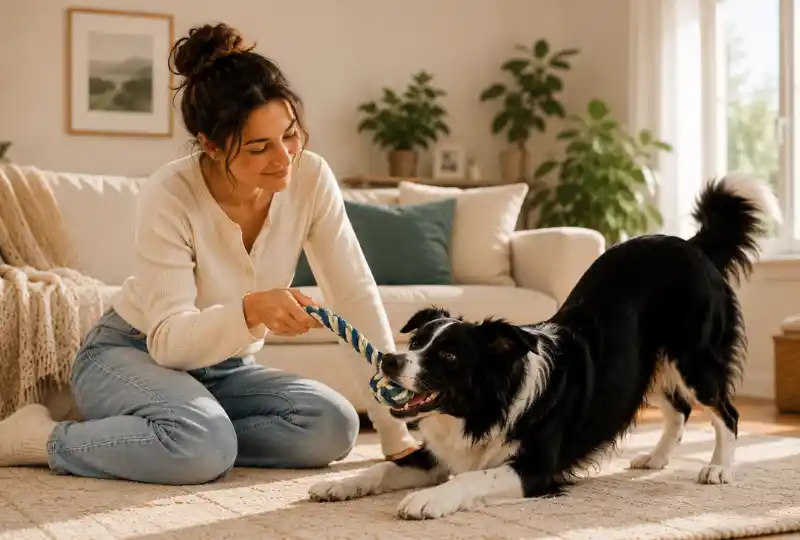
You don’t need a cart full of gadgets, but a few key tools will make your training sessions dramatically more effective:
- A training clicker: A training clicker gives you a precise way to mark the exact moment your dog does something right. The click sound is short, consistent, and unmistakable, much more precise than a verbal “good dog.” Every serious beginner trainer should have one. It’s inexpensive and the single biggest upgrade you can make to your training.
- High-value training treats: Puppy and beginner training treats should be small (pea-sized), soft, and something your dog finds genuinely exciting. Save their kibble for meals. For training, you want treats that make your dog’s eyes light up. Rotating between a few favorites keeps motivation high.
- A beginner dog training book or course: A beginner dog training book or online course gives you a structured curriculum so you’re not guessing what to teach next or how to handle setbacks. Having a roadmap removes a huge amount of beginner confusion. Look for resources built around positive reinforcement by certified trainers.
- A leash and collar or harness: For any training that happens outdoors or involves walking, a well-fitting harness or collar and a standard 4–6 foot leash are essential. Avoid retractable leashes for training: they teach dogs to pull.
- A quiet training space: Especially at the start, minimize distractions. A room where you can close the door and have your dog’s full attention is ideal.
Dog Training at Home for Beginners: Your First-Week Roadmap
Here’s a practical week-by-week framework to get you started. Don’t try to teach everything at once. Pick one or two behaviors at a time and build on them systematically.
Days 1–2: Teach Your Dog That the Clicker Means “Reward Coming”
Before you use the clicker to mark specific behaviors, you need to “charge” it: teach your dog that click = treat. Do this by simply clicking and immediately giving a treat, 10–15 times in a row. That’s it. Do two or three of these sessions over the first day or two.
You’ll know it’s working when you click and your dog immediately looks at you expectantly. Their brain has made the association: that sound predicts something good. Now the clicker becomes a powerful communication tool.
Days 2–4: Teach “Sit”
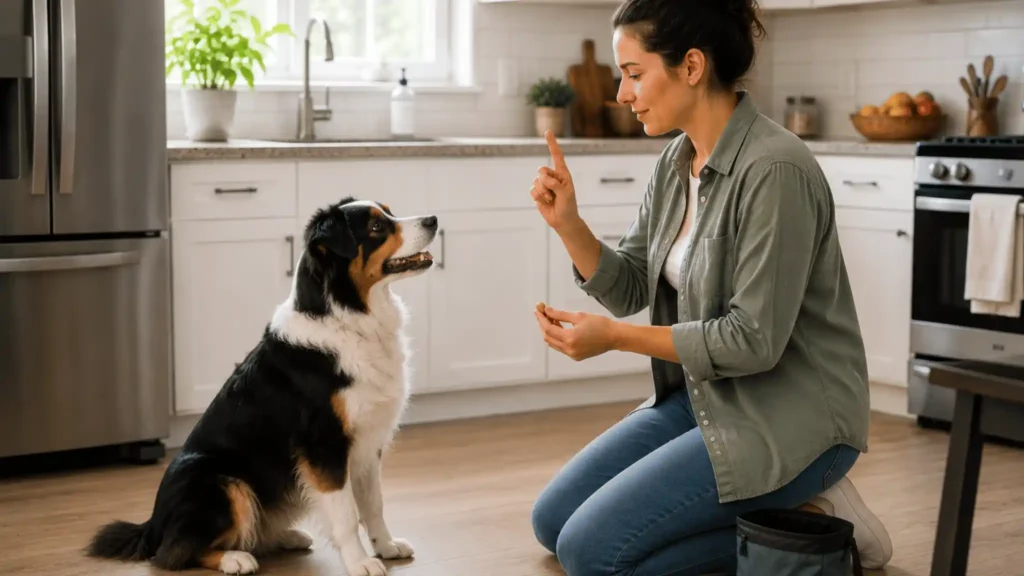
“Sit” is the universal starting point for good reason. Hold a treat at your dog’s nose, then slowly move it up and back toward the top of their head. Their rear will naturally lower as they follow the treat with their nose. The instant their bottom hits the floor, click and treat.
After several successful repetitions with the hand lure, add the word “sit” just before you begin the motion. Once your dog is responding reliably to the lure, try saying “sit” without the hand motion and wait. Most dogs make the connection within a few sessions. Reward generously when they do.
Days 4–7: Teach “Stay”
Ask your dog to sit. Then, instead of immediately clicking and treating, wait one second before you click. Then two seconds. Then three. You’re gradually building duration, teaching your dog that staying in the sit position is what earns the reward, not just getting into it.
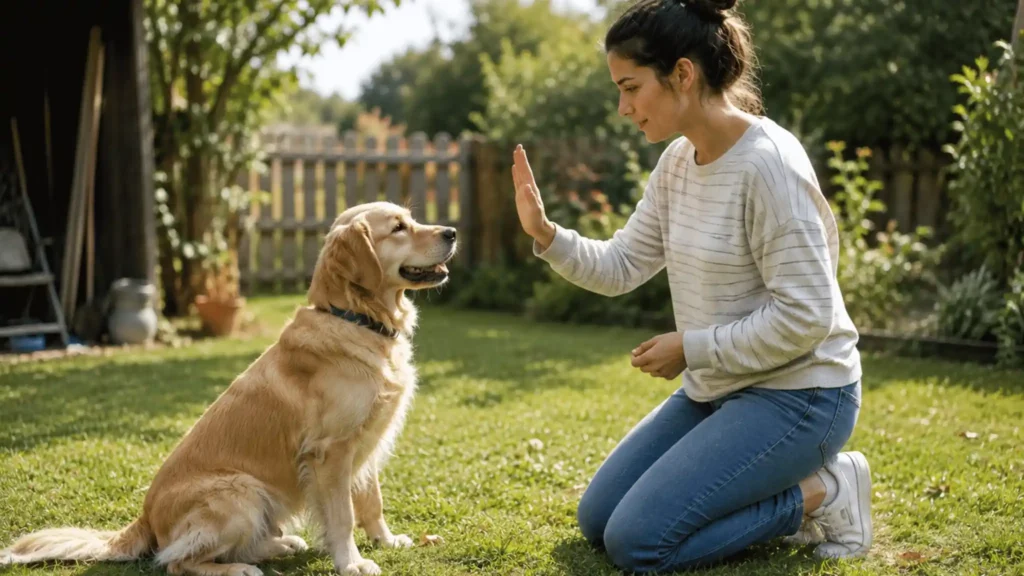
Once your dog will hold a sit for 5–10 seconds, introduce the word “stay.” Use an open palm hand signal in front of you as a visual cue. Practice this dozens of times before you try adding any distance or distractions. Build duration first, then distance, then distraction, always in that order.
Week 2: Add “Down,” “Come,” and Loose-Leash Walking
Once “sit” and “stay” are solid, expand your repertoire:
- “Down”: From a sit, move a treat from your dog’s nose straight down to the floor between their front paws. As they follow it down, their elbows will lower to the ground. Click the moment their belly touches the floor. Then add the word “down” once the physical behavior is consistent.
- “Come” (recall): This is arguably the most important safety command your dog will ever learn. Start indoors in a small space. Crouch down, open your arms, say “come!” in an excited voice, and reward with an extra-special treat when your dog reaches you. Never call your dog to you for something they don’t like (a bath, nail trims, etc.), that poisons the recall.
- Loose-leash walking: Walk with treats in hand. When your dog walks beside you without pulling, click and treat. The moment they pull, stop walking. They learn quickly that pulling gets them nowhere while walking calmly beside you makes forward progress happen. It requires patience but works reliably.
How Do You Stay Consistent With Home Training?
The most common reason home dog training fails isn’t lack of effort, it’s inconsistency. Here’s what that means in practice:
- Everyone in the household has to use the same cues. If one person says “off” when the dog jumps and another says “down,” your dog has to learn two different commands for the same behavior, and they’ll be confused when the cues switch. Pick one word per behavior and stick to it, family-wide.
- Rules have to be consistent. If the dog isn’t allowed on the couch, that rule has to hold 100% of the time, not just when you feel like enforcing it. Dogs don’t understand “sometimes.” Inconsistent rules create anxious, confused dogs.
- Training has to happen every day. Not marathon sessions: 3 to 5 minutes, two or three times a day, every single day. That rhythm produces far better results than occasional long sessions.
What Beginner Training Mistakes Should You Avoid?
A few pitfalls trip up almost every new trainer. Knowing them in advance puts you way ahead of the curve:
- Repeating commands. Say the cue once. If your dog doesn’t respond, don’t repeat it. Reset and try again in a moment. Repeating cues teaches your dog to tune out the first several repetitions.
- Training when your dog is overtired or overstimulated. A dog who just had a huge play session or is in a new, exciting environment won’t learn well. Set your sessions up for success by timing them right.
- Moving too fast. Don’t add distractions, increase distance, or chain behaviors together before the foundation is rock-solid. When your dog makes lots of mistakes, it usually means you’ve progressed too quickly. Back up a step.
- Getting frustrated. Dogs read your emotional state. If you’re tense or irritated, your dog will sense it and become anxious, making learning harder. End the session and try again when you’re both in a better headspace.
- Only training during “training time.” The best trainers integrate training into everyday life. Ask for a “sit” before the leash goes on. Ask for “down” before the food bowl drops. These real-world repetitions add up fast.
Training Puppies vs. Adult Dogs at Home
The core principles are the same for puppies and adults, but there are a few differences worth knowing about.
Puppies have shorter attention spans (think 2–3 minutes per session for very young pups) but are often more eager to engage. They haven’t formed bad habits yet, which is a huge advantage. The downside: they’re also more easily distracted and need more patience around house training, impulse control, and biting/mouthing.
Adult dogs can often focus for longer and understand training faster once they get the concept. The challenge is that they may have existing habits that take time to replace. But adult dogs absolutely can learn: “you can’t teach an old dog new tricks” is a myth. Many rescue dogs go from zero training to reliably responding to a full set of commands within weeks of starting a consistent positive reinforcement program.
When Home Training Isn’t Enough
Home training is highly effective for basic manners and foundational commands. But some behavioral challenges run deeper: separation anxiety, fear-based reactivity, aggression toward people or other dogs. Those situations benefit from professional guidance.
If your dog shows signs of significant distress when left alone, that warrants a specialized approach. Our guide on training for separation anxiety covers exactly what to do, from desensitization protocols to environmental enrichment, so you’re not just guessing.
For general reactivity or fear, a certified trainer (look for a CPDT-KA or CDBC credential) can observe your dog in person and create a customized behavior modification plan. According to the ASPCA, fear and anxiety are among the most common reasons dogs develop problematic behaviors, and they respond best to systematic, compassionate intervention.
Building a Long-Term Training Habit
The dogs who become truly well-behaved aren’t the ones whose owners trained intensively for two weeks and then stopped. They’re the ones whose owners integrated training into daily life as a permanent habit.
Here’s a simple framework for making training sustainable:
- Morning micro-session (3–5 minutes): Practice one or two known behaviors before breakfast. Reinforce foundation skills to keep them sharp.
- Life rewards throughout the day: Ask for behaviors before natural rewards: sit before going through a door, down before getting on the couch (if allowed), come before getting the leash on for a walk.
- Learning session (5 minutes, 2–3x per week): Pick one new behavior or one that needs work. Focus on it exclusively until it’s solid.
- Weekly challenge: Practice a known behavior in a new location or context. A trip to a friend’s house, a different park, or a pet-friendly store all count as new training environments.
Recommended Tools for Beginner Home Trainers
To set yourself up for success, invest in a few quality tools from the start:
- Dog Training Clicker: The cornerstone of marker training. Look for one that’s comfortable to hold and produces a consistent, clear click. Having a clicker in your pocket transforms everyday moments into training opportunities.
- Beginner Training Treats: Small, soft, and irresistible. You’ll go through a lot of them in the early weeks, so stock up. Look for treats with simple, clean ingredients: your dog is eating a lot of them during training sessions.
- Beginner Dog Training Book or Online Course: A structured resource takes the guesswork out of what to teach and when. Look for curricula built around positive methods by credentialed trainers. Some excellent options are available on Amazon, while others are online courses you can follow at your own pace.
Going Deeper: Expanding Beyond the Basics
Once you’ve got sit, stay, down, come, and leash manners under your belt, a world of fun opens up. Many dogs who start with basic obedience go on to enjoy:
- Trick training: Shake, roll over, spin, play dead. Tricks are excellent for mental stimulation and are a blast to teach.
- Canine sports: Agility, nose work, rally obedience, and more. Many of these can be started at home with minimal equipment.
- Advanced impulse control: Leave it, drop it, wait at doorways. These are behaviors that make your dog genuinely safer and easier to live with.
- CGC (Canine Good Citizen): A formal AKC certification that tests 10 real-world behaviors. A great goal for beginner trainers to work toward.
For the full picture of what training your dog can look like from start to finish, check out our complete dog training guide. It maps out the entire journey in one place.
Final Thoughts: You Can Do This
Dog training at home for beginners can feel overwhelming at first. There’s a lot of information out there, and it’s easy to worry about doing it wrong. But here’s the truth: dogs are incredibly forgiving, and they want to understand you. Every moment you spend training, even imperfectly, is building a better relationship with your dog.
Start with one behavior. Use treats. Click at the right moment. Keep sessions short and end on a success. Repeat. That’s genuinely all it takes to get started, and it works for dogs of every age and breed.
Explore our full resources on positive reinforcement dog training to keep building your skills: one click, one treat, one happy dog at a time.