🐾 Does your dog panic when you leave? → Get the Free 7-Day Starter Plan

Anxiety Dog Training: The Complete Guide for Every Owner
Learn how to train your dog at home using methods that actually work - no punishment, no confusion, just a clear system you can start today.

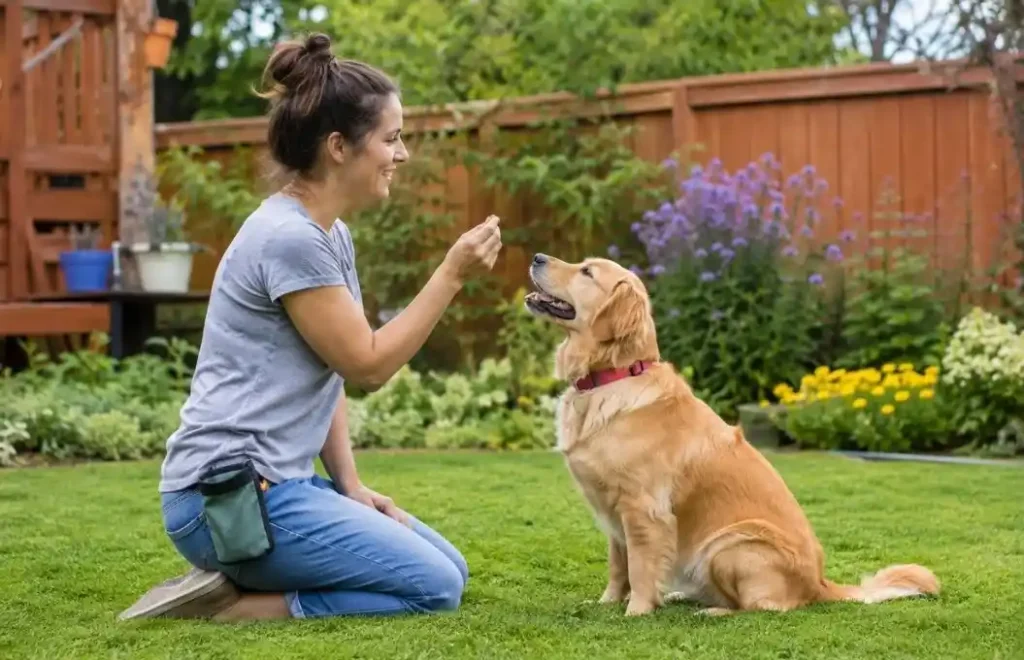
Train your dog right, starting with one simple rule.
Table of Contents
- What dog training actually is
- Why most dogs fail at training
- The method that actually works: positive reinforcement
- What Are the Five Commands Every Dog Should Know?
- Common behavior problems: what’s actually going on
- Building a training schedule that sticks
- The tools worth having
- When progress stalls
- Where to go next
If you’re looking for anxiety dog training that actually works, you’re in the right place. Most dog training advice tells you to be “consistent.” That’s not wrong, but it’s incomplete. You can be consistently wrong, and your dog will consistently learn the wrong things.
This guide covers what actually works: how dogs learn, which methods have the best track record, what tools are worth having, and how to build a routine you can actually stick to. Whether you have an 8-week-old puppy or a 5-year-old dog with habits you’d rather forget, the same core principles apply. Good dog training is less about tricks and more about consistent daily habits.
[Download: Free dog training starter checklist: the 10-step plan that makes week one easier]
What dog training actually is
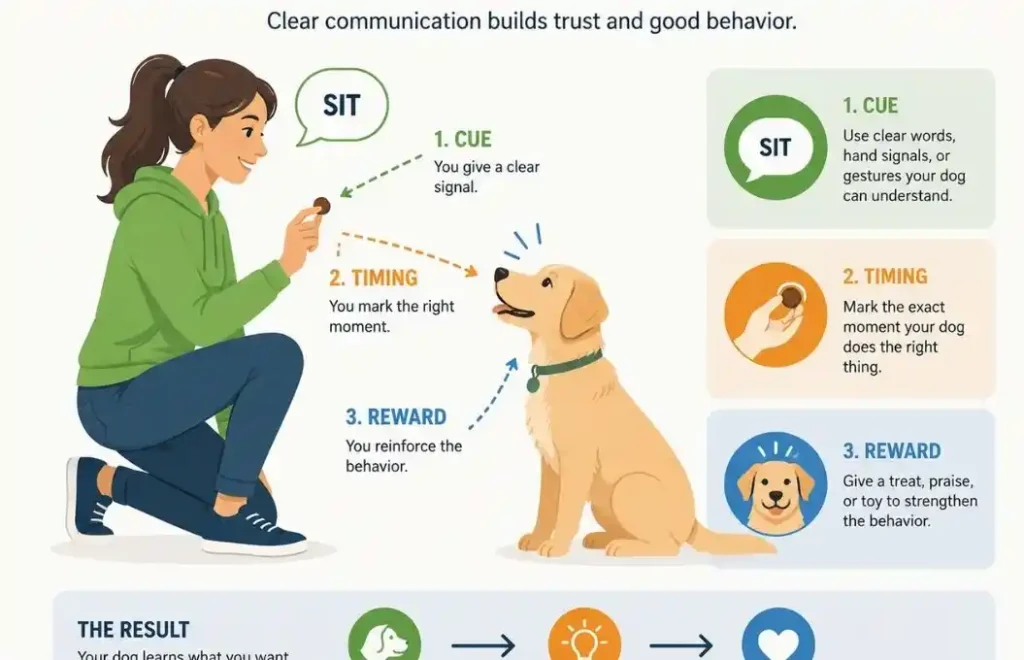
Dog training is communication. Your dog doesn’t know the rules of your house. He doesn’t speak your language. He reads your behavior, your timing, and what happens right after he does something.
When training goes wrong, it’s almost never the dog’s fault. It’s usually a timing problem (the reward came too late), a clarity problem (the cue meant different things in different contexts), or a consistency problem (sometimes jumping was fine, sometimes it wasn’t).
Dogs learn fast when the feedback is clear. That’s the one rule everything else builds on.
What Is the Difference Between Classical and Operant Conditioning?
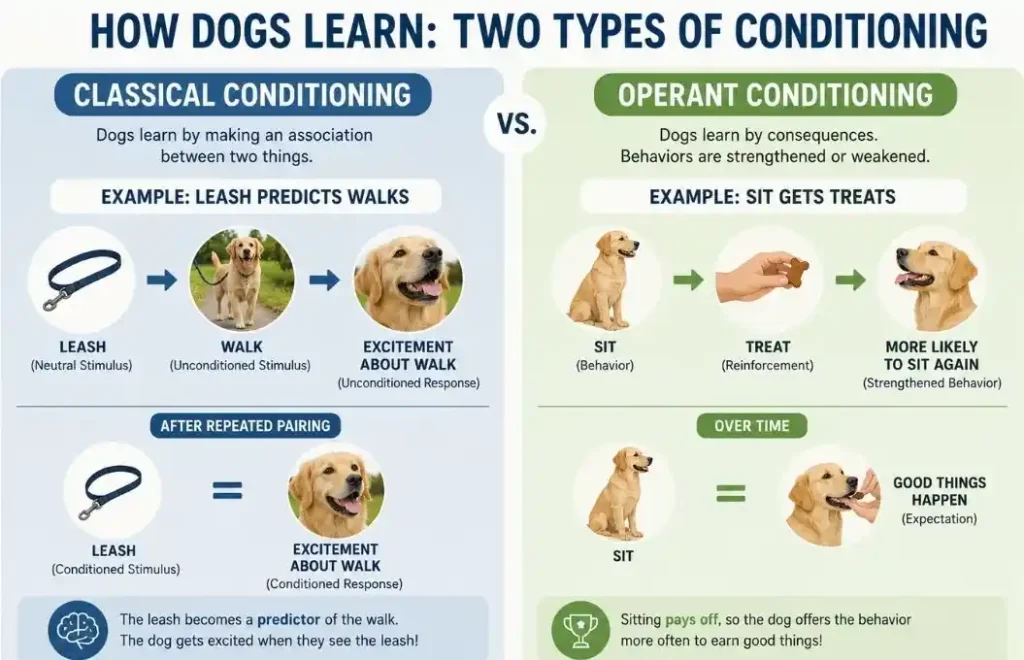
Two overlapping processes shape your dog’s behavior, whether you know it or not.
Classical conditioning is about associations. Ring a bell before meals enough times, and the bell itself triggers anticipation. This is why dogs lose their minds when they see a leash: the leash predicts a walk.
Operant conditioning is about consequences. Behavior that produces good outcomes gets repeated. Behavior that produces nothing, or something unpleasant, fades. This is the mechanism behind most formal training.
You’re using both constantly, whether you mean to or not. Understanding this stops a lot of accidental training.
Why most dogs fail at training
They don’t fail because they’re stubborn or stupid. They fail because:
The timing is off. A reward given 3 seconds after a behavior doesn’t teach that behavior: it teaches whatever the dog was doing at second 3. This sounds obvious until you watch yourself fumbling with a treat bag.
The criteria keep shifting. “Sit” means sit, then sit and wait, then sit and wait while you walk away, without the dog ever learning those are different things. Each step needs to be taught separately.
The environment jumps too fast. Teaching “sit” in the kitchen is easy. The dog will blow it at the park because the park is a completely different place. This is called generalization, and it takes deliberate practice in multiple locations.
Punishment is misused. Yelling after the fact, corrections that don’t clearly connect to the behavior, intimidation: these create anxious, confused dogs, not trained ones. The behavior might stop, but something worse often replaces it. This is exactly why anxiety dog training relies on reward-based methods instead of corrections.
The method that actually works: positive reinforcement
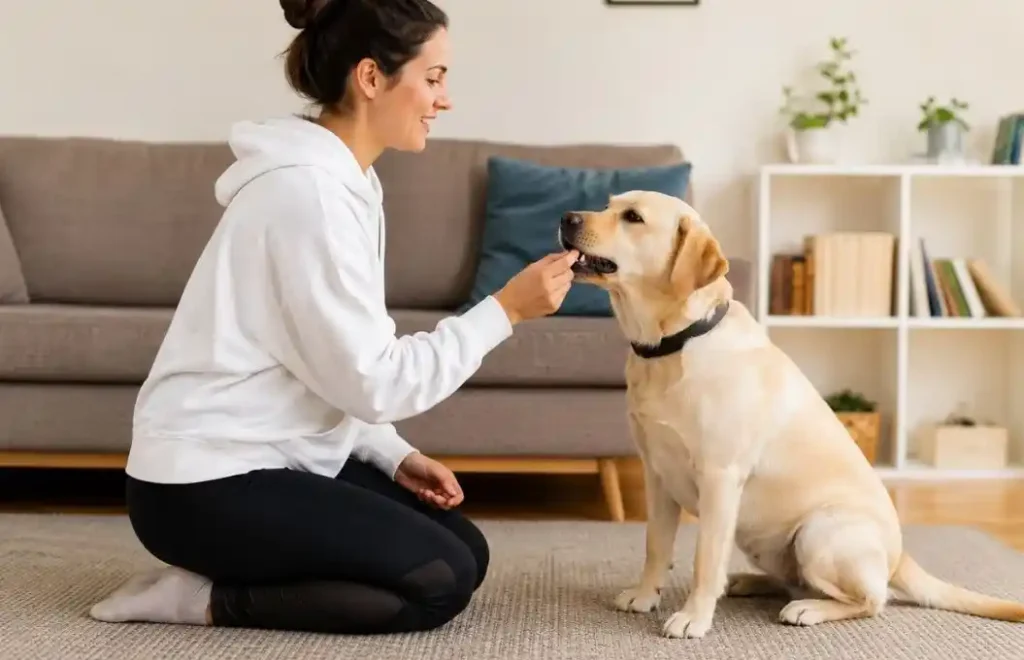
Positive reinforcement means adding something the dog likes when he does the right thing. Usually food, but it can also be play, access to sniff something interesting, or simple attention, whatever that dog actually cares about.
This isn’t about being soft. It’s about being effective. Decades of research in applied behavior analysis (the same science used in zoos, service dog programs, and competitive dog sports) shows this approach produces faster learning, better retention, and dogs that want to work with you.
[Full guide: Positive reinforcement dog training: step-by-step]
The core process is simple:
- Decide exactly what behavior you want
- Wait for it, or prompt it
- Mark it the instant it happens (a word like “yes” or a clicker click)
- Deliver the reward within 1-2 seconds
The marker is the critical piece. It bridges the gap between the behavior and the reward. Without it, you’re guessing what you rewarded.
Using a clicker
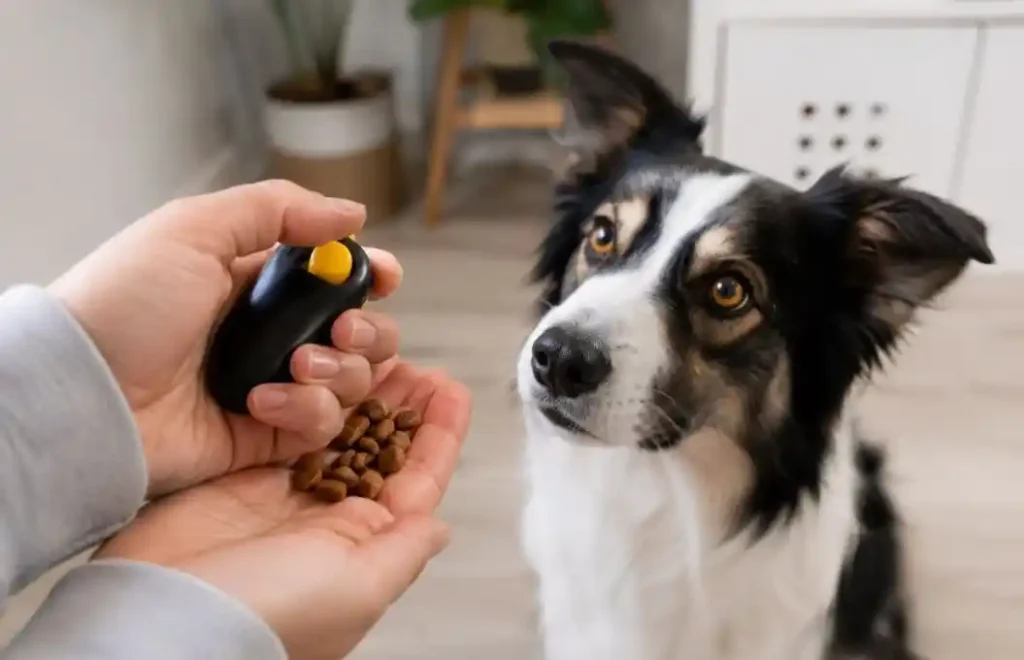
A clicker is precise and consistent. Your voice isn’t. “Yes” said with excitement sounds different from “yes” said when you’re tired or distracted. The click always sounds the same.
To start, you don’t need to explain the clicker to your dog. Just click and give a treat, 10-15 times in a row. After that, the click means “something good is coming” and your dog is already paying attention.
What Treats Work Best for Training?
Use small, soft treats your dog would do almost anything for. The value of the treat should match the difficulty of the task. Kibble works in the kitchen. At the dog park, surrounded by distractions, you need something closer to real chicken or cheese.
What Are the Five Commands Every Dog Should Know?
These are the foundation for any anxiety dog training program. Everything else builds on them.
Sit
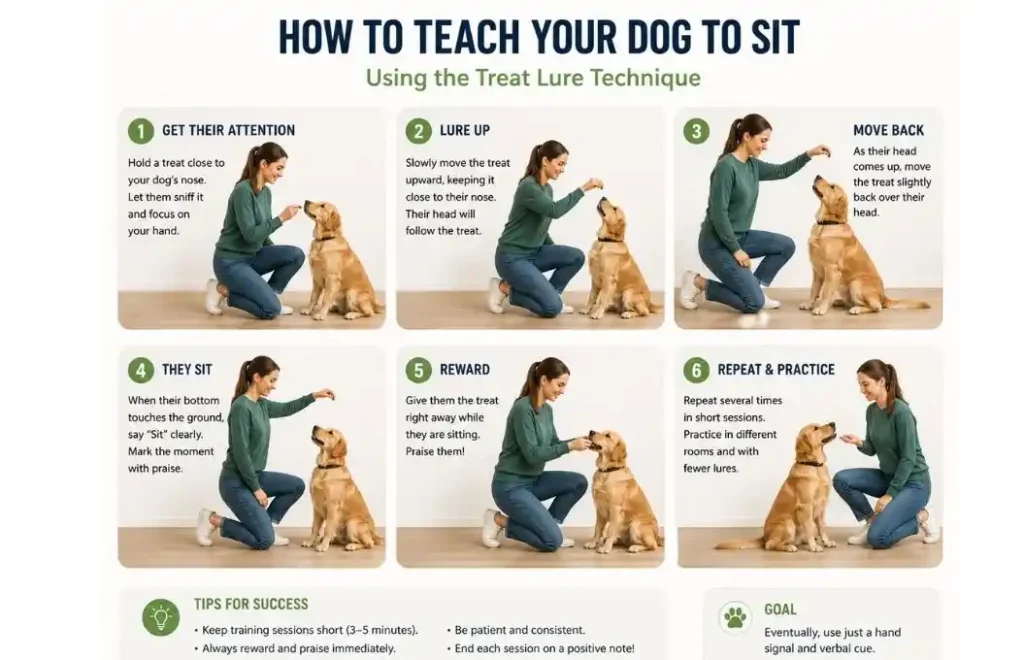
Hold a treat at your dog’s nose, then slowly move it back over his head. As his nose goes up, his rear goes down. Click the instant he sits, then deliver the treat. Repeat 10 times, then add the word “sit” just before you lure.
After 2-3 sessions, try asking for the sit before the lure appears. If he does it, give extra treats.
[Step-by-step: How to teach a dog to sit in under 5 minutes]
Down
From a sit, hold a treat at his nose and slowly lower it straight to the floor, then slide it slightly toward you. He’ll fold into a down. Click and treat the moment his elbows touch the floor.
Stay
Stay is three things: duration, distraction, and distance. Start with 1 second, standing right next to your dog. Build slowly. Never practice at a level where he’s likely to fail: if he’s breaking the stay, you’ve moved too fast.
Come (recall)
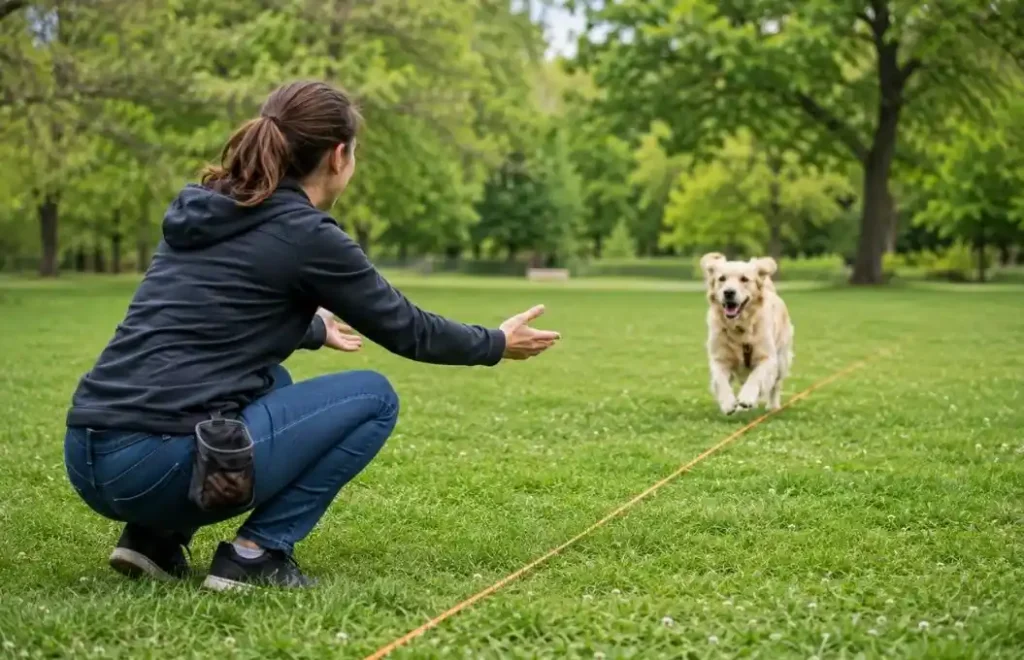
The most important command you’ll ever teach. It could save your dog’s life.
Use a long line in open spaces so you can enforce it without chasing him. Call once, run backwards (this triggers a pursuit instinct), and reward generously when he arrives. Never punish a dog who comes to you, even if it took longer than you wanted.
Leave it
Hold a treat in your closed fist. Let your dog sniff and paw at it. The moment he pulls back or looks away, click and give him a different treat from your other hand. This teaches him that ignoring something produces something better. Useful for everything from food on the floor to dead animals on the trail.
Common behavior problems: what’s actually going on
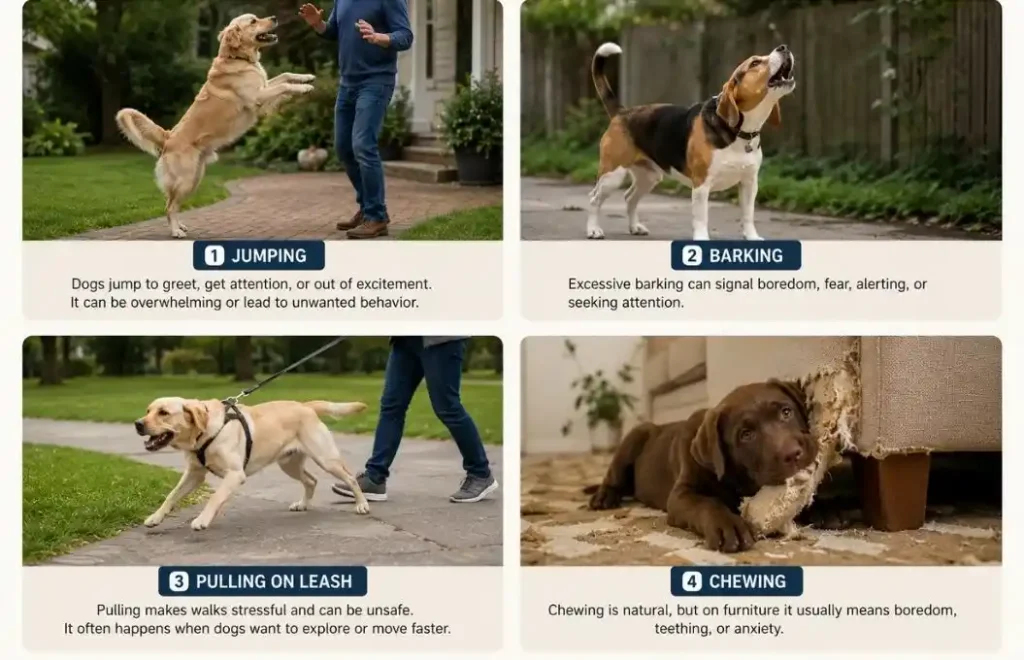
Most behavior problems are communication problems. The dog is doing something that works for him. Your job is to make the right behavior pay off better, a principle that sits at the core of anxiety dog training as well as everyday obedience work.
Jumping
Jumping gets attention. The fix isn’t punishment. It’s removing the reward. Turn your back, cross your arms, zero reaction. The second all four paws hit the floor, give attention immediately. It feels backward, but it works.
[More detail: How to stop your dog from jumping on people]
Barking
Before you address it, figure out why he’s barking. Boredom, alarm, frustration, and demand barking all need different responses. Ignoring demand barking works. Ignoring alarm barking changes nothing.
[Why is my dog barking at nothing? (and how to stop it)]
Pulling on leash
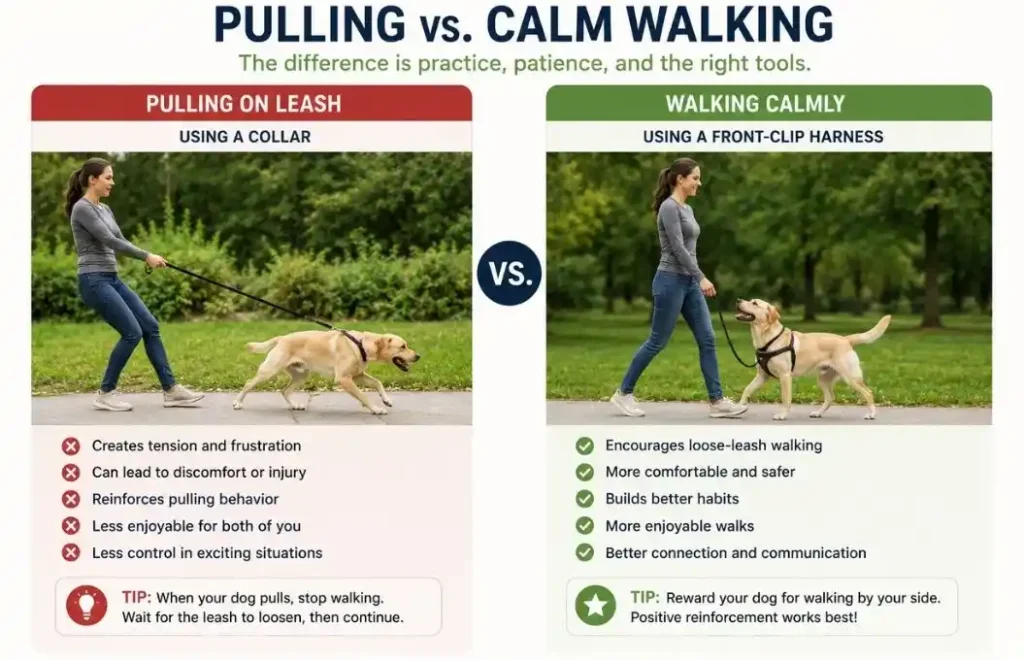
The dog pulls because it works: he gets where he wants to go faster. Stop dead the moment the leash tightens. Reward when it loosens. A front-clip harness makes this faster. Most dogs make the connection within 2-4 weeks of consistent practice.
Chewing
Puppies chew because their gums hurt. Adult dogs chew because they’re bored or anxious. Management (crates, baby gates, supervision) prevents the behavior while you work on the underlying cause. Giving more mental and physical exercise solves it faster than any correction.
[See also: Dog behavior problems: how to fix them fast]
Building a training schedule that sticks
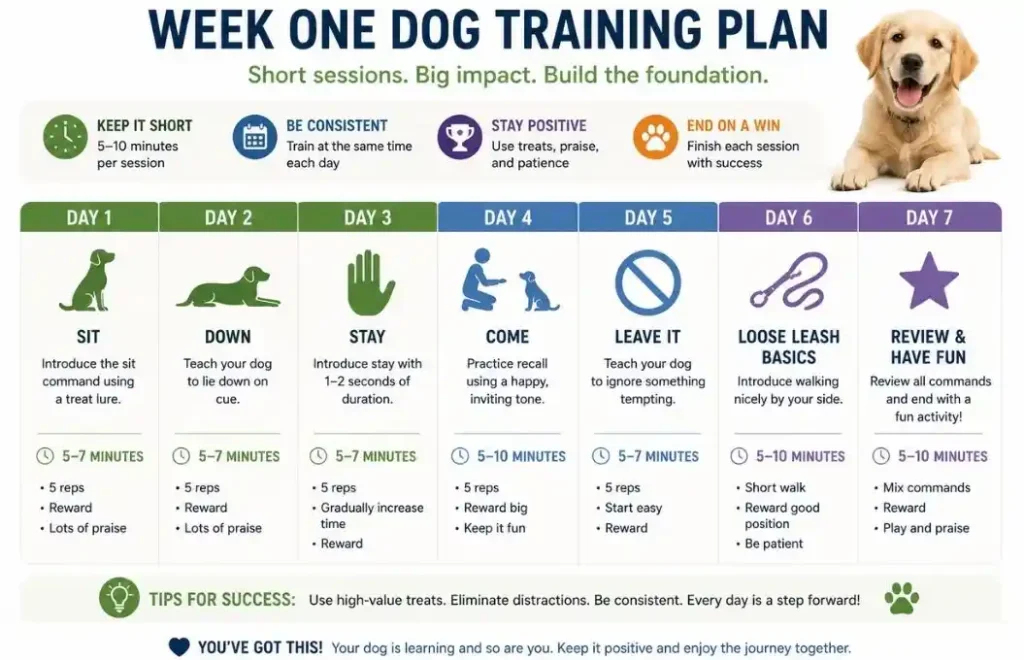
Five minutes twice a day beats a 45-minute session once a week. Dogs have short attention spans for formal training, and their working memory is limited. Short sessions keep the energy up and end before frustration sets in.
A realistic week 1 schedule:
- Morning: 5 minutes on sit and down (10 reps each)
- Evening: 5 minutes on recall in the backyard
Week 2: add stay (start with 1 second), add leave it.
Week 3: practice the same behaviors in at least two new locations.
The goal in week 1 is to build the habit of training, not to rush the behavior. Slow is fast.
[Full plan: Dog training at home for beginners: your first week]
The tools worth having
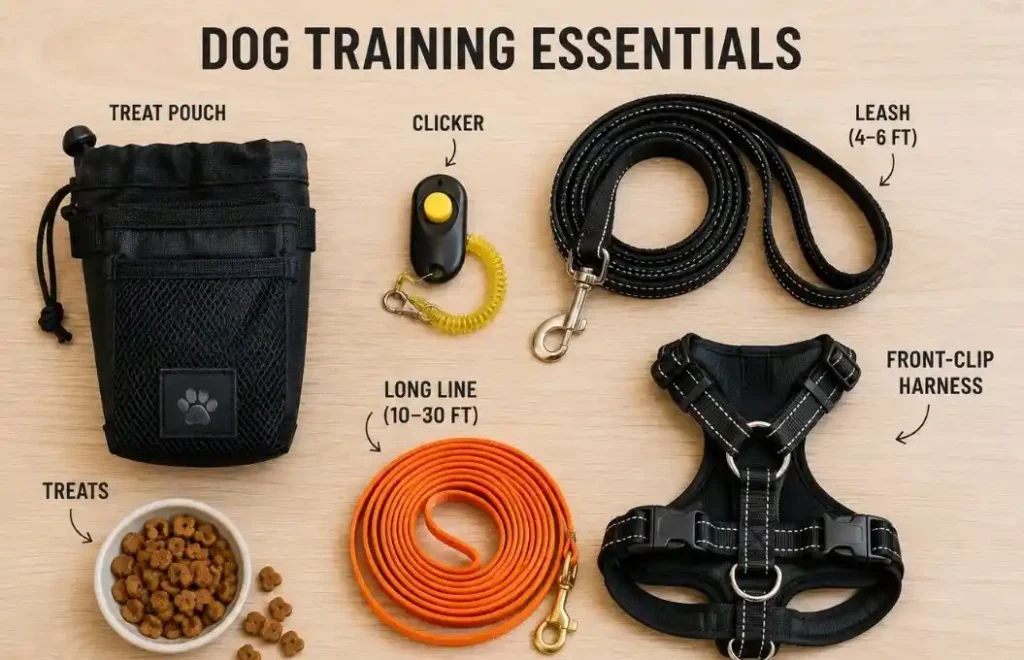
You don’t need much. A treat pouch, a clicker, a standard 6-foot leash, and a 20-30 foot long line for recall practice cover 90% of what you need.
A few things that make a real difference:
Treat pouch: Keeps your hands free and the treats accessible. Magnetic closure silicone ones stay cleaner than the open-top fabric kind.
Long line: Essential for recall practice anywhere off-leash isn’t available. 20-30 feet is the right length: long enough to give freedom, short enough to reel in quickly.
Front-clip harness: Reduces pulling without any punishment or discomfort. One of the most useful tools for dogs who pull hard while you’re still building loose-leash skills.
Clicker: Precise, consistent, cheap. The $3 version works as well as the $20 version.
[Full comparison: Best dog training tools that actually work (2026)]
What to skip: choke chains and prong collars suppress behavior without teaching anything. Spray bottles are mostly just annoying. Shock collars (including low-level “e-collars”) increase stress hormones even when the dog doesn’t visibly react, and there are better options for every situation they’re marketed for.
When progress stalls
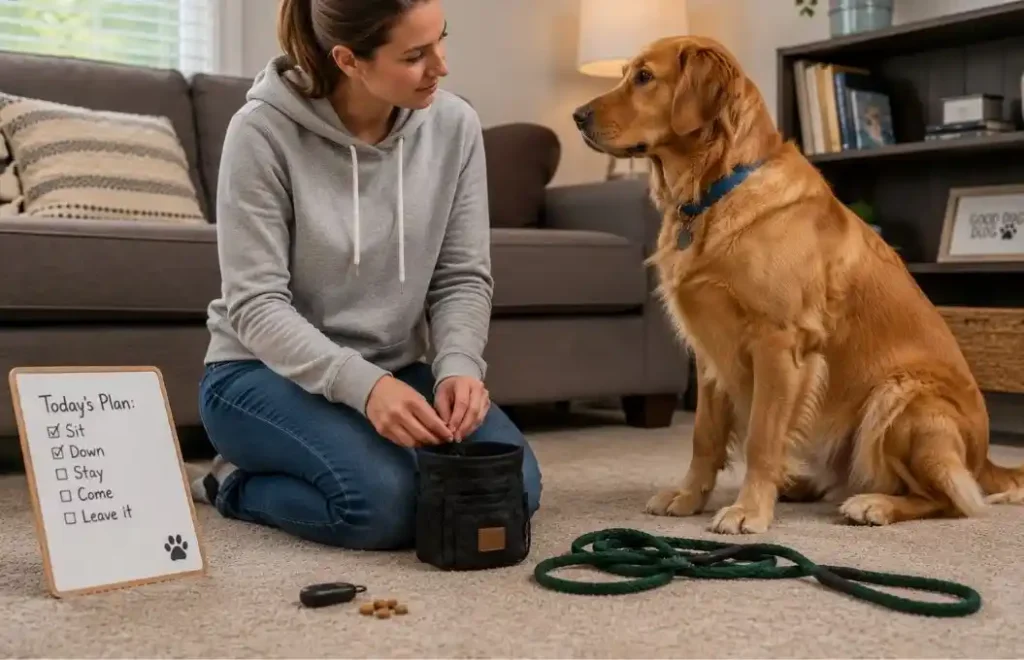
If training isn’t working, run through this before giving up:
Is the treat good enough for this environment? A biscuit won’t compete with a squirrel. Bring chicken to the park.
Is the criteria too high? Break the behavior into smaller pieces. If “sit-stay while the front door opens” isn’t working, go back to “sit-stay for 3 seconds with the door closed.”
Is the dog tired, or not tired enough? A dog who just ran for an hour doesn’t retain information well. Neither does a dog who’s been in a crate since 7 a.m.
Does the dog actually know this behavior? Asking for “sit” in a new location isn’t reviewing it. It’s starting over. That’s normal. Treat it like day one.
Where to go next
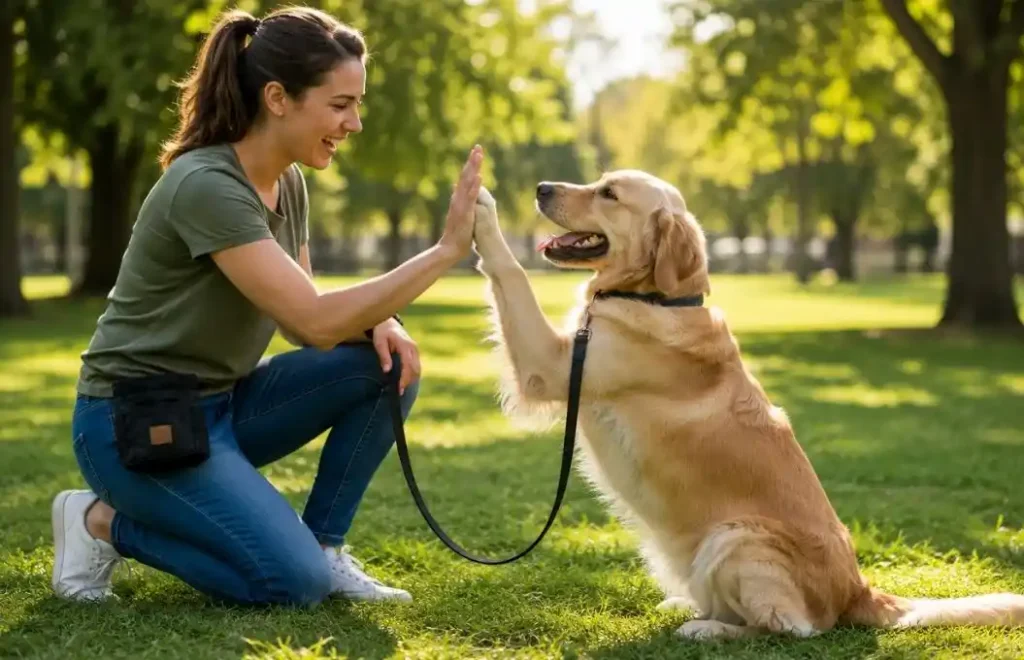
Training a dog is mostly about paying attention: to your timing, to what you’re actually reinforcing, and to what your dog is telling you. The methods here aren’t complicated, and they’re the same core principles used in anxiety dog training for dogs that need extra patience. What takes work is staying consistent without being rigid, and moving slowly enough that your dog actually understands what you’re asking.
[Download: Free dog training starter checklist: get the week-one plan in one page]
- Positive reinforcement dog training: step-by-step: the method in detail, with troubleshooting
- Dog behavior problems: how to fix them fast: when basic training isn’t enough
- Best dog training tools that actually work (2026): what’s worth buying and what to skip
- Dog training for separation anxiety: the full protocol for dogs that panic when left alone
- Separation Anxiety in Dogs: Complete Owner’s Guide: everything you need to know about SA

