🐾 Does your dog panic when you leave? → Get the Free 7-Day Starter Plan

How to Teach a Dog to Sit Fast (Step-by-Step Guide)
How to teach a dog to sit? Discover the simple trick that makes training easier and learn how to build a reliable sit with positive reinforcement and treats.

Affiliate disclosure: This article and its sidebar contain affiliate links. If you buy through these links, PetCalmZone may earn a commission at no extra cost to you.
Learning how to teach a dog to sit is one of the most rewarding first steps you can take as a dog owner. The “sit” command is the foundation of nearly every other behavior your dog will ever learn, and the good news is that most dogs pick it up surprisingly fast when you use the right approach. In this guide, you’ll get a clear, step-by-step method using positive reinforcement dog training so your pup learns quickly and actually enjoys the process.
Whether you just brought home a new puppy or you’re working with an older dog who never learned the basics, this guide has you covered. No punishment, no frustration: a step-by-step approach using positive reinforcement. Progress varies by dog.
Why “Sit” Is the Best First Command to Teach
Before we dive into the steps, it’s worth understanding why “sit” is almost universally recommended as the first command. It’s a natural position for dogs: they do it on their own all the time. That means you’re not asking your dog to do something foreign. You’re just putting a word to something they already know how to do physically.
“Sit” also gives your dog a default polite behavior. Instead of jumping on guests, a dog who knows “sit” can be redirected instantly. It’s a calming behavior that puts your dog in a controlled mindset, which makes every other training session go more smoothly. According to the American Kennel Club, “sit” is the cornerstone of good canine manners.
What You’ll Need Before You Start
Having the right tools makes a huge difference in how quickly your dog learns. You don’t need a lot: just a few key items:
- A training clicker: The Karen Pryor i-Click Training Clicker is a top choice among professional trainers. The click sound acts as a precise “yes!” marker that tells your dog exactly which behavior earned the reward. Clicker training dramatically speeds up learning.
- High-value training treats: Not all treats are equal. You want something small, soft, and irresistible. Zuke’s Mini Naturals Dog Training Treats are perfect: they’re tiny (so you can reward repeatedly without overfeeding), soft enough to eat fast, and dogs go crazy for them.
- A treat pouch: A training treat bag/pouch worn on your hip keeps rewards accessible instantly. The faster you can deliver a treat after the click, the clearer the communication to your dog. A pouch means you’re never fumbling in your pockets.
- A quiet space: Start somewhere with minimal distractions. Your living room or a calm backyard works great. You can add distractions later once your dog has the basics down.
How to Teach a Dog to Sit: Step-by-Step
Follow these steps in order. Keep each training session short: 3 to 5 minutes is ideal. Dogs learn better with frequent short sessions than one long, exhausting one.
Step 1: Get Your Dog’s Attention
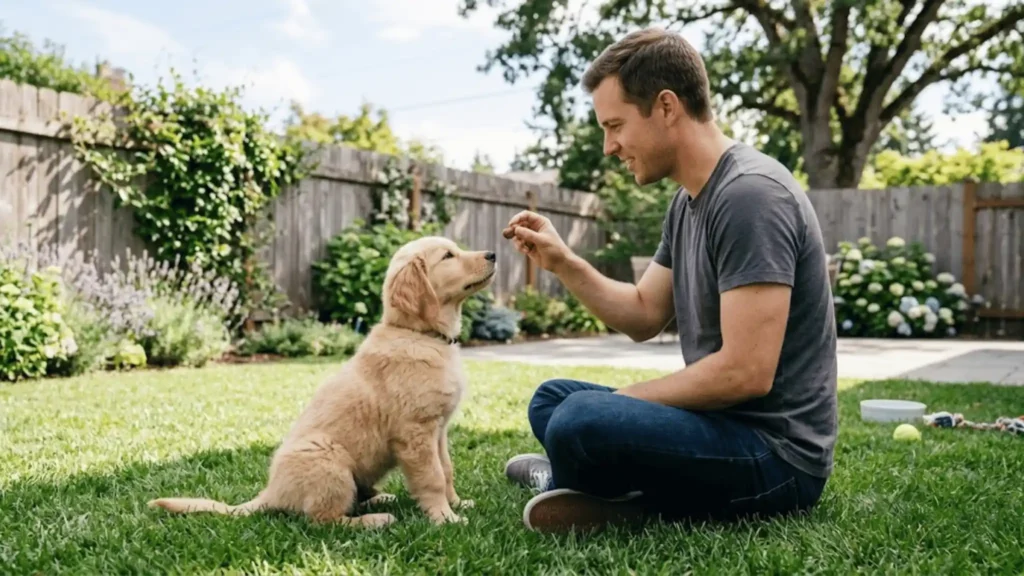
Stand in front of your dog with a treat in your hand. Let them sniff it so they know it’s there. You want their eyes on you and their brain engaged before you start. If your dog is bouncing off the walls, give them a short walk first to burn off some energy.
Step 2: Use the Treat as a Lure
Hold the treat right at your dog’s nose level. Slowly move it up and back, toward the back of their head. As the treat moves backward, your dog’s natural response is to rock back onto their haunches to follow it with their nose. Their bottom will naturally lower toward the floor.
Don’t rush this. Move slowly and keep the treat close to their nose. If your dog jumps up trying to grab it, you’ve raised the treat too high too fast. Lower it and try again.
Step 3: Click and Treat the Moment They Sit
The instant your dog’s bottom touches the floor, click your clicker and immediately give them the treat. Timing is everything here. The click has to happen the exact moment their butt hits the ground, not a second later. That split-second precision is what tells your dog “that position right there is what earned the reward.”
If you’re not using a clicker, use a short, consistent verbal marker like “Yes!” in the same way. The word “good boy” is too long: by the time you’ve said it, your dog may have already moved, and they won’t know exactly which behavior you’re marking.
Step 4: Repeat 5–10 Times
Practice the lure-click-treat sequence several times in a row. After 3–5 successful sits, your dog will start anticipating the movement and sitting faster. You’ll notice them almost “chasing” the sit position because they’ve figured out that sitting = treat.
End the session on a success. Always quit while you’re ahead, not when your dog starts making mistakes. Leaving on a high note keeps their enthusiasm high for next time.
Step 5: Add the Word “Sit”
Once your dog is sitting reliably when you do the hand motion (usually after 2–3 short sessions), it’s time to add the verbal cue. Say “sit” in a calm, clear voice just before you start the lure motion. The sequence becomes: say “sit” → lure → click → treat.
After several more repetitions, try saying “sit” without doing the lure. Just say the word and wait. Many dogs make the connection quickly and will sit on the word alone. When they do, jackpot them: give 3–4 treats in a row and lots of praise. That’s a big breakthrough moment worth celebrating.
Step 6: Fade the Lure
You don’t want your dog to only sit when they see food in your hand. To fade the lure, start delivering the treat from your treat pouch after the click rather than from your luring hand. Your hand can still do a subtle gesture if needed, but make sure the treat isn’t visible before the sit happens.
Eventually you’ll give a simple verbal or hand signal cue, your dog sits, you click, and the treat comes from the pouch. Your dog learns that sitting earns rewards regardless of whether food is visible upfront.
Step 7: Practice in Different Places
Dogs don’t automatically generalize. A dog who sits perfectly in the kitchen may look at you blankly in the park. This is normal: it’s called “context specificity,” and it’s how dog brains work. The fix is simple: practice “sit” in lots of different places.
Start with low-distraction environments and gradually increase the difficulty. Practice in the backyard, then on a quiet street, then in a busier area. Every new location is a mini training session that strengthens the behavior across contexts.
Common Mistakes When Teaching a Dog to Sit
Even well-meaning owners make a few common errors that slow down training. Watch out for these:
- Repeating the cue multiple times: Saying “sit, sit, sit, SIT” teaches your dog that the first “sit” doesn’t mean anything. Say it once, wait, and if they don’t respond, reset and try again.
- Training when your dog is too excited or too tired: Both extremes make learning harder. Aim for calm but alert.
- Sessions that are too long: Mental training is exhausting for dogs. Three to five minutes is plenty. Quality over quantity.
- Pushing your dog into a sit: Physically pushing a dog’s rear down can cause confusion or discomfort. The lure method is more effective and kinder.
- Rewarding too late: If you click or say “yes” while your dog is already standing back up, you’ve rewarded standing up, not sitting. Timing matters enormously.
How Long Does It Take to Teach a Dog to Sit?
Most dogs learn the basic sit behavior within a single training session of 5–10 minutes. Within a few days of consistent short sessions, the majority of dogs will respond reliably to the verbal cue. Puppies as young as 8 weeks can learn “sit”. In fact, starting early has huge advantages.
Older dogs learn just as well, though they may take a little longer if they’re not used to training. Be patient, keep sessions positive, and you’ll get there. The old “you can’t teach an old dog new tricks” saying is simply not true: it’s been debunked repeatedly by animal behaviorists.
Taking “Sit” to the Next Level
Once your dog has a solid “sit” on cue in multiple locations, you can start building on it:
- Sit-stay: Ask for a sit, then take one step back before clicking and treating. Gradually increase distance and duration.
- Sit before meals: Ask your dog to sit before placing their food bowl down. This builds impulse control and makes mealtimes calmer.
- Sit to greet people: Instead of jumping on guests, your dog sits to say hello. A lifesaver for bigger dogs or those who knock people over with excitement.
- Sit at curbs: Training your dog to automatically sit when you stop at a curb is a safety behavior that can literally save their life during walks.
For a broader look at training your dog across all situations, check out our complete dog training guide: it covers everything from basic commands to more advanced skills.
Products That Make Teaching “Sit” Easier
You don’t need expensive equipment, but the right tools genuinely speed things up. Here’s a quick recap of what we recommend:
- Karen Pryor i-Click Training Clicker: Compact, comfortable to hold, and produces a consistent click sound that dogs respond to well. One of the most popular clickers among professional trainers for good reason.
- Zuke’s Mini Naturals Dog Training Treats: Small, soft, low-calorie, and absolutely delicious to most dogs. Perfect size for rapid-fire reward sessions without overfeeding.
- Dog Training Treat Pouch: Keeps treats at your fingertips so rewards are delivered instantly. Many trainers say this single tool speeds up training more than almost anything else.
Final Thoughts on Teaching Your Dog to Sit
Teaching your dog to sit is one of those skills that pays dividends for years. It’s the gateway behavior: once your dog understands that training is a fun game where they earn rewards, every subsequent skill becomes easier to teach. More than that, the process of training deepens your bond with your dog in a way that nothing else quite does.
Stick to short, positive sessions. Use good treats. Click (or mark) at exactly the right moment. Be consistent, and be patient. Your dog is trying their best to figure out what you want: your job is just to make it as clear as possible that sitting is the golden ticket.
Keep exploring our guides on positive reinforcement dog training to build a full repertoire of behaviors with your dog, one positive session at a time.