🐾 Does your dog panic when you leave? → Get the Free 7-Day Starter Plan

Dog Behavior Problems: Causes, Management and When to Seek Help
Learn about common dog behavior problems, possible causes, positive reinforcement approaches and when to seek professional help.

https://www.petcalmzone.com/positive-reinforcement-dog-training/If you’ve ever been frustrated by your dog’s behavior problems, you’re not alone. Whether it’s excessive barking in dogs, destructive chewing, jumping on guests, or full-blown anxiety when you leave the house, dog behavior problems are one of the top reasons owners seek professional help, or give up entirely. The good news? Most of these issues are 100% fixable with the right approach, and you don’t need to be a professional trainer to make real progress. This guide walks through the most common dog behavior problems one at a time, with fixes you can start today.
Table of Contents
- Why Do Dogs Develop Behavior Problems?
- When Anxiety Is the Root Cause
- The 8 Most Common Dog Behavior Problems (And How to Fix Them)
- How Do You Build Better Behavior?
- When to Call a Professional
- Quick-Reference: Dog Behavior Problems at a Glance
- Your Next Steps
In this guide, you’ll get a clear breakdown of the most common dog behavior problems, why they happen, and, most importantly, what you can actually do about them starting today. Whether you have a new puppy or a stubborn adult dog, this is your starting point.
[IMAGE: A dog looking guilty next to chewed-up shoes | Alt: “dog with chewed shoe illustrating common dog behavior problems”]
Why Do Dogs Develop Behavior Problems?
Before diving into solutions, it helps to understand the “why.” Dogs don’t misbehave out of spite or stubbornness. Almost every behavior problem has a root cause, and that root cause is almost always one of these:
- Lack of mental and physical stimulation: A bored dog will find ways to entertain himself. Usually those ways involve your couch cushions.
- Anxiety or fear: Stress is one of the biggest drivers of unwanted behaviors, from destructive chewing to aggression.
- Inconsistent training: If “down” sometimes means “get off the couch” and sometimes means “lie down,” your dog is confused, not defiant.
- Lack of early socialization: Dogs who weren’t exposed to a variety of people, sounds, and environments as puppies often develop fear-based problems.
- Medical issues: Always rule these out first. Pain, thyroid issues, and neurological conditions can all cause sudden behavior changes.
Understanding why your dog is acting a certain way makes it much easier to choose the right solution. Now let’s get into the specific problems.
When Anxiety Is the Root Cause
Three of the most disruptive behavior problems (destructive chewing, excessive barking, and compulsive behaviors like pacing or spinning) are almost always driven by anxiety, especially separation anxiety. If your dog only shows these behaviors when you’re not home, anxiety is almost certainly the cause.
We’ve put together dedicated guides for each:
- Dog Destructive Behavior and Separation Anxiety: why dogs chew, scratch, and destroy when left alone, and what actually helps
- Dog Barking and Howling When Left Alone: why dogs vocalize and how to reduce it without suppressing the underlying anxiety
- Dog Compulsive Behaviors and Anxiety: pacing, spinning, and repetitive behaviors explained
For the full picture on separation anxiety, including treatment options, medication, and a step-by-step desensitization plan, read our complete guide to dog separation anxiety.
The 8 Most Common Dog Behavior Problems (And How to Fix Them)
1. Excessive Barking
Barking is normal dog communication, but when it’s constant, it becomes a serious problem for you and your neighbors. Dogs bark for many reasons: alerting to strangers, boredom, anxiety, attention-seeking, or responding to other dogs.
What to do: First, identify the trigger. Is your dog barking at people walking by the window? Cover the lower portion of the window so he can’t see them. Is he barking for attention? Stop rewarding it: don’t look at him, talk to him, or push him away (any attention, even negative, is a reward). Instead, wait for silence, then reward immediately.
Teaching a “quiet” command takes patience but works well. Say “quiet” calmly, wait for even a two-second pause in barking, and immediately reward with a high-value treat. The click of a training clicker marks the exact moment of quiet, which speeds up learning significantly, but a simple “yes!” works just as well if you don’t have one.
2. Destructive Chewing
Chewing is a completely natural dog behavior: puppies chew to relieve teething pain, and adult dogs chew to relieve stress and keep their jaws strong. The problem is when your belongings become the target.
What to do: Management is step one. If your dog is destroying things when you’re not home, he has too much unsupervised freedom too soon. Use baby gates, a crate, or a playpen to limit access to chewable items until the habit is broken. Simultaneously, make sure he has appropriate outlets: durable chew toys, frozen Kongs, bully sticks.
When you catch him chewing something he shouldn’t, calmly redirect to an appropriate toy and praise him for taking it. Never punish after the fact: he won’t connect the punishment to the chewed shoe you found an hour ago.
3. Jumping Up on People
A dog jumping up on you might be cute when he’s a 10-pound puppy. It’s not cute when he’s 70 pounds and knocking over your elderly mother. Jumping is almost always an attention-seeking behavior, and the problem is that it works. People say “down!” while making eye contact and pushing the dog away, which is exactly the interaction the dog wanted.
What to do: Remove the reward. The moment your dog jumps, turn your back, cross your arms, and ignore completely. When all four paws are on the floor, immediately turn around and give calm praise or a treat. The key is consistency: everyone in the household (and visiting guests) must do the same. One person letting the dog jump “just this once” will undo weeks of work.
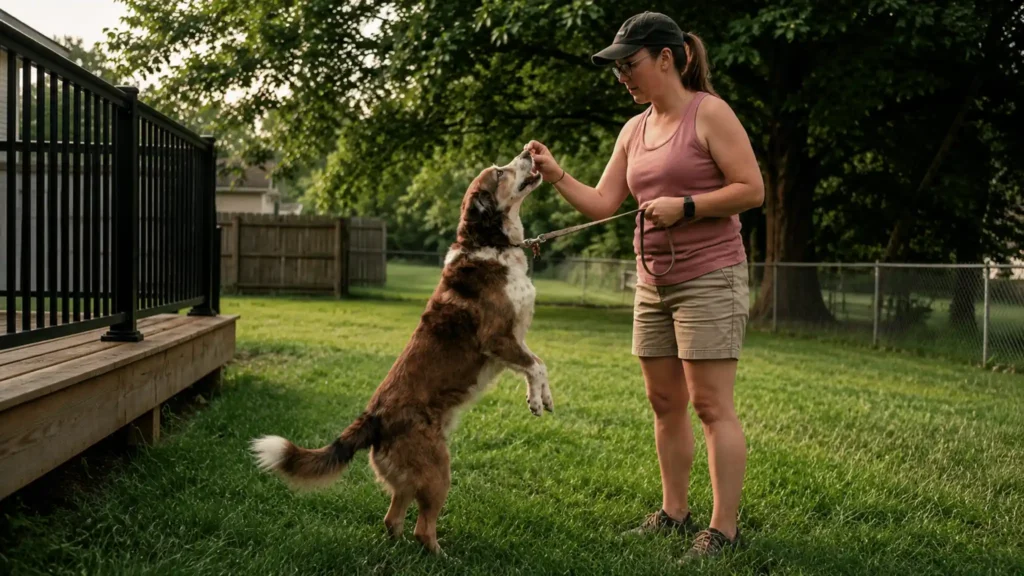
You can also teach an incompatible behavior: a dog who is sitting cannot simultaneously be jumping. Ask for a “sit” before greetings and reward generously with high-value training treats, something more exciting than his regular kibble, like small pieces of chicken or soft training treats.
[IMAGE: Person training a dog to sit using positive reinforcement | Alt: “owner training dog to sit to prevent jumping behavior”]
4. Pulling on the Leash
Leash pulling is probably the most common complaint among dog owners. Your dog pulls because it works: he moves forward. Every time you allow him to drag you toward the fire hydrant, you’re reinforcing the pulling.
What to do: Stop moving the moment the leash goes tight. Stand still. Wait. The second there’s slack in the leash, mark it (with a click or a “yes!”) and take a step forward. You’re teaching your dog that a loose leash makes you move, a tight leash makes you stop. This feels excruciatingly slow at first, but it works.
You can also try the “be a tree” method combined with direction changes: the moment the leash tightens, turn and walk the other direction. Your dog will learn to pay attention to where you’re going. Pair this with a front-clip harness to reduce the physical force of pulling while you work on the training.
5. Aggression
Dog aggression is one of the most alarming behavior problems, and also one of the most misunderstood. Aggression is almost always rooted in fear, pain, or resource guarding, not in dogs “being mean” or “dominant.” According to the ASPCA, the most common triggers include fear, pain, possessiveness, and territorial behavior.
What to do: If your dog has shown true aggression (growling, snapping, or biting), please consult a certified applied animal behaviorist or a veterinary behaviorist. This is not a situation where YouTube tutorials will cut it. In the meantime, manage the environment carefully to prevent rehearsal of the aggressive behavior. Every time a dog successfully uses aggression to make something go away, that behavior is reinforced.
Never punish aggression with physical force or harsh corrections. This suppresses the warning signals (growling, stiffening) without addressing the underlying fear, and can lead to a dog who bites without warning.
6. Separation Anxiety
Separation anxiety is one of the most heartbreaking dog behavior problems to deal with. Dogs with separation anxiety experience genuine panic when left alone: it’s not misbehavior, it’s a phobia. Signs include destructive behavior only when alone, excessive vocalization, house soiling despite being fully house-trained, and frantic behavior at departures.
What to do: True separation anxiety requires a systematic desensitization program: you gradually teach your dog that being alone is safe by starting with absences of just seconds and building up very slowly. This is detailed extensively in our guide to dog training for separation anxiety. For a complete overview including medication options and real-world protocols, read our complete guide to dog separation anxiety.
For severe cases, talk to your vet about medication: anti-anxiety medication combined with behavior modification has the best outcomes for true separation anxiety.
7. House Soiling / Inappropriate Elimination
When a previously house-trained dog starts having accidents indoors, the first step is always a vet visit. Urinary tract infections, kidney disease, Cushing’s disease, and many other medical conditions can cause sudden house soiling. Rule out medical causes before assuming it’s behavioral.
If it’s behavioral, you essentially go back to house training basics: more frequent outdoor trips, supervision indoors, and immediately rewarding the dog for eliminating outside. Clean any indoor accidents thoroughly with an enzymatic cleaner: dogs can smell the lingering scent of previous accidents and are drawn back to the same spots.
8. Begging at the Table
Begging is an easy problem to create and a harder one to fix, because it was created by humans giving the dog scraps, and the fix requires humans to be consistent about not doing that. If your dog begs at the table, he learned that begging works.
What to do: Teach your dog a “place” command: a designated spot (a mat or dog bed) where he goes during mealtimes. When you sit down to eat, send him to his place and reward him for staying there. This gives him something to do other than beg, and over time it becomes a comfortable habit. The entire family must stop giving table scraps. Even one “just this once” incident will reset the behavior.
[IMAGE: Dog lying calmly on a mat during a family meal | Alt: “well-trained dog on mat during mealtime, no begging behavior”]
How Do You Build Better Behavior?
Here’s the truth about dog behavior problems: they rarely exist in isolation. A dog who jumps also tends to pull on the leash. A dog with separation anxiety often has other anxiety-related behaviors. And almost all of them share the same underlying need: a dog who understands what’s expected of him, gets adequate exercise and enrichment, and feels safe and secure.
Building that foundation requires a consistent training approach. For a full overview of how to train your dog effectively from the ground up, check out our complete dog training guide. It covers everything from basic obedience to advanced behavioral work, all using positive reinforcement methods, with results that vary by dog.
What Role Does Management Play?
Management means setting up your dog’s environment so that problem behaviors are impossible or unlikely. It’s not a long-term solution, but it’s an essential tool while you work on training. Examples of management include:
- Keeping shoes in a closed closet while your dog is learning not to chew them
- Using a baby gate to keep your dog out of the room where guests are sitting until he’s learned to greet calmly
- Putting your dog in another room during mealtimes while you teach the “place” command
- Using a leash indoors so you can quickly redirect problem behaviors
Management prevents the behavior from being practiced, which is important because behaviors that get practiced get stronger. The longer your dog has been jumping on people, the harder the habit is to break, so management buys you time while training rewires the behavior.
What Role Do Exercise and Enrichment Play?
A tired dog is a good dog, and that’s not just a saying. Under-exercised, under-stimulated dogs are significantly more likely to develop behavior problems. Before you spend hours working on training, ask yourself honestly: Is my dog getting enough physical and mental exercise?
Physical exercise looks like daily walks, fetch, off-leash time in a safe area, or dog sports. Mental stimulation can include training sessions, puzzle feeders, sniff walks (where you let your dog sniff at his own pace), and stuffed Kongs. Even 15 minutes of training, using your dog’s regular kibble as rewards, can tire out a dog more than a 30-minute walk.
Why Does Consistency Matter?
One of the biggest reasons dog behavior problems persist is inconsistency. Your dog cannot understand “no jumping on people” if it means “no jumping most of the time, but jumping on me on the couch is fine, and jumping on Grandma is tolerated because she secretly loves it.”
Set clear rules, make sure everyone in the household enforces them the same way, and be patient. Most behavior problems took weeks or months to develop: they won’t disappear overnight. Consistent application of training principles over days and weeks is what actually moves the needle.
[IMAGE: Family consistently training their dog together | Alt: “family working together to consistently train dog behavior”]
When to Call a Professional
Some dog behavior problems are best handled with professional guidance. Consider calling a certified professional dog trainer (look for CPDT-KA credentials) or a veterinary behaviorist (DACVB) if:
- Your dog has shown any form of aggression toward people or other animals
- You suspect true separation anxiety (not just mild distress)
- The behavior is getting worse despite consistent training efforts
- You’re feeling unsafe around your dog
- The problem started suddenly with no obvious trigger (this warrants a vet check first)
A good trainer will assess your specific dog and situation, not just give you generic advice. Be wary of trainers who promise quick fixes or use intimidation and punishment. Force-free, science-based training has a much better track record and doesn’t damage your relationship with your dog.
Quick-Reference: Dog Behavior Problems at a Glance
| Problem | Common Cause | First Step |
|---|---|---|
| Excessive barking | Boredom, anxiety, alert | Identify trigger, teach “quiet” |
| Destructive chewing | Boredom, stress, teething | Manage environment + add outlets |
| Jumping up | Attention-seeking | Ignore jumping, reward four-on-floor |
| Leash pulling | Pulling works | Stop when leash tightens |
| Aggression | Fear, pain, resource guarding | Consult a professional |
| Separation anxiety | Panic when alone | Desensitization program |
| House soiling | Medical or behavioral | Vet check first |
| Begging | It worked in the past | Teach “place” command |
Your Next Steps
Dealing with dog behavior problems can feel overwhelming, especially when you’re in the thick of it. But remember: every behavior has a cause, and every cause has an appropriate response. You don’t need to shout, punish, or give up on your dog.
Start with one behavior: the one causing the most stress in your household. Apply management to stop the behavior from being practiced. Then introduce training, using clear cues and consistent rewards. Be patient with yourself and with your dog as you work through the process.
Most importantly, remember that training is a relationship, not a quick fix. The effort you put in now will pay off for the entire life of your dog, and that bond you build in the process? That’s the best reward of all.