🐾 Does your dog panic when you leave? → Get the Free 7-Day Starter Plan

Dog Licking Anxiety: Why It Happens & How to Stop It
Struggling with dog licking anxiety? Discover why compulsive licking happens, what it signals, and the 5 proven ways to calm it before it causes real damage.

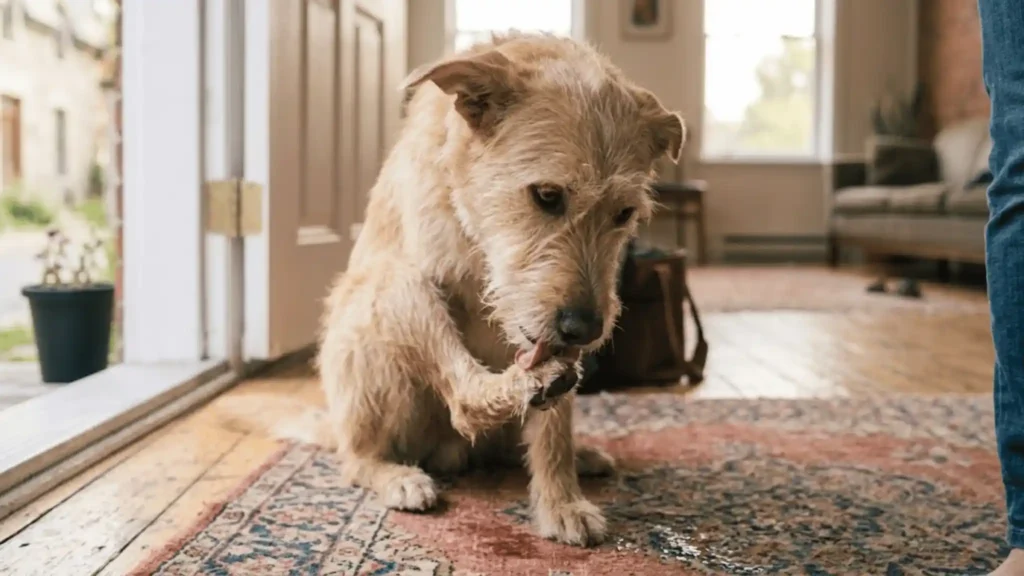
Your dog has been licking the same spot on his leg for weeks, and nothing you try seems to stop it. Maybe he also spins in tight circles when something excites him, or chases shadows until he’s panting and glazed-eyed. You’ve tried distracting him, you’ve tried ignoring it, and it just keeps happening, often getting worse over time.
Table of Contents
- What Compulsive Behavior Actually Is
- What Causes Dog Licking Anxiety
- Excessive Licking and Other Compulsive Behaviors to Watch For
- 5 Approaches That Actually Work
- What Does Not Work
- When to Get Professional Help
- Frequently Asked Questions
- The Bottom Line
The Merck Veterinary Manual’s overview of canine behavior problems covers compulsive disorder in more clinical detail, if you want to go deeper.
Dog licking anxiety and other compulsive habits are closely connected, but most owners don’t make that link until the behavior has been going on for months. Understanding what’s actually driving it changes everything about how you approach it, because these habits don’t respond to the same fixes as normal misbehavior. They’re not stubbornness, and they’re not attention-seeking. They’re the outward sign of a nervous system that’s struggling to regulate itself.

What Compulsive Behavior Actually Is
Compulsive behavior in dogs, sometimes called canine compulsive disorder (CCD) or canine OCD, refers to repetitive, stereotyped actions performed far beyond any functional purpose. It often starts in a context that makes some sense, such as chasing his tail when excited, or licking a wound, but then becomes detached from the original trigger and happens regardless of context, and is extremely difficult to stop.
The key diagnostic feature is that the behavior is out of proportion and hard to interrupt. Briefly chasing his tail when excited is normal. Spinning for 20 minutes until he’s exhausted and can’t be called off by his name, food, or a leash. That’s compulsive.
These patterns tend to escalate over time if untreated. They often start as occasional, mild repetitions and gradually become more frequent, longer in duration, and harder to redirect. Some dogs reach a point where the habit takes up hours of each day and causes physical harm.
What Causes Dog Licking Anxiety
The link between anxiety and repetitive behavior is well-established in both dogs and humans. Rhythmic actions activate the brain’s reward pathway and temporarily reduce tension: think of the way some people tap their foot, crack their knuckles, or bite their nails when stressed. Licking provides the same kind of neurological “relief valve,” which is exactly why dog licking anxiety is so hard to interrupt once it starts.
Chronic, unresolved anxiety is the single biggest risk factor for developing a compulsive habit. The most common triggers behind dog licking anxiety include separation anxiety (a chronically elevated baseline when left alone), under-stimulation or confinement, physical pain or chronic discomfort, unpredictable environments with frequent change, and genetic predisposition in certain breeds.
Breed plays a real role here. Bull Terriers are significantly predisposed to tail chasing and spinning. Doberman Pinschers commonly develop flank sucking. German Shepherds, Border Collies, and Labrador Retrievers are over-represented in shadow and light chasing. Large, intelligent, high-drive breeds tend to be more vulnerable: partly genetics, partly because their need for stimulation is high enough that boredom creates significant stress.
For dogs with separation anxiety specifically, compulsive habits often emerge or intensify during alone time and continue afterward: that period raises the baseline, and the behavior becomes a self-soothing mechanism that persists even once the owner is home. For more background on separation anxiety and how it escalates, the complete guide to dog separation anxiety covers the progression in detail.
Excessive Licking and Other Compulsive Behaviors to Watch For
Different repetitive habits tend to have somewhat different triggers and implications, though underlying stress is the common thread in nearly all of them.
Excessive Licking and Dog Licking Anxiety: Acral Lick Dermatitis
The most physically damaging of these habits, and the one most owners search for by name. The pattern: repeatedly licking one or more spots on the lower legs (typically the carpal or tarsal area) until the skin is raw, thickened, and ulcerated, a condition called acral lick dermatitis or lick granuloma. Licking releases endorphins, so it provides real neurological relief, which reinforces the habit even as the wound worsens.
Important: rule out primary dermatological or orthopedic causes first: licking a fresh wound, an allergic skin lesion, or a painful joint isn’t compulsive, it’s a response to a physical trigger. True compulsive licking persists after the skin heals and involves no underlying primary lesion, which is the clearest sign you’re dealing with dog licking anxiety rather than a medical issue.
Tail Chasing and Spinning
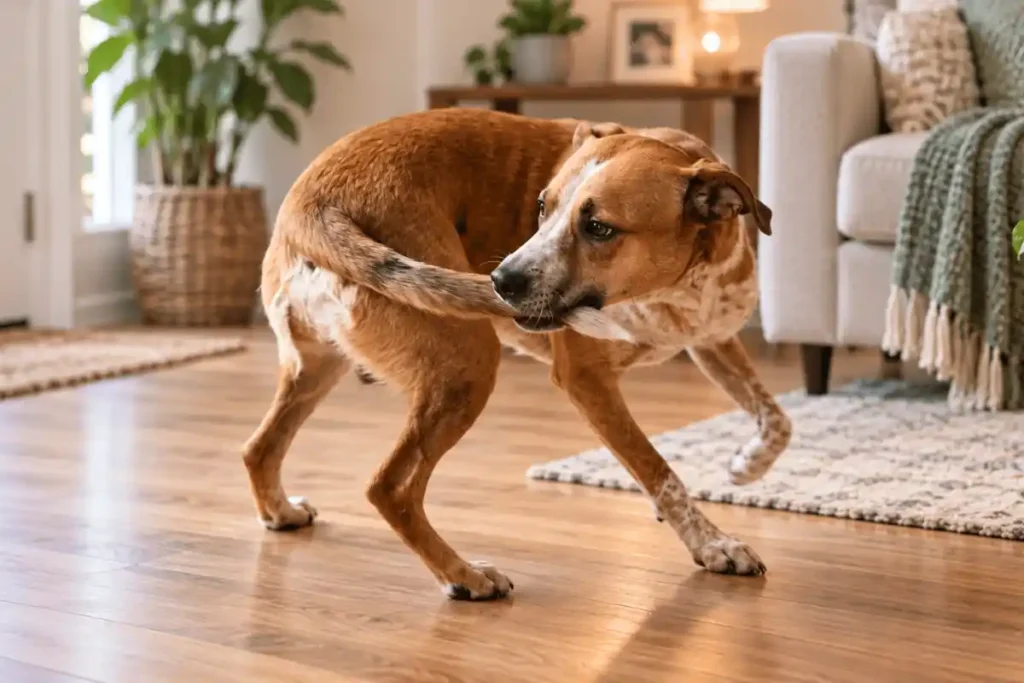
The most recognizable of the other compulsive behaviors. Brief tail chasing in puppies is normal play. Once it becomes compulsive, it typically happens in predictable high-arousal contexts at first (before a walk, when excited by guests) before becoming increasingly untethered from any trigger. Bull Terriers have a specific genetic variant linked to this pattern. In other breeds, it’s often associated with early-life stress, frustration, or confinement. Some dogs escalate to actually catching and injuring their tails repeatedly.
Flank Sucking
Most common in Doberman Pinschers, this involves grabbing and sucking on the flank skin, often while lying down. It’s closely analogous to thumb-sucking in children, appears to be strongly genetic in the breed, and is associated with underlying compulsive disorder. It’s generally less physically harmful than licking granulomas but can still signal significant stress.
Shadow and Light Chasing
Dogs that obsessively track shadows on the floor and walls, or chase reflections and light patterns, often to the exclusion of everything else. This frequently starts when an owner plays with a laser pointer and the animal finds it intensely engaging. The problem: unlike physical prey, light sources never provide a “catch” endpoint, leaving the drive perpetually activated. It can become so consuming that some dogs can’t relax in rooms with any natural light variation. Border Collies and herding breeds are especially vulnerable due to their intense visual prey drive.
Repetitive Pacing and Fence Running
Dogs confined to small spaces, especially without adequate exercise, often develop a stereotyped route: the same back-and-forth path worn into the grass or floor. Fence running follows the same pattern. This is strongly associated with chronic frustration and confinement stress. Unlike most other habits on this list, pacing and fence running are particularly common in animals that don’t show overt symptoms in other contexts: confinement alone is the primary driver.
Fly Snapping
Suddenly snapping at the air as if catching invisible flies, sometimes tracking something with the eyes, sometimes appearing to snap at nothing. This is one of the most complex presentations because it can have multiple causes: compulsive disorder, partial seizure activity, or visual floaters from an eye condition. If you see this, a veterinary exam matters before assuming it’s behavioral, because seizure-related snapping needs a different approach entirely.
5 Approaches That Actually Work
1. Address the Root Cause of Dog Licking Anxiety
These habits are symptoms of an underlying state, most often dog licking anxiety or a related stress response. Treating only the visible action, through interruption, redirection, or punishment, typically results in one of two outcomes: it returns, or it’s replaced by a different outlet as the animal finds another relief valve. The most effective protocols target both the trigger and the habit at once.
If separation anxiety is the primary driver, systematic desensitization is the core intervention: building tolerance for being alone at sub-threshold durations before the stress response activates. For generalized stress from confinement or under-stimulation, increasing exercise, enrichment, and environmental predictability addresses the root more directly. Our overview of common dog behavior problems covers how this connects to multiple presentations at once.
2. Interrupt and Redirect Correctly
Catching the habit early, before it reaches full intensity, is far more effective than trying to stop it once fully engaged. The window is right at the start, before what behaviorists sometimes call the “compulsive loop” sets in. At that point, even a mild prompt (name call, hand clap) can redirect attention. Once a session is fully underway, interruption takes far more effort and often just delays rather than stops it.
What matters is what you redirect to. The replacement should be incompatible with the original habit: something genuinely engaging, like a frozen stuffed Kong, a nose work activity, or a brief training session. Simply saying “no” or removing the dog from the room without giving him something else to do rarely holds for long.
Never punish this kind of behavior. Punishment raises stress, which raises the very pressure driving the habit. It reliably makes things worse over time.
3. Increase Exercise and Structured Enrichment
For many dogs, dramatically increasing physical exercise and mental enrichment reduces frequency significantly, not because it “tires them out” but because it addresses the chronic under-stimulation feeding the underlying stress. The key word is structured: unstructured yard time doesn’t deliver the same benefit as a focused activity that actually engages the brain.
Nose work is particularly effective. A structured sniffing task, searching for a hidden treat or object, provides intense mental stimulation, activates the parasympathetic (“rest and digest”) system, and produces genuine calm afterward. A 20-minute sniff session often outperforms a 45-minute run. Other high-value options: food puzzle toys, skills training, and structured social play.
For shadow and light chasers specifically: stop all laser pointer and light-reflection play immediately. There’s no safe way to use these once a compulsive response has developed. Remove the trigger, cover reflective surfaces, and use frosted window film to cut down light patterns. This won’t cure the compulsion, but it removes the strongest stimulus maintaining it.
4. Calming Support Tools as a Complement
No product eliminates a compulsive habit on its own, but several can lower the baseline enough to make behavior modification more effective and reduce the frequency of episodes.
Adaptil (dog appeasing pheromone) diffusers and calming supplements with L-theanine, valerian, or melatonin are the most commonly used options. They work best as part of a broader protocol rather than in isolation. Our guide to the best calming treats for dogs with separation anxiety covers which products have the strongest evidence and how to integrate them effectively.
5. Veterinary Medication for Moderate-to-Severe Cases
Compulsive disorders respond well to medication, significantly better than many other behavioral conditions. SSRIs (fluoxetine, sertraline) and tricyclic antidepressants (clomipramine) are the most used options for canine compulsive disorder. Clomipramine in particular has well-documented efficacy across multiple controlled trials. These medications don’t sedate: they reduce the underlying drive, giving behavior modification a much better chance to work.
The decision depends on severity and quality of life. A dog spending 3+ hours daily on a compulsive habit, causing self-injury, or unable to relax is suffering significantly, and medication can produce meaningful improvement relatively quickly (4-8 weeks). It works best combined with behavior modification, not as a replacement for it.
What Does Not Work
Punishing the behavior is consistently counterproductive. These habits aren’t choices. Punishing them raises the very pressure driving them. Dogs that are punished often show short-term suppression followed by worse behavior as the underlying tension compounds.
Ignoring it and hoping it resolves doesn’t work once a habit is established. Unlike some attention-seeking behaviors, these don’t extinguish through non-reinforcement: they’re maintained by internal neurological processes, not external rewards. Without intervention, they almost always worsen.
Encouraging or participating in it, filming the tail chasing for social media, letting guests watch the light chasing because it’s “entertaining”, maintains and often escalates the pattern by building the arousal state that triggers it. The more often it occurs, the more entrenched the neural pathway becomes.
Managing without treating, blocking access to a trigger without addressing what’s underneath, often just leads to displacement. A dog who can no longer access the shadow he was chasing may develop licking, pacing, or a new outlet instead.
When to Get Professional Help
This is one of the behavioral conditions where professional support makes the biggest difference. Early intervention, before a habit is deeply entrenched, produces significantly better outcomes than late intervention.
Seek a veterinary behaviorist (DACVB) or certified applied animal behaviorist (CAAB) if:
- The behavior is causing physical harm: licking wounds, tail injuries, or any self-injury
- It takes up more than 30 minutes per day
- It’s difficult or impossible to interrupt: no response to name or treats mid-episode
- You’ve seen consistent worsening over weeks or months despite management attempts
- Your dog shows fly-snapping behavior (needs a veterinary exam first, to rule out seizure activity)
- It’s affecting sleep, eating, or normal engagement with the environment
Veterinary behaviorists have specific expertise in canine compulsive disorder and can prescribe medication, design a targeted modification protocol, and monitor progress. Combining medication with behavior modification typically outperforms either approach alone by a significant margin.
Frequently Asked Questions
My dog only does it when excited. Is it still compulsive?
Not necessarily, not yet. Many compulsive behaviors start in high-arousal contexts and are completely normal there. The warning signs to watch for: the behavior is getting more frequent, it’s starting to appear in contexts beyond the original trigger, it lasts longer each time, or it becomes difficult to interrupt. If the tail chasing at arrival is a brief 10-second spin that stops when you say his name and he goes back to normal, that’s probably fine. If he spins for 5 minutes every time and you can’t call him off it, that’s moving toward compulsive territory.
Can a dog “learn” a compulsive behavior from watching another dog?
Social facilitation, one dog copying another dog’s behavior, does occur, but it’s not a reliable mechanism for compulsive disorder. If your dog has started a repetitive behavior after watching another dog do it, and the behavior is mild and context-specific, it may be learned imitation rather than a true compulsion. The distinction matters: learned imitation can be addressed through management and redirection much more simply. True compulsive behaviors don’t start from watching: they develop from the dog’s own anxiety and neurological state.
Could it be dog licking anxiety if my vet says the skin is fine?
If the skin itself is healthy (no allergies, no underlying wound or pain), repetitive licking of the same site is very likely dog licking anxiety expressing itself as compulsive behavior. The licking itself releases endorphins and creates a self-reinforcing loop. Even once the behavior has become entrenched, addressing the underlying anxiety and working through a behavior modification protocol (often with medication) can reduce or eliminate the behavior. Physical barriers (e-collars, bandages) can prevent physical damage in the short term but don’t address the underlying drive.
Is compulsive behavior more common in rescue dogs?
Yes, for a few reasons. Many rescue dogs have experienced early-life stress, inconsistent environments, or extended kennel time, all of which are risk factors for developing compulsive behaviors. Some behaviors develop or worsen during kennel stays and continue post-adoption. This doesn’t mean the behaviors are permanent. With appropriate treatment, many rescue dogs with compulsive behaviors show significant improvement, especially with early intervention after adoption.
How long does treatment take?
It depends heavily on how long the behavior has been established and how severe it is. Mild behaviors caught early can respond to enrichment and anxiety reduction within a few weeks. Established behaviors, particularly those involving self-injury or long daily duration, typically require 3-6 months of consistent treatment, and medication often produces the first clear improvements within 4-8 weeks. Most dogs don’t completely eliminate a well-established compulsive behavior but achieve a level where it’s infrequent, mild, and no longer impacts quality of life.
The Bottom Line
Dog licking anxiety and compulsive behavior aren’t two separate problems: one usually causes or maintains the other. The tail chasing, the incessant licking, the shadow obsession: these are a nervous system trying to regulate itself under too much chronic pressure. They’re not personality quirks to work around, and they’re not stubbornness to train out of.
The good news: these conditions respond well to treatment when it addresses both the stress and the behavior itself. Medication, behavior modification, and environmental change used together give most dogs meaningful improvement. The earlier the intervention, the better the outcome: the longer a habit continues, the more deeply wired it becomes.

