🐾 Does your dog panic when you leave? → Get the Free 7-Day Starter Plan

Cocker Spaniel Separation Anxiety: Signs, Causes and Support

Affiliate disclosure: This article and its sidebar contain affiliate links. If you buy through these links, PetCalmZone may earn a commission at no extra cost to you.
Cocker Spaniel separation anxiety should be assessed from behavior during absences, not inferred from the breed’s sporting history. Barking, chewing and a strong greeting can have several causes. See our guide to anxiety-prone dog breeds for broader context.
Here’s what drives the behavior, what it looks like across the full day, and a 5-step plan that accounts for the Cocker Spaniel’s specific needs.
What to assess in your Cocker Spaniel
Record whether distress occurs when one person leaves, when everyone leaves, or when the dog is confined. Also note outside noises, opportunities for activity and any appetite or skin changes. These patterns are individual; they cannot be reliably assigned to Cocker Spaniels versus Chihuahuas or herding breeds.
Signs of Cocker Spaniel separation anxiety
Record the pattern rather than assuming a fixed first-hour peak. Persistent licking or chewing may need medical assessment. Keep edible chews and plush play supervised rather than using them as a departure kit.
These signs can have other causes. Record the context and discuss persistent or concerning behavior with your veterinarian.

Possible signs include vocalizing, pacing, escape attempts and difficulty settling. Chewing or licking can also have other behavioral or medical causes; discuss persistent signs with your veterinarian.
Before you leave
- Shadows you from room to room more than usual
- Gets visibly unsettled when the whole family starts getting ready at once
- Refuses food or eats very slowly before a departure
- Starts panting or pacing before you’ve left
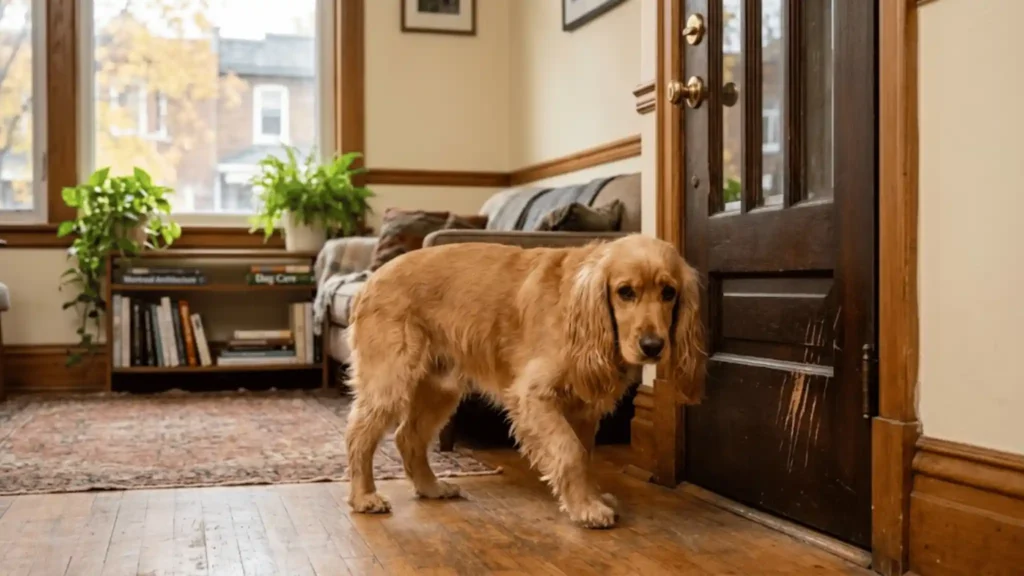
- Stands by the door or lies across the exit
While you’re away
- Barking or whining that starts within minutes of the door closing
- Destructive chewing: focused on items that carry your scent or are near exits
- Accidents despite being reliably house-trained
- Excessive self-licking or paw chewing as a self-soothing behavior
- Pacing, circling, or restless movement throughout the absence
When you return
- Intense greeting that can include jumping, spinning, and vocalizing
- Difficulty settling after you return
- Clingy behavior that continues through the evening
Damage does not establish when distress began or ended. Record the absence when necessary and share footage with your veterinarian; do not assume the rest of the day was comfortable because damage appears limited.
The 5-step Cocker Spaniel separation anxiety plan
The plan should combine assessment, suitable activity, management and comfortable separation practice. Enrichment is optional and does not make a distressing absence acceptable.
Step 1: Offer suitable activity and time to settle
Choose exercise and enrichment according to health, age and preference. Observe whether the dog is relaxed afterward rather than assuming a fixed walk duration treats anxiety. Ask your veterinarian about activity limits if needed.
Step 2: Break the departure trigger associations
By the time cocker spaniel separation anxiety is noticeable, the dog has already mapped your departure routine in detail. Keys, coat, bag, shoes: each one triggers a stress response because each one predicts what’s coming.
Practice mild departure cues while your dog stays relaxed. Reduce intensity if they trigger distress, and keep departures calm. There is no five- to seven-day deadline, and reassuring the dog is not proof of causing anxiety.
Step 3: Give them a physical and mental occupation
Introduce food enrichment while you are home and your dog is relaxed. It is optional support, not proof that separation anxiety is resolved. Follow the product’s sizing and supervision instructions. If your dog stops eating, becomes distressed, or damages the toy, stop the session and reassess. Do not extend an absence because food is available. Use your dog’s normal food where appropriate and check any peanut butter for xylitol. Reserve edible chews such as bully sticks for supervised use; do not leave them as a timed bridge through an absence.
Step 4: Add calming support to the environment
A pheromone product may be considered as an adjunct after discussion with your veterinarian. Response varies, and benefit cannot be assumed for this breed. Follow the instructions for the exact product; it does not replace a behavior plan. Background sound or a pressure wrap should also be tested individually and stopped if uncomfortable. Familiar fabric is unsuitable if your dog chews or swallows it.
Step 5: Build alone time gradually from two minutes up
You need to see what’s happening when you leave, not guess at it. A dog camera is the tool that makes this phase work. Without footage, you’re making decisions based on what you come home to, which tells you almost nothing about the timing or intensity of the anxiety.
Start with a separation your dog can handle without signs of distress, which may be only a moment out of sight. Monitor body language rather than waiting for barking to stop. If distress appears, end the attempt calmly and make the next session easier. Increase duration only after repeated relaxed sessions; do not follow a fixed schedule.
There is no reliable breed-specific recovery timetable. Track relaxed behavior at each duration and adjust the plan with your veterinarian or qualified behavior professional. Do not test a full workday before shorter absences are comfortable.
Optional tools and product considerations with Cocker Spaniel separation anxiety
Cocker Spaniels are medium-sized dogs with strong jaws and a natural chewing instinct. The toy selection matters: anything too small or too flimsy won’t hold up and won’t hold their attention.
KONG Classic: choose size and rubber strength for your dog
The current Amazon listing shows a Small two-pack, not the Medium described here. Follow the manufacturer’s guidance and supervise use. Do not recommend a size solely because the dog is a Cocker Spaniel. View KONG Classic listing on Amazon.
Bully sticks: 12 inch
The current Amazon destination lists Best Bully Sticks 12 Inch, 12 Count. These are optional chews for supervised use, not a treatment or a safe default for an unattended anxious dog. Check suitability with your veterinarian and follow the product instructions. Check price on Amazon.
Furbo Dog Camera
A camera can document behavior during necessary absences. Check the exact features and any subscription requirements. Two-way audio is optional and should be stopped if it increases distress. Check price on Amazon.
Adaptil Calm Home Diffuser
The current destination is a ThunderEase pheromone refill powered by ADAPTIL, not an Adaptil starter kit. If you already have the compatible diffuser, follow the refill instructions; otherwise this is not a verified complete setup. Benefit cannot be assumed.
Outward Hound Hide-A-Squirrel puzzle
The linked Hide-A-Squirrel is a plush squeaky toy, not a dedicated food-dispensing puzzle. Use it only according to the manufacturer’s instructions and under supervision; do not prescribe stuffing food into the plush trunk or leaving it as part of an unattended departure kit. Check price on Amazon.
Free 7-Day Dog Anxiety Starter Plan
Our free 7-Day Dog Anxiety Starter Plan is an optional planning resource. Adapt practice to your dog’s comfort and your veterinarian’s advice; its name does not promise recovery in seven days.
Use this optional planning resource at your dog’s pace. It does not guarantee recovery in seven days. Download the 7-Day Dog Anxiety Starter Plan here.
When to involve your vet or a behaviorist
Seek veterinary advice promptly for persistent distress, loss of appetite, escape attempts, self-injury or a sudden change in behavior. You do not need to wait several weeks before asking for help. Your veterinarian can assess medical causes and recommend a qualified behavior professional.
If your dog is injuring itself, cannot settle or has stopped eating, contact your veterinarian promptly. For persistent or severe distress, consult your veterinarian or a board-certified veterinary behaviorist. Prescription medication may be considered alongside behavior modification. Reconcile (fluoxetine) and Clomicalm (clomipramine) are veterinary products approved in the United States for canine separation anxiety as part of a behavior management plan. Suitability, response, side effects and monitoring depend on the individual dog. Do not start, combine or adjust medication without your veterinarian.
Cocker Spaniel separation anxiety FAQ
My Cocker Spaniel only destroys things in the first hour. Does the anxiety get better after that?
Not necessarily. Limited damage in the first hour does not prove that anxiety ended afterward. Review the full recording where possible and assess whether the dog is actually relaxed. Food or chewing does not establish that a longer absence is tolerable.
Does exercise actually make a measurable difference?
Suitable activity supports welfare, but it is not a demonstrated Cocker-specific treatment. Tiira and Lohi (2015) found an association between reported daily exercise and anxiety in a questionnaire study. It did not establish that a pre-departure walk lowers cortisol or treats separation anxiety.
Can a dog walker help with cocker spaniel separation anxiety?
A walker can help with activity and practical care, but a midday visit does not prevent distress that starts immediately after departure. Arrange company or other suitable management for periods beyond the dog’s relaxed tolerance.
My Cocker Spaniel is fine with my husband but anxious when I leave. Is that normal?
If your dog is comfortable with your husband but distressed when you leave, record the pattern and discuss possible person-specific separation distress with your veterinarian. Do not assume that this pattern differs from a Chihuahua’s solely because of breed.
How long until my Cocker Spaniel can handle a full workday alone?
There is no reliable breed-specific recovery timetable. Track relaxed behavior at each duration and adjust the plan with your veterinarian or qualified behavior professional. Do not test a full workday before shorter absences are comfortable.
Final thoughts
Cocker Spaniel separation anxiety requires an individualized assessment and support plan. Use recorded behavior to guide management and comfortable practice. Activity and supervised enrichment can support welfare, but improvement cannot be promised within a fixed number of weeks.
For a full look at which breeds are most prone to separation anxiety and what drives it in each, see our guide to dog anxiety by breed.