🐾 Does your dog panic when you leave? → Get the Free 7-Day Starter Plan

Australian Shepherd Anxiety: Signs, Causes and Real Fixes
Australian Shepherds were built to work alongside people all day. Here's why that makes separation anxiety so common - and what actually helps.

Affiliate disclosure: This article and its sidebar contain affiliate links. If you buy through these links, PetCalmZone may earn a commission at no extra cost to you.
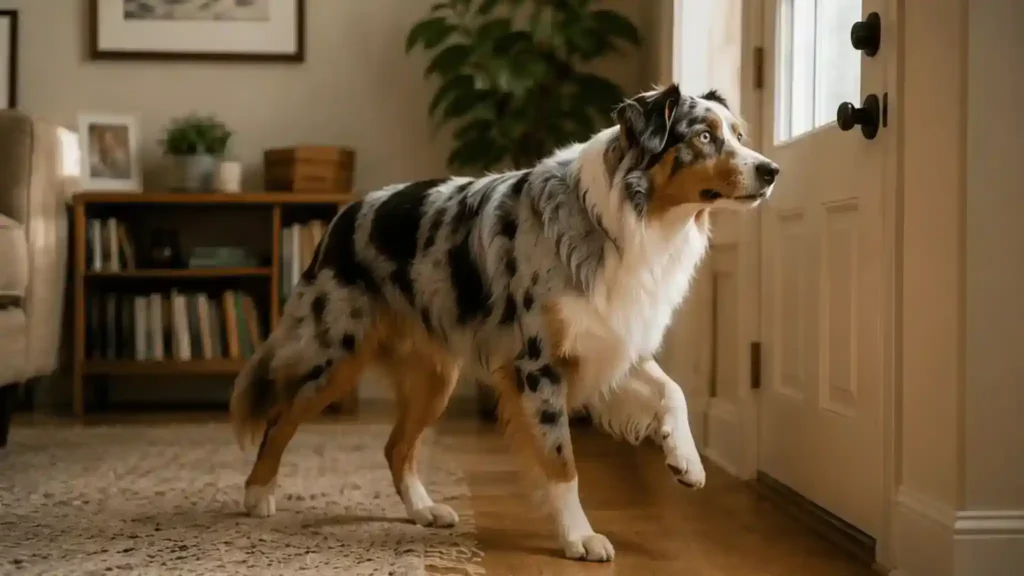
Australian Shepherd anxiety can be difficult to recognize, especially when your dog seems fine until you leave. Many Aussies follow their owners everywhere and struggle when left alone.
In this guide, you’ll learn the common signs, why separation can be difficult for Australian Shepherds, and five practical steps that can help them feel calmer and more secure.
Why Australian Shepherd Anxiety are prone to separation anxiety
Despite the name, Australian Shepherds are an American breed, developed in the western US to work cattle and sheep alongside ranchers. “Alongside” is the key word. These dogs weren’t working at a distance or independently, they were working in close coordination with a person, reading signals, responding to commands, staying in constant contact throughout the day.
That’s the job they were bred for. Centuries of selection pressure produced a dog that is highly attuned to human presence, deeply motivated by having a task, and genuinely uncomfortable when cut off from both.
Layer that on top of one of the highest energy and intelligence profiles in the dog world, and you have a breed that doesn’t just get bored when left alone, it actively struggles. A bored Aussie without an outlet tends to find one. That usually means your baseboards, your couch, or your neighbors’ ears.
Signs your Australian Shepherd has separation anxiety
The defining feature of separation anxiety is that the behavior is triggered by your absence, not by boredom in general, not by bad training, but specifically by you leaving.
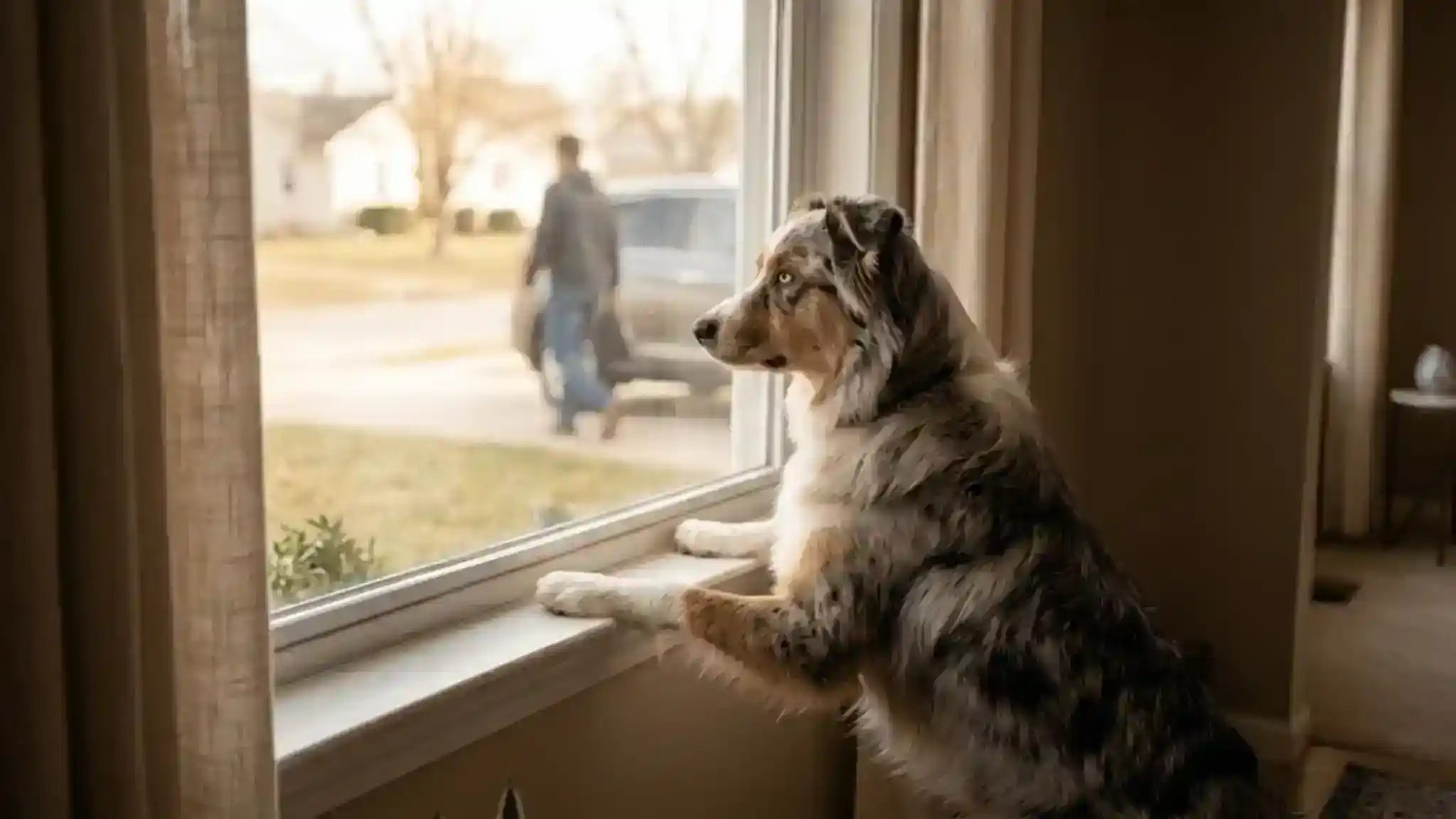
While you’re away
- Barking, howling, or whining that starts within minutes of you leaving
- Destructive chewing, usually near exits (doors, windows, gate latches)
- Scratching at doors or escape attempts
- House accidents in a fully trained dog
- Refusing to eat until you return
Before you even leave
- Shadowing you while you get ready, closer than usual, tenser than usual
- Yawning, lip-licking, or panting at departure cues (shoes, keys, bag)
- Trembling or whining before you’ve opened the door
- Refusing breakfast on workday mornings
A pet camera is worth the investment if you’re not sure what’s happening while you’re gone. Aussies can spiral fast, from calm to full panic within 10 minutes of a departure. If you see that on camera, you’re not dealing with a “difficult dog.” You’re dealing with a dog in genuine distress.
The 5-step calming plan
This isn’t a “try it once and see” plan. Australian Shepherd separation anxiety built up over time, and undoing it takes consistent, deliberate work over weeks. The steps below are ordered, skip one and the next one won’t land as well.
Step 1: Exercise first, always
An Aussie with unspent energy is an Aussie with anxiety to spare. Before any alone time, this breed needs:
- 45–60 minutes of real physical output: fetch, trail running, frisbee, or swimming
- 10–15 minutes of mental work, a training session, nose work, or agility drills
You’re not trying to tire them out completely. You’re lowering their baseline arousal enough that the alone-time transition doesn’t feel like a crisis. At 80% energy, an Aussie will pace and escalate. At 30%, they have a fighting chance of settling.
Step 2: Desensitize your departure cues
Australian Shepherds are observant to a fault. They know what your work shoes look like. They know the sound of your car keys. They’ve logged every step of your “leaving” routine and they start bracing for impact the moment you begin it.
Break that association by running the routine without leaving. Put on your jacket and watch TV. Pick up your keys and sit back down. Do this multiple times a day until your dog stops reacting. Then practice real departures: out the door for 30 seconds, back in, no drama. Extend gradually, 1 minute, 5 minutes, 20 minutes.
This is systematic desensitization, and it’s the most evidence-backed treatment for this problem. It’s also the slowest. Don’t rush it: each threshold needs to be stable before you push to the next one.
Step 3: Give them a job at departure
Aussies need a task. Use that at departure time. The goal is to occupy the anxiety window, the first 20–30 minutes after you leave, when stress peaks, with something genuinely engaging.
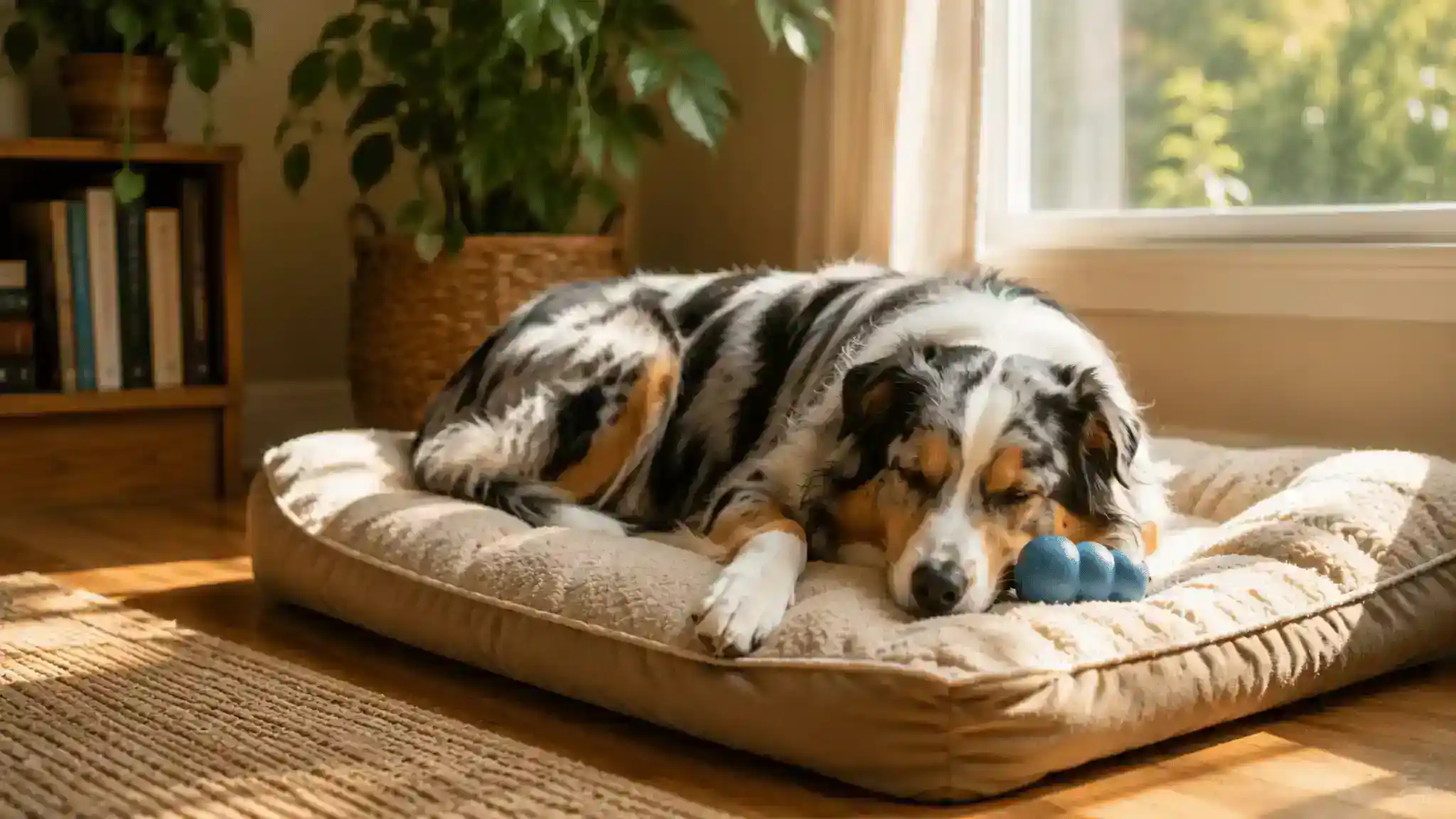
- A frozen Kong stuffed with wet food, kibble, and peanut butter (make it the night before)
- A snuffle mat with treats scattered through the fabric
- A puzzle feeder that requires active problem-solving
Only give this enrichment when you leave, never at other times. Over a few weeks, your departure starts to predict something excellent instead of something terrible. The association shift is slow but real.
Step 4: Set up the right space
Some Aussies do better with limited space during training, while others feel more trapped. Either way, a few things consistently help:
- Leave an unwashed shirt in their bed, your scent is calming in a way no spray replicates
- White noise, a fan, or a radio on low reduces alertness to outside sounds that can spike anxiety
- Block window access if your dog obsessively watches for you, “waiting at the window” isn’t settling, it’s sustaining the stress
On crates: properly introduced, they can help. Forced into one unprepared, they make everything worse. If your dog is breaking out of or injuring themselves in a crate, that’s your signal to stop using it until you’ve worked through the basics first.
Step 5: Cap solo time during training
While you’re building duration in your desensitization practice, keep real-world alone stretches as short as possible. Under 4 hours is ideal during the active training period. A midday dog walker, a trusted neighbor, or two days a week of daycare can make the difference between steady progress and hitting a wall.
This isn’t permanent. It’s the training window. Once your dog can handle 90–120 minutes reliably in practice sessions, you can start testing longer real departures.
Products that help
None of these work on their own. Used consistently alongside the plan above, they can take the edge off enough to make the training stick faster.
Calming supplements
Evidence for calming supplements in dogs is limited and varies by ingredient and formulation. Research on an ingredient does not establish that a particular chew treats separation anxiety, and effects cannot be assumed for this breed. Ask your veterinarian whether a supplement is appropriate, including possible side effects and interactions. Supplements do not replace an individualized behavior plan.
→ Zesty Paws Calming Bites on Amazon
→ Check price on Amazon
Enrichment toys
The Kong Classic stuffed and frozen is the baseline for a reason. For an Aussie that burns through it in 5 minutes, try the West Paw Toppl (larger capacity) or a lick mat for a lower-intensity option.
→ Kong Classic on Amazon
→ West Paw Toppl on Amazon
→ LickiMat Soother on Amazon
Anxiety wrap
The ThunderShirt works better for some dogs than others, results vary a lot. It’s more consistently useful for noise sensitivity and storm phobia than separation anxiety, but worth trying during the initial training phase if your dog seems to respond to pressure.
Pet camera
Being able to see what’s actually happening, when anxiety peaks, whether the Kong kept them busy, whether they eventually settled, gives you real data to work with instead of guessing. The Furbo has two-way audio, while the Wyze Cam works well at a lower price point.
→ Furbo Dog Camera on Amazon
→ Check price on Amazon
Want a day-by-day structure for the first week? our free 7-Day Dog Anxiety Starter Plan walks you through the exact routine, exercise timing, departure practice, enrichment setup, so you’re not piecing it together yourself. Get it here →
When to get professional help
Most Australian Shepherds with mild-to-moderate separation anxiety improve significantly within 4–8 weeks of consistent work. Some need more support.
Talk to your vet if your dog is injuring themselves trying to escape, has stopped eating entirely, or shows aggression when anxiety spikes. After 6–8 weeks of honest, consistent effort with no improvement, that’s also a sign to bring in a professional.
If your dog is injuring itself, cannot settle or has stopped eating, contact your veterinarian promptly. For persistent or severe distress, consult your veterinarian or a board-certified veterinary behaviorist. Prescription medication may be considered alongside behavior modification. Reconcile (fluoxetine) and Clomicalm (clomipramine) are veterinary products approved in the United States for canine separation anxiety as part of a behavior management plan. Suitability, response, side effects and monitoring depend on the individual dog. Do not start, combine or adjust medication without your veterinarian. Related resources: FDA-approved
FAQ
Can Australian Shepherds be left alone?
Yes, with training and management, but this breed has a lower baseline tolerance for solitude than most. With consistent work, many Aussies can handle 4–6 hours comfortably. Full 8–9 hour workdays are genuinely hard for this breed and usually require midday breaks even after training is complete.
Does having two Australian Shepherds help with separation anxiety?
Sometimes. If the dog’s distress is primarily about social isolation rather than specifically about your absence, a second dog can help. If the anxiety is attachment-based, triggered by being away from you specifically, a second dog often doesn’t change much. You may end up with two anxious dogs instead of one.
How long does it take to treat Australian Shepherd separation anxiety?
Mild cases: 3–6 weeks with consistent daily work. Moderate cases: 2–4 months. Severe cases: dogs that spiral within minutes or injure themselves, often need medication alongside training and can take 4–6 months or longer. Progress depends on consistency more than anything else.
Is my Australian Shepherd’s separation anxiety my fault?
Not in any meaningful sense. The breed predisposition is genetic. Some management choices, always having the dog with you, overly emotional departures and arrivals, can reinforce the problem, but they don’t cause it. The question isn’t about blame. It’s about what to change going forward.
Will my Aussie grow out of separation anxiety?
Rarely without intervention. Most dogs stay at the same level or gradually worsen as they age, especially if their anxiety has been reinforced by owner behavior (coming back when the dog panics, for example). Active training is what changes the trajectory.
Ready to Help Your Australian Shepherd Feel Calm Alone?
Australian Shepherd separation anxiety is common, manageable, and when you approach it systematically, genuinely improvable. These are smart, motivated dogs that respond well to clear, consistent training. The problem isn’t that they can’t learn. It’s that they’ve learned the wrong thing: that your absence is a catastrophe.
Your job is to teach them a different lesson. That takes time, and it takes repetition. But most owners who follow the plan above see real changes within a month.
Ready to help your Aussie feel calmer alone? Our free 7-Day Dog Anxiety Starter Plan gives you a clear routine to follow during the first week. Get it here →

