🐾 Does your dog panic when you leave? → Get the Free 7-Day Starter Plan

Border Collie Separation Anxiety: Signs and Support
Border collies feel separation anxiety hard. Here's why - and the step-by-step calming plan that actually helps your dog cope alone.


Affiliate disclosure: This article and its sidebar contain affiliate links. If you buy through these links, PetCalmZone may earn a commission at no extra cost to you.
Border Collie separation anxiety can be confused with boredom, reactions to outside stimuli or distress caused by confinement. This guide explains what to record and how to seek an individualized plan. See our guide to anxiety-prone dog breeds and dog anxiety by breed guide.
Assess separation distress separately from activity needs
Do not infer a separation-anxiety diagnosis from a herding background. Research distinguishes noise sensitivity, fearfulness and separation-related behavior; these outcomes are not interchangeable. Record whether episodes follow your departure, an outside sound, visual stimulation or confinement. Salonen et al. (2020) examined several different anxiety-related traits and does not justify the ranking stated here.
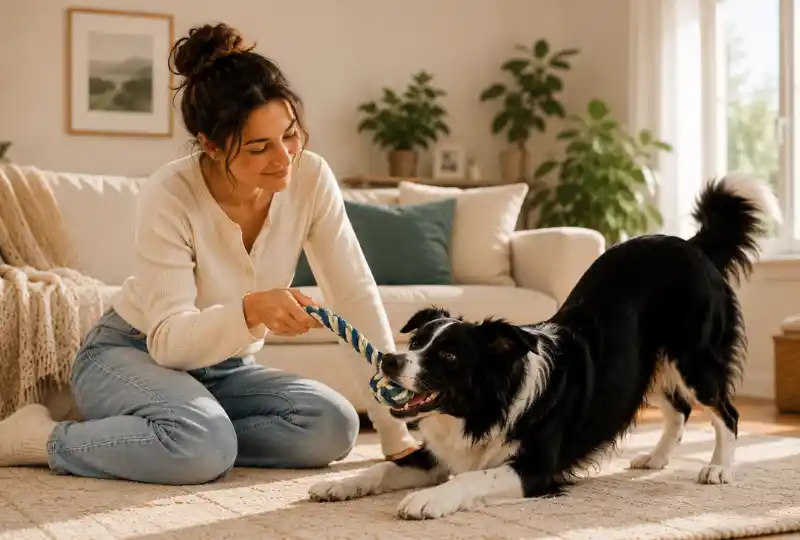
Signs your border collie has separation anxiety
Record whether pacing or barking occurs while people are home, after outside sounds, or specifically during separation. Meeting activity needs is useful welfare support, but does not rule out an anxiety disorder.
These signs can have other causes. Record the context and discuss persistent or concerning behavior with your veterinarian.
The signs can look different from dog to dog, but the common thread is that they start right after you leave, or even when they sense you’re about to leave.
Behavioral signs while you’re away
- Destructive chewing (often near exits: doors, windows, baseboards)
- Non-stop barking or howling that neighbors report
- Pacing, circling, or spinning in repeated patterns
- Attempts to escape: some border collies injure themselves on crates or fences
- House accidents even in a house-trained dog
Signs before you even leave
- Shadowing you room to room as you get ready
- Trembling, yawning, or excessive lip-licking when they see your keys
- Refusing to eat their breakfast (which they’d normally inhale)
- Whining when you pick up your bag
A camera can document when behavior starts and what triggers it. Signs soon after departure are relevant to an assessment, but a five- or ten-minute cutoff does not diagnose separation anxiety. Share recordings with your veterinarian.
The 5-step calming plan
The following steps are starting points to adapt with professional guidance. Improvement and the appropriate pace vary between dogs.
Step 1: Meet activity needs without forcing exhaustion
Offer exercise and enrichment suited to your dog’s health, age and preferences. Allow time to settle before separation practice. Do not prescribe hard running or agility before every absence, and do not treat tiredness as evidence that anxiety is resolved.
Step 2: Build a departure routine that means “no big deal”
If departure cues are upsetting, practice a milder version while your dog remains relaxed. Keep the routine calm. Begin actual separation at a duration your dog tolerates, not a preset thirty seconds.
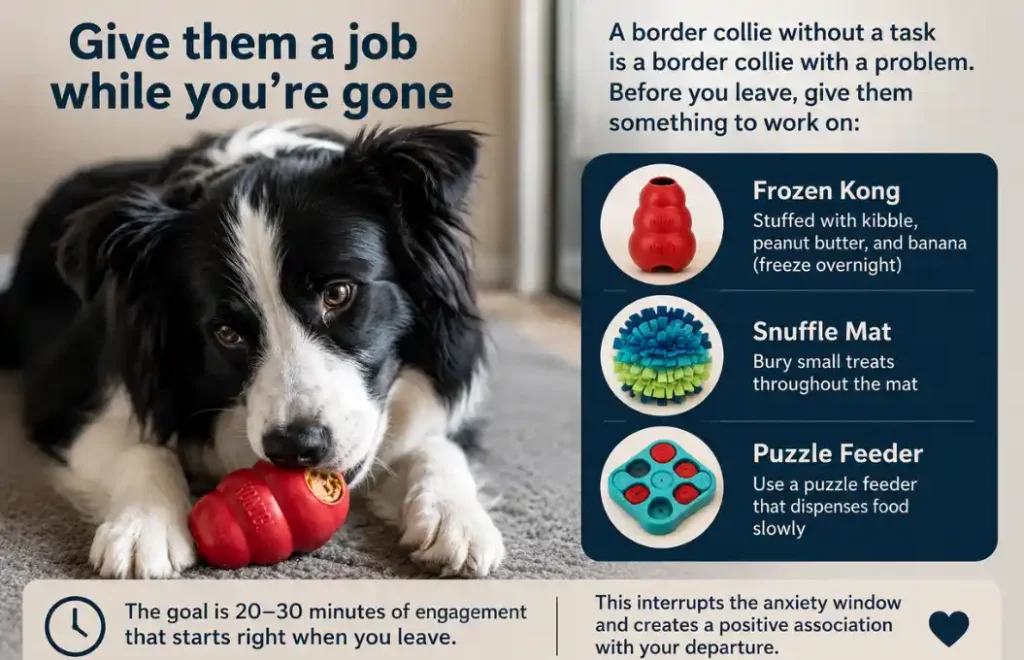
Introduce food enrichment while you are home and your dog is relaxed. It is optional support, not proof that separation anxiety is resolved. Follow the product’s sizing and supervision instructions. If your dog stops eating, becomes distressed, or damages the toy, stop the session and reassess. Do not extend an absence because food is available. If peanut butter is used, check for xylitol and follow veterinary dietary advice.
Step 4: Create a calm space
Some border collies do better with access to a whole room, while others do better in a crate. There’s no universal answer, but some principles hold:
- Use a familiar resting area. Leave fabric items only if your dog does not chew or swallow them; an owner-scented shirt is not a treatment.
- Background noise (a TV on low, a white noise machine, or a radio) can reduce hyper-vigilance to outside sounds
- Keep it away from windows if your dog obsessively watches for you
If you’re using a crate, make sure it’s been properly introduced over days or weeks before you rely on it for alone time. A dog that was shoved into a crate isn’t using it as a safe space: it’s just trapped.
Step 5: Build in a midday break
Arrange care that prevents absences longer than your dog can currently tolerate without distress. A midday walker may help with practical needs, but does not protect a dog who panics immediately after you leave. Consider trusted company and professional support.
Optional tools and product considerations
The products below are optional observation or enrichment tools. They do not replace assessment or an individualized behavior plan.
Calming chews
Evidence for calming supplements in dogs is limited and varies by ingredient and formulation. Research on an ingredient does not establish that a particular chew treats separation anxiety, and effects cannot be assumed for this breed. Ask your veterinarian whether a supplement is appropriate, including possible side effects and interactions. Supplements do not replace an individualized behavior plan.
→ Check Zesty Paws Calming Bites on Amazon
Puzzle toys and enrichment feeders
The Kong Classic (stuffed and frozen) is the standard for a reason. The West Paw Toppl is another option with more surface area. A snuffle mat works well for shorter sessions.
→ Kong Classic on Amazon
→ View West Paw Toppl on Amazon
Anxiety wraps
A pressure wrap is an optional support, not an established breed-specific treatment. Check fit and manufacturer instructions, introduce it under supervision, and stop if your dog appears uncomfortable. Being comfortable when held does not establish that a wrap will help.
→ ThunderShirt on Amazon The linked Amazon listing initially selects Large; confirm the size for your individual dog before purchase.
Dog camera with two-way audio
A camera can document behavior and help you review progress. Check current model features before buying. Stop two-way audio if your dog reacts with increased distress.
Use this optional planning resource at your dog’s pace. It does not guarantee recovery in seven days. Get the protocol here →
When to call a vet or behaviorist
Seek veterinary advice promptly for persistent distress, loss of appetite, escape attempts, self-injury or a sudden change in behavior. You do not need to wait several weeks before asking for help. Your veterinarian can assess medical causes and recommend a qualified behavior professional.
Call your vet if:
- Your dog is injuring themselves trying to escape
- They’re not eating at all during the day
- They’re showing aggression as anxiety spikes
If your dog is injuring itself, cannot settle or has stopped eating, contact your veterinarian promptly. For persistent or severe distress, consult your veterinarian or a board-certified veterinary behaviorist. Prescription medication may be considered alongside behavior modification. Reconcile (fluoxetine) and Clomicalm (clomipramine) are veterinary products approved in the United States for canine separation anxiety as part of a behavior management plan. Suitability, response, side effects and monitoring depend on the individual dog. Do not start, combine or adjust medication without your veterinarian.
FAQ
How long does it take to treat border collie separation anxiety?
There is no reliable breed-specific recovery timetable. Track relaxed behavior at each duration and adjust the plan with your veterinarian or qualified behavior professional. Do not test a full workday before shorter absences are comfortable.
Can I use a crate for a border collie with separation anxiety?
You can, but it needs careful introduction. A border collie that hasn’t been properly crate-trained will escalate in a crate rather than calm down. If your dog is hurting itself trying to get out, stop using the crate and consult a professional.
Is border collie separation anxiety the owner’s fault?
Breed background can provide context, but it does not diagnose separation anxiety or predict severity. Assess the individual dog’s health, history, behavior during absences and response to the plan. Affection and close companionship alone do not establish that an owner caused the problem.
Do border collies ever grow out of separation anxiety?
Do not rely on age alone to resolve persistent separation distress. A veterinary assessment can help identify the problem and plan support.
Are female border collies less anxious than males?
There’s no strong evidence of a sex difference in separation anxiety within the breed. Individual temperament, early socialization, and training history matter far more than sex.

Final thoughts
Border collie separation anxiety is real, it’s hard, and it’s not going to resolve itself. But it’s also one of the most trainable problems in dogs: these are dogs that were literally built to learn.
Start with an assessment of triggers and current relaxed tolerance. Adapt activity and separation practice to your dog; no improvement deadline is promised.
Use this optional planning resource at your dog’s pace. It does not guarantee recovery in seven days. Get it here →