🐾 Does your dog panic when you leave? → Get the Free 7-Day

Bichon Frise Separation Anxiety: A Calming Plan That Works

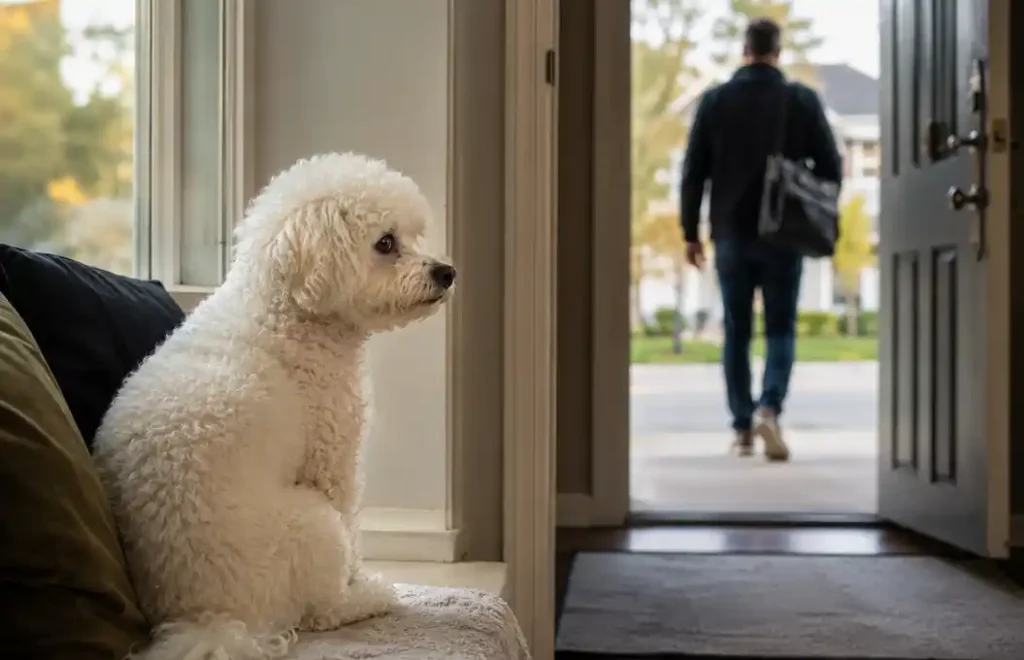
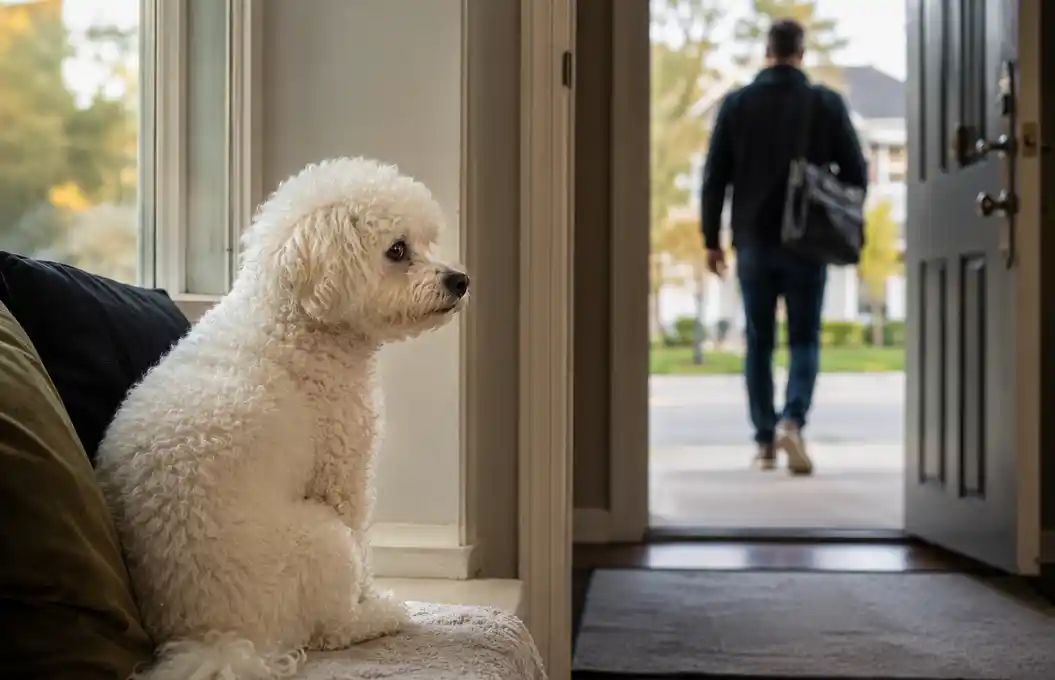
You walk to the front door and your Bichon Frise is already at your feet. You grab your keys and the whining starts. You step outside – and it’s chaos. Barking, scratching, sometimes a chewed pillow waiting when you get back.
Bichon frise separation anxiety is one of the most common calls veterinary behaviorists get about this breed. It makes sense when you know the history. Bichons were bred for centuries to be companion dogs – lap dogs for French royalty who rarely left their pets behind. Your dog isn’t being dramatic. He’s doing exactly what hundreds of years of selective breeding trained him to do.
That doesn’t mean you’re stuck with the barking. Here’s what’s actually happening in your dog’s brain, the warning signs owners miss, and a 5-step plan built for the Bichon’s specific personality.
Why Bichon Frises Struggle With Being Alone
Most dogs can adapt to moderate alone time. Bichon Frises have a harder time than most – and it’s not a training failure on your part. It’s biology.
The Bichon Frise was developed as a companion breed, not a working dog. Unlike a Border Collie that needs a job or an Australian Shepherd that needs to run, a Bichon’s entire purpose was to be present with people. Their emotional regulation system is closely tied to human contact in a way other breeds simply aren’t.
Three things make bichon frise separation anxiety worse than average:
- The velcro habit. Bichons follow their people from room to room. Owners let it happen because it seems sweet. Over time the dog never learns to self-soothe – because there’s never been a reason to.
- Apartment living. Many Bichons live in apartments or small homes. When the door closes, the silence is total. No yard sounds, no passing animals – just nothing.
- Owner coddling. Because Bichons are small and cute, owners carry them everywhere, let them sleep in the bed every night, and rarely leave them alone even briefly. The dog’s tolerance for solitude stays at zero.
None of this is your fault. It’s just how this breed works – and how most people naturally treat them.
Signs of Bichon Frise Separation Anxiety
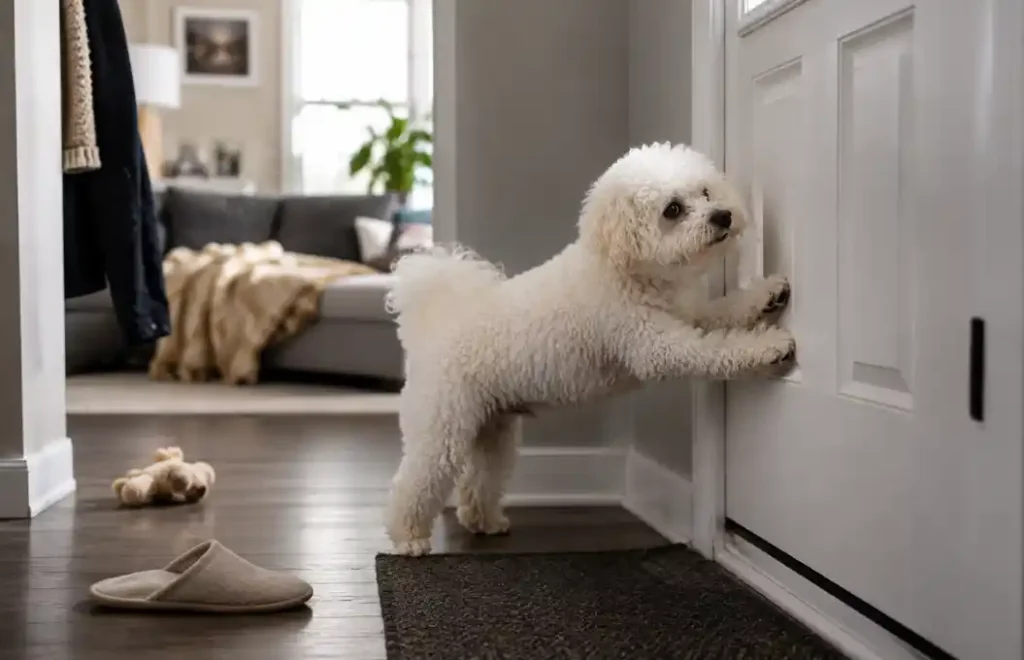
Some of these you’ll see before you leave. Some you’ll only find out about from the neighbor complaint or the damage you come home to.
Before you leave
- Follows you from room to room more than usual
- Gets restless the moment you pick up your keys or bag
- Paws at you, whines, or jumps repeatedly while you’re getting ready
- Won’t eat breakfast if you’re about to leave
While you’re gone
- Barking or howling that starts within minutes (neighbors will tell you)
- Scratching at doors or windows
- Chewing furniture, shoes, or anything near the exit
- Pacing or circling
- Urinating or defecating indoors despite being house-trained
When you get home
- Frantic greeting that lasts longer than 5 minutes
- Panting, pacing, or trembling even after you’ve returned
- Excessive licking or clinging for the rest of the evening
One sign that trips people up: Bichons with separation anxiety often seem completely fine once you’re home. The distress is real – it just shuts off when the trigger (your absence) is resolved. That can make owners underestimate how bad things get while they’re away. A dog camera is genuinely useful here.
The 5-Step Bichon Frise Separation Anxiety Plan
This isn’t about punishing the behavior or flooding your dog with alone time to “toughen him up.” Both approaches backfire with Bichons. What works is a slow, structured desensitization – giving your dog evidence, over and over, that being alone is safe.
Step 1 – Break the velcro habit before you leave
This is the step most owners skip, and it’s why the other steps don’t work as well as they could.
While you’re home, start requiring your Bichon to spend time in another room. Five minutes at first, then ten. Use a baby gate so he can see you but can’t reach you. Give him something good to chew while you’re separated. Ignore the whining – wait for quiet, then reward it.
If your dog can’t be calm when you’re 15 feet away in the kitchen, he won’t be calm when you’re 15 miles away at work. This step is not optional.
Step 2 – Build a departure routine that signals safety
Right now, your departure cues – keys jingling, putting on shoes, picking up your bag – are stress triggers. Your dog has learned that these sounds mean panic time.
Desensitize them one at a time. Pick up your keys and sit back down. Put on your shoes and watch TV for ten minutes. Open the front door and close it without leaving. Do this multiple times a day until none of these actions cause your dog to react.
Then build a real departure routine: keys go on, treat goes in the Kong, you leave quietly without drama. No long goodbyes. No “it’s okay, mama loves you.” The calmer your exit, the calmer your dog stays.
Step 3 – Give them something better to do than panic
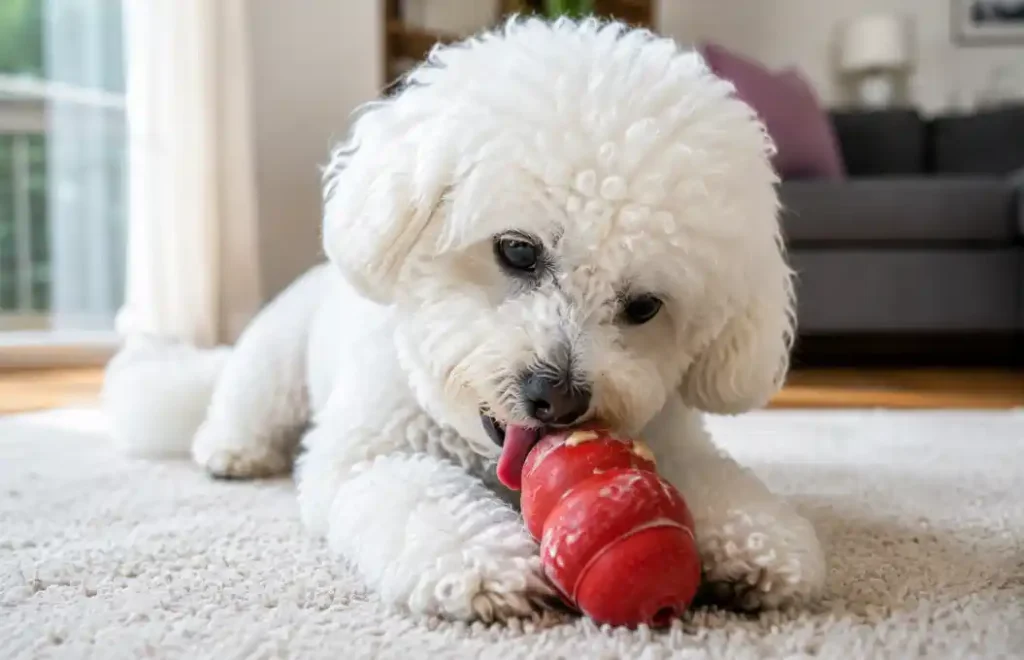
A dog that’s actively working on a frozen KONG is a dog that’s not spiraling. The math is that simple.
The key word is frozen. A regular KONG lasts three minutes. A frozen one – stuffed the night before and put in the freezer – lasts 20 to 30 minutes. That’s the window when bichon frise separation anxiety is at its worst: right after you leave.
Use high-value fillings: peanut butter mixed with banana, cream cheese with kibble, or shredded cooked chicken. Only give the frozen KONG when you’re leaving so it stays special. After a week or two, your dog may start looking forward to your departure.
Rotate in snuffle mats and puzzle feeders to keep things interesting. Bichons aren’t driven by physical exercise the way working breeds are, but they need mental engagement to stay calm.
Step 4 – Add calming support – but use it right
Calming aids work best when combined with the training steps, not instead of them. On their own they take the edge off. Paired with a structured plan they make the whole process faster.
Three things worth trying for bichon frise anxiety specifically:
- Adaptil diffuser or collar. Synthetic dog-appeasing pheromone that mimics what nursing mothers produce. Research supports modest reductions in anxiety scores. Works well for Bichons because it’s passive – no getting them to take something.
- Calming music designed for dogs. Specifically classical music or tracks at 50-60 BPM. Leaving the TV on can backfire – sudden loud noises from commercials spike anxiety. Dog-specific calming music playlists are a better option.
- A worn clothing item. An old T-shirt you’ve slept in, left in the dog’s bed. Your scent is genuinely calming to a dog bonded to you. Free, and it works.
Step 5 – Increase alone time gradually using data
This is where a dog camera earns its price. You need to know what actually happens when you leave – not what you imagine, not what the neighbors say. What you can see on video.
Start with absences of two minutes. Watch the footage. If your dog settled within 90 seconds, try five minutes next time. If he didn’t settle, stay at two minutes for another week before pushing forward.
Never increase absence length if the dog didn’t succeed at the previous duration. The whole point is to build a track record of calm, not push through panic and hope for improvement.
Progress for a Bichon with moderate separation anxiety typically looks like this: two to three weeks of two-to-five-minute absences, then a gradual push to 30 minutes over the following two weeks. Getting to two hours of calm may take six to eight weeks of consistent daily work.
Products That Help With Bichon Frise Separation Anxiety
These are the tools that show up most often in the toolkit of owners who actually made progress. No gimmicks – just things with a track record for anxious small dogs.
KONG Classic – Small or Medium
The stuffable food toy that’s been around for decades for a reason. Freeze it the night before. A Bichon-sized dog does well with the small or medium Classic. Check price on Amazon | Check price on Chewy
Adaptil Calm Home Diffuser
Plugs in like an air freshener. Releases synthetic calming pheromone continuously for 30 days per refill. Works best in the room where your dog spends most of his time while you’re gone. Check price on Amazon | Check price on Chewy
Furbo Dog Camera
Two-way audio and video. Sends alerts when it detects barking. Lets you watch and talk to your dog from your phone. Essential for the gradual exposure phase – you can’t build a training program without knowing what’s actually happening while you’re away. Check price on Amazon
Snuggle Puppy Behavioral Aid
A stuffed toy with a simulated heartbeat and heat pack. Works surprisingly well for Bichons who cling because they want warmth and physical contact. Designed for puppies but adult anxious dogs respond to it too. Check price on Amazon | Check price on Chewy
Nina Ottosson Dog Puzzle – Level 2
Mental stimulation that buys you 15-20 minutes of calm focus. Rotate between two or three different puzzles to keep it unpredictable. Bichons are smart enough to get bored fast – variety matters. Check price on Amazon
The 7-Day Calm Dog Protocol
If you want a day-by-day framework that takes all the guesswork out of this, the 7-Day Calm Dog Protocol is what we built for exactly this situation.
It walks you through the desensitization steps in order, tells you exactly what to practice each day, when to advance, and when to hold. It includes a KONG recipe guide, a daily tracking sheet, and a checklist your dog has to pass before moving to the next stage.
No guessing. No wasted weeks. Just a clear daily plan for a calmer Bichon. Download the 7-Day Calm Dog Protocol here.
When to Call Your Vet or a Behaviorist
The plan above works for mild to moderate bichon frise separation anxiety. If your dog is hurting himself trying to escape – broken nails, bloody paws from door scratching, injuries from throwing himself at windows – you need professional help, not just training tips.
Your vet can prescribe medications that reduce baseline anxiety enough for training to get traction. The most common option is fluoxetine, which typically takes four to six weeks to reach full effect. It’s not a fix on its own – it’s a tool that lowers the starting level of panic so the desensitization work can actually land.
A veterinary behaviorist is worth the cost if you’ve been consistent with training for eight weeks and seen no improvement. They can observe, diagnose, and build a protocol specific to your dog’s exact triggers.
Bichon Frise Separation Anxiety FAQ
How long does it take to fix bichon frise separation anxiety?
Mild cases improve in three to four weeks of daily work. Moderate anxiety – where the dog is barking for 20 or more minutes – typically takes six to ten weeks. Severe cases where the dog injures himself may require medication plus three to six months of structured desensitization.
Does getting a second dog help with bichon frise anxiety?
Sometimes – but less often than people expect. A dog with true separation anxiety is anxious about the absence of a specific person. A second dog doesn’t replace that. It may reduce barking slightly because they have company, but the underlying anxiety usually stays. Solve the anxiety first, then consider a second pet if you want one.
Should I crate my Bichon?
Only if your dog was already comfortable in the crate before the anxiety started. Crating a Bichon who dislikes the crate and already has separation anxiety makes both problems worse simultaneously. If the crate causes stress on its own, skip it and use a baby-gated room instead.
Are Bichon Frises worse for separation anxiety than other small breeds?
They’re in the higher-risk group, along with Toy Poodles, Chihuahuas, and Cocker Spaniels. The common thread is that all of these breeds were developed as close companion dogs. It doesn’t mean they can’t learn independence – it means you have to teach it intentionally, which most owners don’t know to do.
My Bichon only acts anxious on weekday mornings. Why?
Dogs read patterns fast. If you leave at 8 AM Monday through Friday and stay home on weekends, your dog tracks that. The routine itself becomes the trigger. Mixing up your departure times – even on weekends, leaving for five minutes occasionally – helps break the pattern.
Final Thoughts
Bichon frise separation anxiety looks like stubbornness or manipulation from the outside. It’s neither. It’s a dog doing exactly what his genetics and his history with you trained him to do – stay close to his person at all costs.
The good news is that Bichons are smart and people-oriented, which means they respond well to clear, consistent training. The five steps above – breaking the velcro habit, desensitizing departure cues, freezing that KONG, adding calming support, and building alone time slowly – give you a real path forward.
It takes a few weeks. It takes consistency. But it works.
For more on how breed affects anxiety levels and what that means for your training approach, see our full guide to dog anxiety by breed.
