🐾 Does your dog panic when you leave? → Get the Free 7-Day

Toy Poodle Separation Anxiety: The Calming Plan That Works

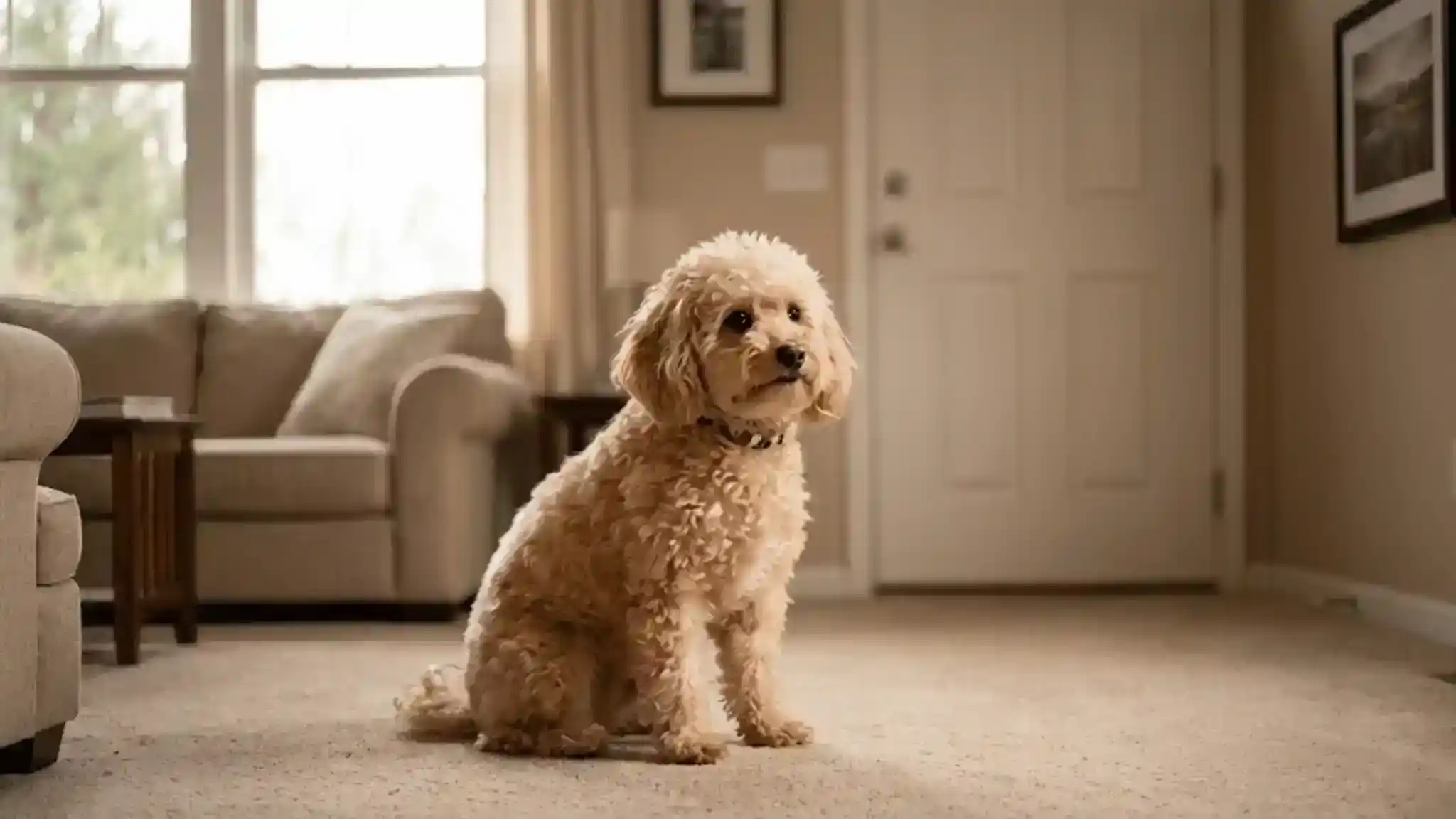
Your Toy Poodle knows you’re leaving before you do. The moment you reach for your keys – or sometimes just look at your shoes – the pacing starts. By the time you’re out the door, so is the barking. You come home to a dog that acts like you were gone for a week.
Toy poodle separation anxiety isn’t a quirk. It’s a direct result of what this breed was built to do. Poodles rank second on Stanley Coren’s intelligence scale – just behind the Border Collie. That brain is constantly reading the room, tracking routines, and logging patterns. When you leave, it has nothing to do with that intelligence except spiral.
Here’s what’s actually driving the behavior, the signs to watch for, and a 5-step plan that uses the Toy Poodle’s intelligence as an advantage rather than fighting it.
Why Toy Poodles struggle so much with being left alone
Intelligence and anxiety are linked in Toy Poodles in a way that surprises a lot of owners. Most people expect a smart dog to handle alone time better. It’s often the opposite.
Toy Poodles were bred down from Standard Poodles, originally water retrievers that worked closely with humans all day. The Toy variety was refined specifically as a companion dog for French aristocracy – a dog whose entire existence centered on being close to a person. That mix of high intelligence and deep social bonding creates a dog that reads human behavior with uncanny accuracy and feels its absence with equal intensity.
The intelligence piece matters. A Toy Poodle can figure out your departure routine in about three repetitions. After a week of the same morning pattern, the anxiety often starts not when you leave – but when you wake up. They see the sequence coming and begin bracing for it before you’ve even had coffee. That pre-departure distress is one of the things that separates toy poodle separation anxiety from what you see in less perceptive breeds.
There’s also the sensitivity factor. Toy Poodles attune themselves closely to their owner’s emotional state. If you feel anxious about leaving – guilty, rushed, apologetic – they pick that up and treat it as confirmation that something is wrong. The goodbye ritual that feels kind to you often makes the anxiety worse.
Signs of Toy Poodle separation anxiety
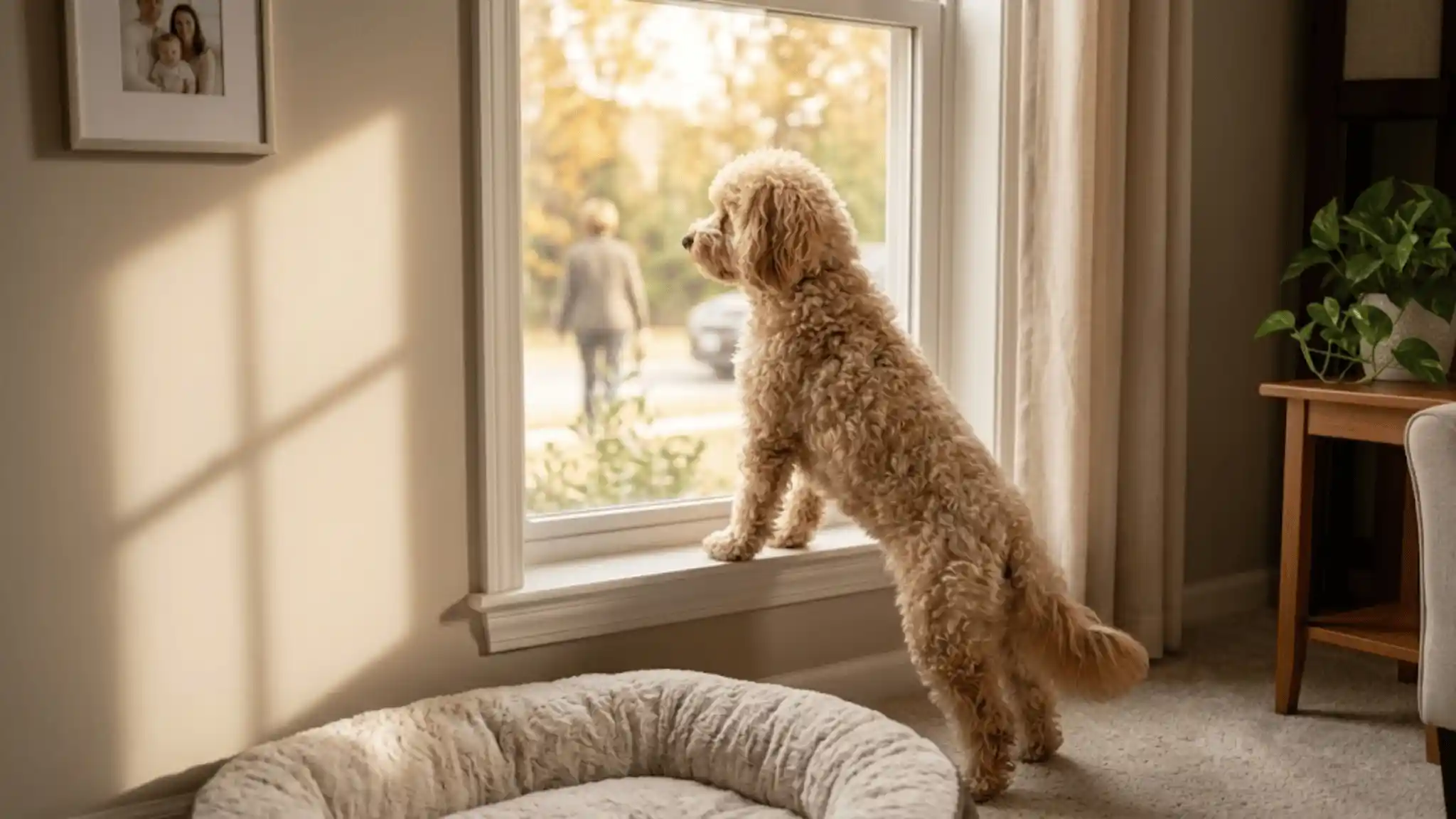
Some of these happen before you leave, some while you’re gone, and some only show up in patterns over time.
The pre-departure phase
- Follows you into every room, even the bathroom
- Shows visible distress when you pick up keys, put on shoes, or open a specific closet
- Refuses food in the morning if you’re leaving soon
- Trembles, pants, or yawns excessively before you’ve left
- Jumps and barks at the door when you put on your coat
While you’re away
- Barking or howling within the first few minutes (apartment neighbors are usually the first to report this)
- Destructive behavior focused near exits – chewed door frames, scratched floors by the front door
- Accidents despite being fully house-trained
- Pacing, circling, or repetitive movement
- Vomiting in severe cases from sustained stress
When you return
- Frantic, prolonged greeting that takes many minutes to wind down
- Jumping, mouthing, or inability to settle even after you’ve been home for 20 minutes
- Trembling or exaggerated panting that continues well after your return
One thing Toy Poodle owners often miss: the dog can seem completely calm in the evenings and on weekends. That makes owners think the problem is improving when nothing has changed. A camera during absences is the only reliable way to know what’s actually happening.
The 5-step Toy Poodle separation anxiety plan
With most breeds, you can start the desensitization steps in any order. With Toy Poodles, the sequence matters. Their intelligence means departure cues become triggers faster, so those need to be neutralized before anything else will work.
Step 1 – Scramble your departure cues first
This is the step that’s most specific to intelligent breeds, and most owners skip it entirely.
Your Toy Poodle has already mapped your morning routine to the minute. Keys mean leaving. Shoes mean leaving. Even the specific order you check your pockets in might mean leaving. Every one of those cues carries emotional weight right now.
Scramble them. Pick up your keys and then sit down and watch TV. Put on your shoes and make breakfast. Open the front door, get the mail, come back in. Do this dozens of times over the course of a week – not to trick your dog, but to break the prediction. Once these actions stop reliably predicting your departure, the pre-departure anxiety shrinks on its own.
This step alone sometimes produces visible improvement within four or five days with a Toy Poodle, because the brain that was running anxiety algorithms about your departure cues has nothing reliable to compute anymore.
Step 2 – Build real independence while you’re still home
A Toy Poodle that cannot be in a different room from you without distress is not ready to be in a different building from you without distress. The math doesn’t work any other way.
Start with short separations at home. Baby gate across the kitchen. Five minutes of being out of sight. Work up to 15, then 30. Give the dog something good to chew on the other side and ignore the complaining until there’s a pause – then calmly return. You’re not being cruel. You’re teaching a skill the dog genuinely needs.
Most Toy Poodles take to this faster than people expect once they understand the structure. They’re problem-solvers. When they figure out that calm behavior is what gets you to return, many of them make the connection quickly.
Step 3 – Tire the brain before you leave
A Toy Poodle has a brain that needs a job. When you leave and the brain has nothing to process, it starts processing the fact that you’re gone. Give it something else to work on first.
Ten minutes of training before a departure is worth more than a 20-minute walk. Put your dog through a short obedience session: sit, down, place, stay. Keep it brisk and varied. Then immediately pivot to a stuffed, frozen KONG or a puzzle feeder as you leave. The dog that’s been mentally activated and then given a task is in a completely different headspace than the dog you walked and then left.
Freeze the KONG the night before – peanut butter, banana, and a bit of kibble packed in and frozen solid. A frozen one lasts long enough to bridge that critical first 20 minutes after departure, which is when toy poodle separation anxiety peaks.
Step 4 – Add calming support in the environment
Environmental tools work best when the training is already in motion, not as a substitute for it. But they make a real difference in how quickly a Toy Poodle settles.
An Adaptil diffuser in the room where your dog spends most of the day is a reasonable first add – it releases synthetic dog-appeasing pheromone continuously, and the research on it is modest but consistent. Leave classical music or a dog-specific calming playlist running rather than the TV; sudden volume changes from commercials can spike anxiety in a dog that was starting to settle. And if your dog has a crate they actually like, a worn T-shirt of yours in there adds your scent without requiring anything special.
One thing that often helps Toy Poodles specifically: a consistent “place” command, where the dog has one spot – a bed, a mat – they’re trained to go to and stay. A dog that has a known, practiced location to go to when stressed has something concrete to do with the anxiety rather than pacing.
Step 5 – Build alone time from two minutes up, with footage
You need a camera. Without one, you’re making decisions based on guesses. A dog that’s quiet when you return could have been barking for 45 minutes and then given up. That’s not improvement – that’s exhaustion.
Start at two minutes. Watch the footage before deciding to advance. If your dog was calm within 90 seconds, try four minutes next time. If not, stay at two minutes and work steps 1 through 3 harder before pushing the duration.
With Toy Poodles, this phase often moves faster than with other breeds once the departure-cue work is done. A dog that spent two weeks in pre-departure panic can sometimes progress from two minutes to 30 minutes of calm within three weeks once they stop predicting your departure and start having a good experience with short absences. Progress is real – but it has to be built, not assumed.
Products that help with Toy Poodle separation anxiety
These are the tools worth keeping in your rotation. Toy Poodles need mental challenge more than most breeds – straight treat dispensers go stale fast, so variety matters here.
KONG Classic – Small
The small size is right for a Toy Poodle. Stuff and freeze the night before. This is the single most effective bridge tool for the departure window. Check price on Amazon | Check price on Chewy
Nina Ottosson Dog Tornado – Level 3
A puzzle that genuinely challenges a smart dog. Toy Poodles solve the easier levels in under two minutes – go straight to level 3 or higher. Rotate two or three puzzles to keep it from becoming routine. Check price on Amazon
Furbo Dog Camera
Non-negotiable for the gradual exposure phase. Two-way audio and video, barking alerts, and a treat-toss feature. You can’t calibrate your training without knowing what actually happens when you leave. Check price on Amazon
Adaptil Calm Home Diffuser
Plug-in pheromone diffuser, good for 30 days per refill. Works best in the room your dog spends most time in when alone. Won’t solve the anxiety on its own but takes the edge off during the training period. Check price on Amazon | Check price on Chewy
Snuffle mat
Scatter kibble in the mat and leave it for your dog before you go. Nose work is mentally tiring in a way that toys aren’t – it activates the scent-processing parts of the brain that tend to settle a dog down. Any snuffle mat works; look for one with enough density to be a real challenge. Check price on Amazon | Check price on Chewy
The 7-Day Calm Dog Protocol
If you want a structured day-by-day framework instead of figuring out the sequencing yourself, the 7-Day Calm Dog Protocol is built for exactly this. It covers the departure-cue desensitization, the independence training, and the gradual exposure phase in order, with daily practice checklists and a pass/fail gate before each stage advance.
It also includes a KONG recipe sheet and a progress tracker. Toy Poodles do especially well with structured plans because the routine itself becomes calming. Download the 7-Day Calm Dog Protocol here.
When to involve your vet or a behaviorist
Mild to moderate toy poodle separation anxiety responds well to the training approach above. If your dog is injuring himself – cracked nails from scratching, bloody paws, damage from attempting to break through doors or windows – that level of distress needs professional support before training will be effective.
Fluoxetine is the most commonly prescribed medication for canine separation anxiety, and it works reasonably well for Toy Poodles when the dose is right – typically taking four to six weeks to reach full effect. It lowers the baseline panic level enough that the desensitization work can actually get traction. Your regular vet can prescribe it; a veterinary behaviorist can fine-tune the protocol if things aren’t progressing.
Medication is not a shortcut – it’s a lower floor, not a ceiling. Training still has to happen alongside it.
Toy Poodle separation anxiety FAQ
Is toy poodle separation anxiety harder to treat than in other breeds?
Not harder – different. The departure-cue sensitivity means you have to do more upfront work on scrambling those signals before the gradual exposure phase will work. But Toy Poodles also learn the new patterns faster than most breeds once you’re consistent. The timeline is usually six to ten weeks for moderate cases.
My Toy Poodle is fine with my partner but panics when I leave. Why?
Toy Poodles often bond most intensely with one person. If you’re that person, your departure is the trigger – not the absence of all humans. A second person in the home helps somewhat, but won’t fully resolve the anxiety unless you specifically work on your own departure through the desensitization steps.
Can I use doggy daycare as a solution?
Doggy daycare is a management tool, not a treatment. It prevents the anxiety from happening on days your dog attends, but it doesn’t build the tolerance for alone time. If you rely on it long-term without doing the desensitization work, the anxiety will be just as bad on the days daycare isn’t available. Use daycare to give yourself a break during training – not as the plan itself.
How much exercise does a Toy Poodle need before being left alone?
Physical exercise matters less than mental exercise for this breed. A 30-minute walk before you leave is less effective than 10 minutes of training followed by a frozen KONG. Tire the brain first – the body follows.
My Toy Poodle started having separation anxiety after we moved. Is that normal?
Very common. Toy Poodles use environmental cues and routines as anchors. A move disrupts all of them at once. The anxiety is partly about the change in home and partly about the disrupted patterns. Start the departure-cue desensitization from scratch in the new place – the old patterns don’t transfer reliably.
Final thoughts
Toy poodle separation anxiety is frustrating precisely because of how perceptive these dogs are. A breed that reads your body language better than most humans also reads every sign that you’re leaving and treats it as a countdown to distress. That intelligence feels like it should make things easier. It usually makes the anxiety start sooner and run deeper.
But the same intelligence that creates the problem also responds well to a clear, consistent training plan. Scramble the departure cues. Build independence at home first. Tire the brain before you go. Add calming support. Build alone time from two minutes up, using footage to guide your decisions. These steps work with the Toy Poodle’s wiring rather than against it.
Six to eight weeks of consistent work changes most cases significantly. Some dogs take longer. But a Toy Poodle that currently can’t handle five minutes alone can, with enough structure, learn to handle two hours calmly. It happens.
For a full breakdown of which breeds are most prone to separation anxiety and why, see our guide to dog anxiety by breed.
