🐾 Does your dog panic when you leave? → Get the Free 7-Day

Vizsla Separation Anxiety: Why They Struggle and How to Help
Vizslas are called velcro dogs for a reason. Here's what's behind their separation anxiety — and a realistic plan to help your dog cope when you're not there.

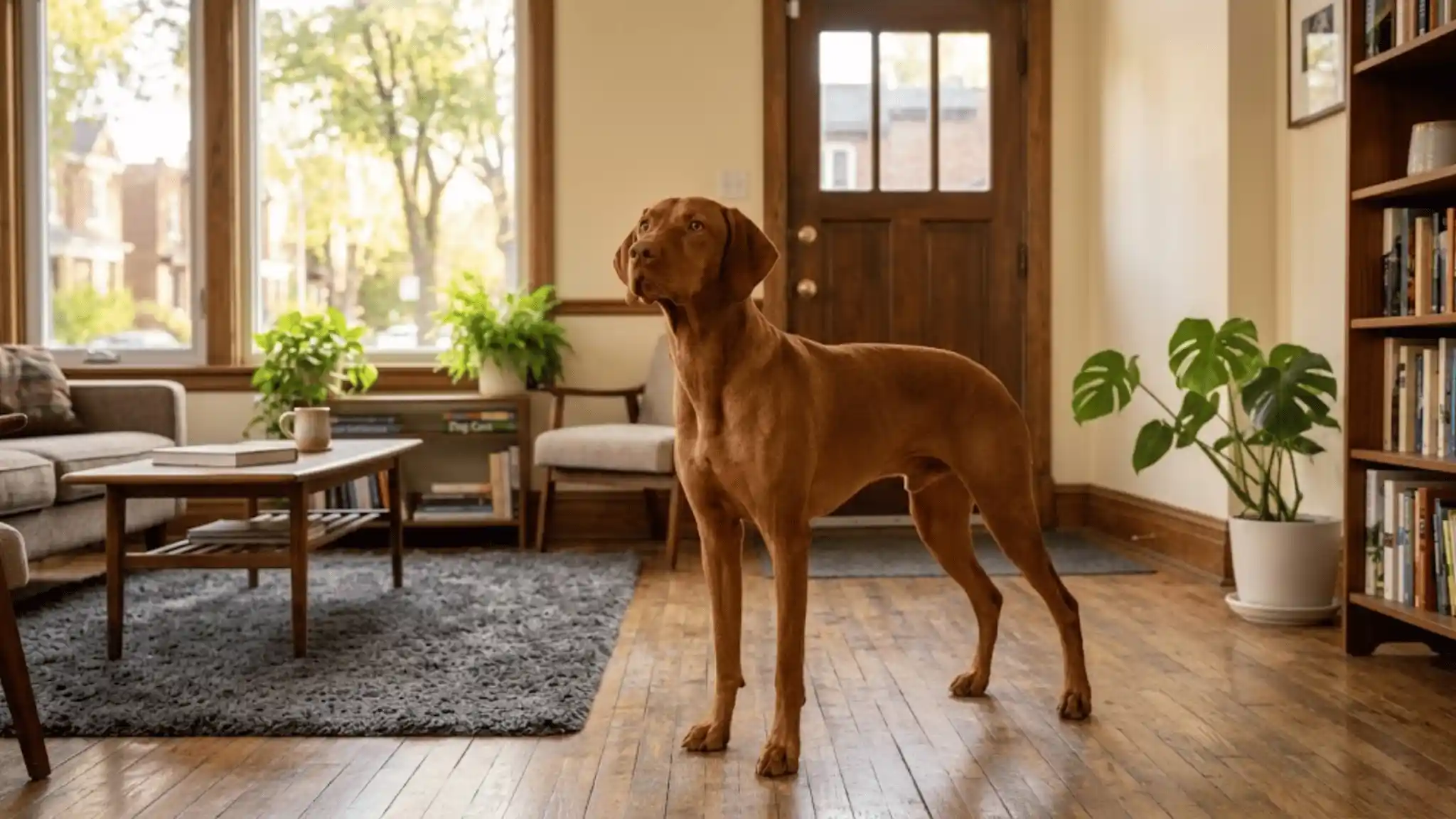
If you own a Vizsla, you already know they don’t do “independent.” They follow you to the bathroom. They sleep pressed against you. They watch the door like a hawk the moment you grab your keys. Vizsla separation anxiety isn’t a training failure – it’s what happens when a dog bred for constant human contact gets left alone in a quiet house.
This guide explains why Vizslas hit so hard with this problem, what it looks like in real life, and what actually helps. No generic advice. No “just ignore them when you leave.” Real steps that work for this specific breed.
Why Vizslas are wired for separation anxiety
The Vizsla is a Hungarian hunting breed that spent centuries working alongside a single hunter all day. Not in a pack. Not at a distance. Right next to one person, reading their body language, responding to their movements, staying in constant contact. That’s what the breed was selected for.
The result is a dog that forms unusually intense bonds with their person. “Velcro dog” is the nickname the breed community uses – and it fits. Vizslas don’t just like being near you. They need it in a way most breeds don’t.
Layer on top of that a sensitive nervous system and a very high energy requirement, and you have a dog that struggles with alone time on multiple fronts. They miss you, they have nowhere to put their energy, and they don’t have the emotional regulation to just wait it out quietly.
Research consistently ranks Vizslas among the breeds most likely to develop separation-related behaviors. A 2020 study in Scientific Reports found that attachment style and breed were significant predictors of separation distress – Vizslas and similar velcro breeds scored high on both.
Signs your Vizsla has separation anxiety
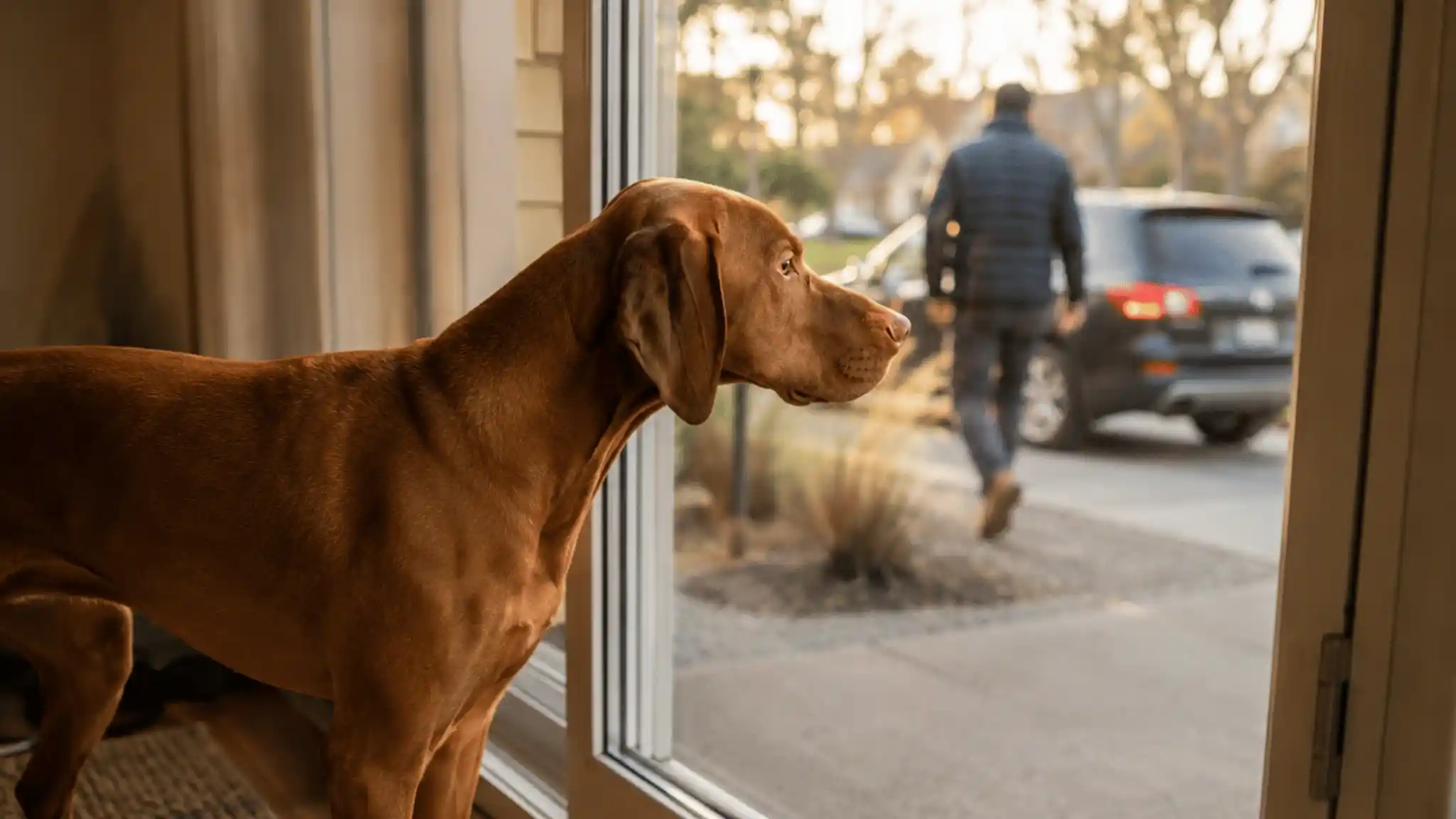
Vizsla separation anxiety doesn’t always look the same. Some dogs destroy. Some vocalize. Some just shut down and don’t eat. What they have in common is that the behavior starts when you leave – or when they sense you’re about to.
What you might see while you’re away
- Howling or barking that starts within minutes of you leaving and doesn’t stop
- Chewing through furniture, baseboards, or anything near the door
- Scratching at exits – some Vizslas damage their paws or nails trying to get out
- House accidents despite being fully trained
- Refusing to touch food or water until you return
- Frantic, over-the-top greeting when you walk back in (more than normal excitement)
Pre-departure signals to watch for
- Gluing themselves to you as you get ready in the morning
- Trembling or panting when they hear your alarm or see you put on shoes
- Yawning, lip-licking, or drooling – all signs of stress, not tiredness
- Whining or pacing before you’ve even picked up your bag
A pet camera is worth it if you’re not sure. Vizslas can go from fine-looking to full panic within 10 minutes of a departure. If you see that on camera, you’re not dealing with normal settling – you’re dealing with separation anxiety.
The calming plan: what actually works for Vizslas
Vizslas are smart and trainable. That’s the good news. The less good news: they’re also perceptive enough to see through half-measures. Leaving the TV on isn’t going to cut it. Here’s what does.
Step 1: Take the edge off before you leave
A tired Vizsla is a calmer Vizsla. This breed needs real exercise – not a 15-minute walk. Before any alone time, aim for:
- 45–60 minutes of hard running, fetch, or swimming if accessible
- A short training session (10 minutes) to burn mental energy – Vizslas respond well to nose work, recall drills, or heel work
The goal isn’t to wear them out so they sleep. It’s to lower their baseline arousal enough that the transition to alone time doesn’t feel like a crisis. A Vizsla at 80% of their energy capacity will struggle. One at 30% has a fighting chance.
Step 2: Desensitize your departure cues
Vizslas read you like a book. They know what your alarm sound means. They know the difference between “going to the mailbox” shoes and “gone all day” shoes. That predictive ability works against you when every departure cue triggers anxiety before you’ve even opened the door.
Fix this by decoupling the cues from the actual leaving. Put on your jacket and sit down. Pick up your keys and watch TV for 20 minutes. Do your full “leaving routine” several times a day and go nowhere. Repeat until your dog stops reacting.
Then work up to actual departures: out the door for 30 seconds, back in, no drama. One minute. Five minutes. You’re teaching your dog that departures predict a return, not abandonment. This is the slow part. Skip it and nothing else works properly.
Step 3: Give them something to do when you walk out
Vizslas do better with a task at departure time. The idea is to occupy the anxiety window – the first 20–30 minutes after you leave, when stress peaks – with something engaging enough to compete with the panic.
- A frozen Kong stuffed with wet food, kibble, and a smear of peanut butter (freeze the night before)
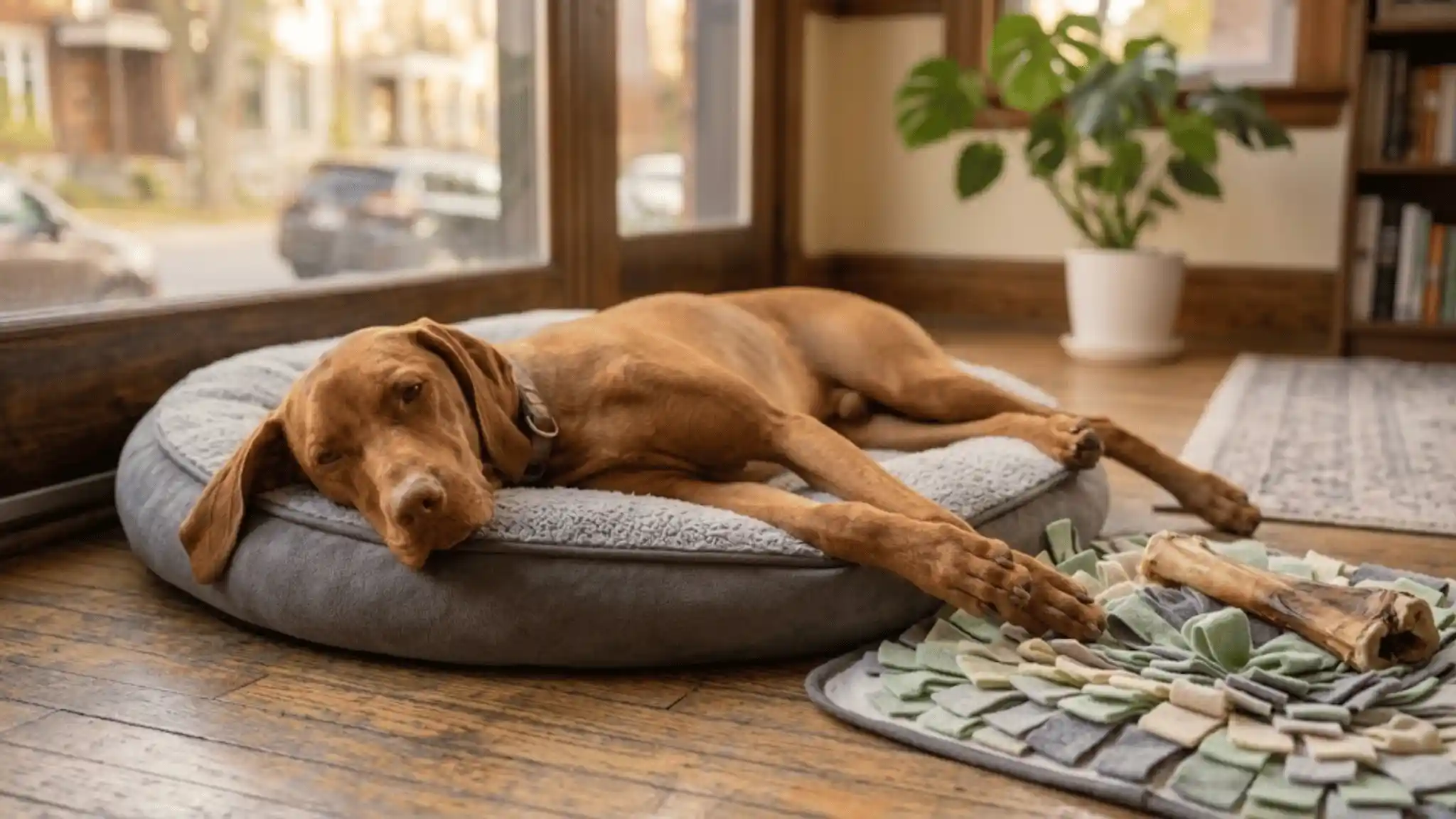
- A lick mat spread with plain yogurt or wet food
- A Kong Wobbler or similar food-dispensing toy that gives them something to work for
Only give this when you leave – not at other times. You want your departure to predict something good, not just tolerable. Over time, the association shifts: you leaving means the frozen Kong appears, and the frozen Kong is excellent.
Step 4: Set up the environment carefully
Some Vizslas do better with free roam; others spiral worse with too much space. A middle ground works well: one or two rooms with no access to exits or windows that face the driveway.
- Leave something that smells like you – an unwashed shirt in their bed does more than most calming sprays
- White noise or a radio on low can help muffle outside sounds that would otherwise trigger alert barking
- Avoid putting them somewhere they can watch for you – a Vizsla stationed at the window is a Vizsla building anxiety, not releasing it
Crates are a mixed bag with this breed. Some Vizslas find them genuinely soothing once properly introduced. Others feel confined in a way that amplifies the panic. If your dog is hurting themselves trying to get out of a crate, that’s your answer – the crate isn’t helping.
Step 5: Cap alone time during training
While you’re working through the desensitization process, keep solo stretches short. Under 3–4 hours if you can manage it. This isn’t forever – it’s the training period. A dog walker at lunchtime, a neighbor checking in, or two days a week of doggy daycare can make the difference between slow progress and no progress.
Vizslas are social in a way that makes isolation genuinely hard. If your lifestyle requires long alone stretches every day, that’s worth thinking through before the training starts.
Products worth trying
None of these replace the training above. But alongside a consistent plan, they can help.
Calming supplements
Look for products with l-theanine or ashwagandha – both have decent evidence behind them for reducing anxious arousal in dogs. Give them 30–60 minutes before a departure during the early training phase.
→ Zesty Paws Calming Bites on Amazon | ~$25 for 90 chews
→ Check price on Amazon | ~$20 for 30 chews
Food enrichment toys
The Kong Classic is the baseline. For Vizslas that burn through it too fast, the West Paw Toppl holds more and has a wider opening for stuffing. A lick mat is a lower-intensity option that still keeps them occupied.
→ Kong Classic on Amazon | Starting at $12
→ West Paw Toppl on Chewy | Starting at $15
→ LickiMat Soother on Amazon | Starting at $13
ThunderEase collar or Adaptil diffuser
Adaptil is a synthetic version of the calming pheromone mother dogs produce. The research is mixed – it doesn’t work for every dog – but some Vizsla owners report a noticeable difference, especially when combined with training. The collar version travels with the dog; the diffuser stays in the room.
→ Check price on Amazon | ~$25
→ Adaptil Diffuser Starter Kit on Chewy | ~$35
Pet camera
Knowing what your dog is actually doing while you’re gone changes how you train. You can see when anxiety peaks, whether the Kong is keeping them occupied, and whether the plan is working. The Furbo has two-way audio if you want to check in; the Wyze Cam is a cheap option if you just need eyes on the room.
→ Furbo Dog Camera on Amazon | ~$140
→ Check price on Amazon | ~$35
Want a day-by-day plan for the first week? The 7-Day Calm Dog Protocol gives you the exact schedule – exercise timing, departure practice, enrichment setup – laid out so you’re not guessing. Get it here →
When to bring in professional help
A consistent plan works for most Vizslas with mild-to-moderate anxiety. Some need more than that.
Talk to your vet if your dog is injuring themselves, has stopped eating for entire days, or if you’ve been working the plan for 6–8 weeks with no improvement. A veterinary behaviorist (DACVB) can assess whether medication makes sense – fluoxetine and clomipramine are both FDA-approved for canine separation anxiety and can take enough edge off that training actually sticks.
A certified separation anxiety trainer (CSAT) is another route. These are professionals who specialize specifically in this problem and work with you over video to build a protocol for your specific dog. For severe cases, this is often the most effective option short of medication.
FAQ
Are Vizslas the worst breed for separation anxiety?
They’re consistently in the top tier. The combination of velcro attachment, high energy, and emotional sensitivity makes separation hard. That said, individual variation matters – not every Vizsla will develop clinical separation anxiety, and those that do range from mild to severe.
Can a Vizsla be left alone all day?
With proper training and management, many Vizslas can handle 4–6 hours. Full workdays of 8–9 hours are genuinely hard for this breed, even after training. If that’s your situation, a midday break – walker, daycare, or a trusted person checking in – makes a significant difference in how the training holds.
Does getting a second dog help Vizsla separation anxiety?
Sometimes, not always. If your Vizsla’s distress is specifically about being separated from you (not just being alone), a second dog won’t solve it. You’ll have two dogs panicking instead of one. If they bond well with the other dog and their distress is primarily about social isolation, a companion can help. It’s not a fix on its own – it’s one variable among many.
How long does it take to treat Vizsla separation anxiety?
Mild cases: 3–6 weeks with consistent work. Moderate cases: 2–4 months. Severe cases can take longer, especially if medication is involved and needs time to reach therapeutic levels (typically 4–6 weeks). The pace is set by the dog, not the calendar.
Is Vizsla separation anxiety permanent?
No. It’s manageable and, in most cases, significantly improvable. “Manageable” might mean your dog can handle 4 hours alone instead of 20 minutes – that’s real progress, even if they never become a dog that naps happily through a full workday.
Final thoughts
Vizsla separation anxiety is one of the harder versions of this problem to treat, mostly because the breed’s attachment runs so deep. But “harder” doesn’t mean “hopeless.” These are dogs that learn quickly when you give them clear, consistent information – and the information you’re teaching is that alone time is survivable.
Start with the exercise and departure desensitization. Give the enrichment a consistent role at departure time. Keep alone stretches short during the training window. Most owners see real change within a month when they stay consistent.
If you want a structured week-by-week plan to follow, the 7-Day Calm Dog Protocol walks you through it day by day. Get it here →

[…] breeds – Labrador Retrievers, German Shepherds, Vizslas, Border Collies – are genetically wired for high human attachment. That closeness is a feature. […]