🐾 Does your dog panic when you leave? → Get the Free 7-Day Starter Plan

How to train an anxious dog: step-by-step guide
Training an anxious dog means changing the conditions, not the techniques. Find the threshold, lower the stress load, use high-value food, keep sessions short. Here's how it works in practice.

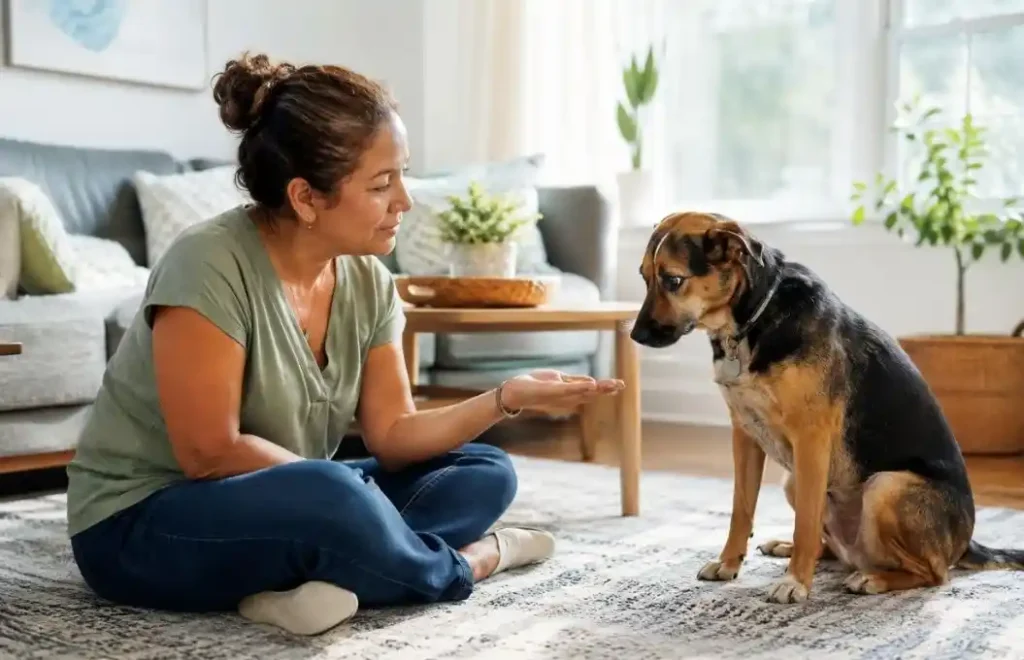
To train an anxious dog, build a predictable routine, reward calm behavior, and expose your dog to triggers slowly, always below the point where fear begins.
Training an anxious dog isn’t harder than training a calm dog. It’s just different. The rules change when fear is involved.
This guide covers anxiety more broadly: strangers, loud noises, cars, vet visits, and other specific fears, not just being left alone. If your dog’s anxiety is specifically about being alone, our dog training for separation anxiety guide and its step-by-step protocol will be more directly useful.
Table of Contents
Learning how to train an anxious dog takes patience, but most dogs respond faster than owners expect once the approach fits their specific triggers.
Standard obedience training assumes a dog who is mentally available, relaxed enough to pay attention, motivated by treats, willing to try. An anxious dog is often none of these things. When stress is high, the learning brain goes offline. You can repeat a command 50 times and get nothing, not because the dog is stubborn, but because he literally can’t process it right now.
This guide covers how to adapt training for dogs who are operating under chronic stress: the adjustments that make standard techniques actually land.
[→ If the anxiety is specifically about being left alone: Dog training for separation anxiety: the complete guide]
Why standard training fails anxious dogs
The problem isn’t the techniques: positive reinforcement, marker training, and shaping all work when you know how to train an anxious dog properly. The problem is the conditions under which you’re trying to use them.
Fear activates the sympathetic nervous system: heart rate increases, cortisol rises, digestion slows. In this state, a dog’s ability to learn new behaviors drops significantly. They may refuse food even when hungry. They may “know” a behavior in calm settings but lose access to it entirely when stressed.
This is why anxious dogs seem inconsistent. They’re not being defiant. They’re working with a brain that’s been hijacked by stress chemistry.
The first step: find the dog’s threshold
The first skill in learning how to train an anxious dog is recognizing its threshold: the point at which a dog crosses from “aware of the trigger” to “reactive to the trigger.” Below threshold, the dog can function: observe calmly, take treats, respond to cues. Above threshold, the dog is in fight-or-flight mode and training is essentially impossible.
Every dog’s threshold is different. Some dogs lose it when they see another dog at 20 feet. Others can handle 5 feet without reacting. Distance, volume, movement, and familiarity all affect where the threshold sits.
Your job in the first few training sessions isn’t to make progress. It’s to find the threshold: to identify exactly where the dog starts showing stress signals. Then you’ll work consistently below it.
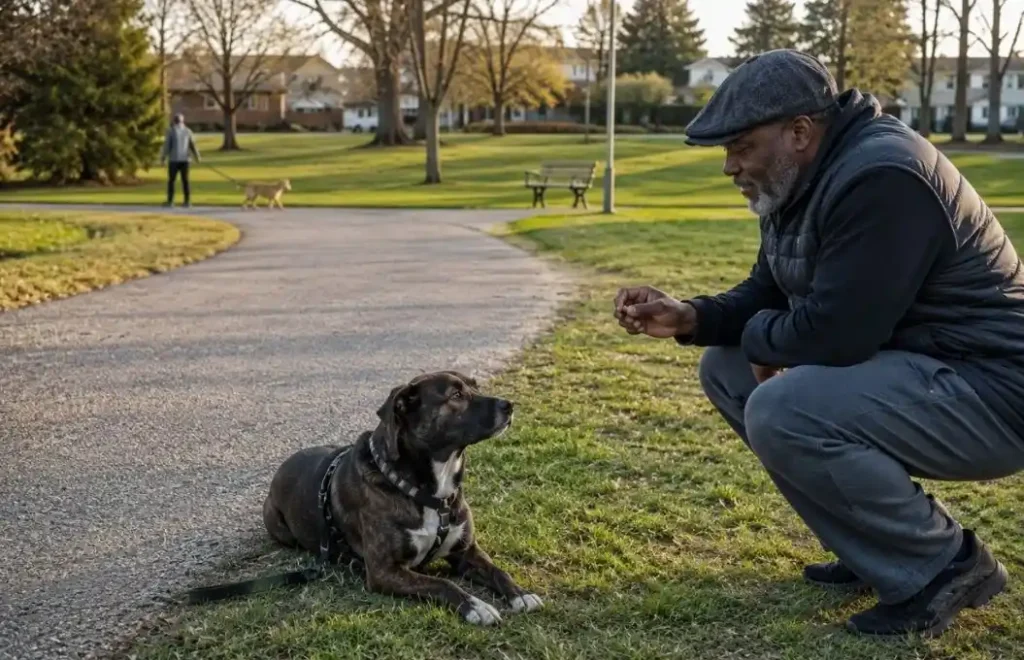
Early stress signals to watch for: lip licking, yawning, turning away, whale eye (showing whites of eyes), ears pinned back, tail lowered, rapid sniffing of the ground. These appear before barking or lunging: they’re the early warning system.
Reduce the stress load before you start training
Cortisol from a stressful event can stay elevated in a dog’s system for 48-72 hours. A dog who had a bad experience Monday is still running hotter on Wednesday. Training on that elevated baseline is harder: the threshold is lower, food motivation is weaker, progress stalls.
Practical implications: don’t schedule training sessions right after stressful events. Don’t train when the dog has been overstimulated (stress park, vet visit, loud household). Give 24-48 hours of decompression after anything scary.
Also: regular decompression walks matter more for anxious dogs than for calm ones. Sniff-led walks (where the dog sets the pace and follows their nose) lower cortisol measurably. A 20-minute sniff walk before a training session genuinely improves results.
Use higher-value food than you think you need
Dry kibble works fine for training a calm dog. It doesn’t work for an anxious one near a trigger. When stress hormones are elevated, the dog’s interest in food drops: low-value food disappears from the picture entirely.
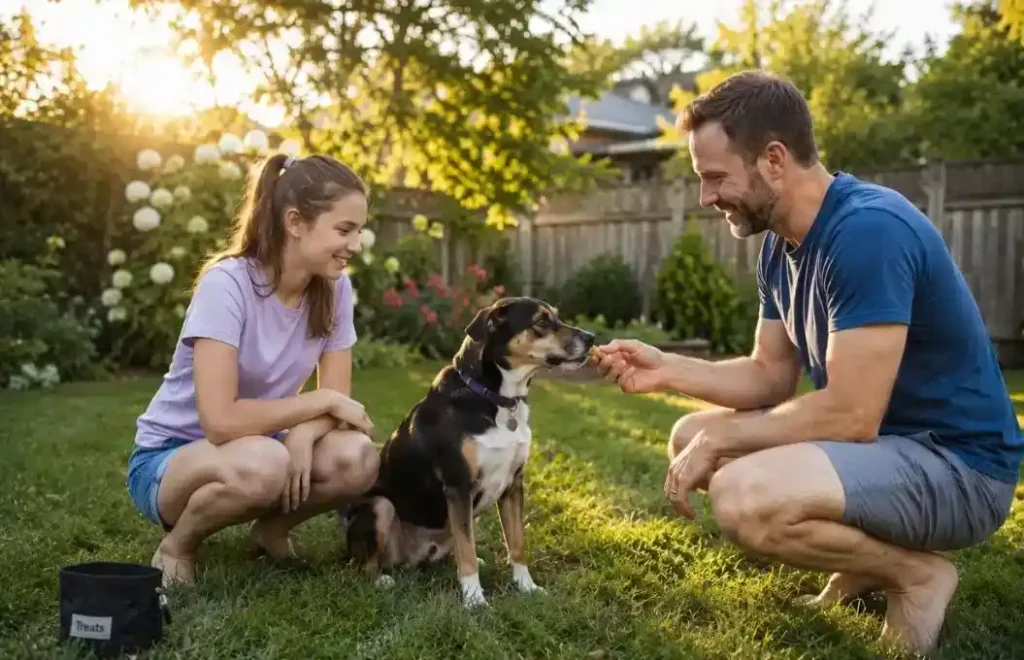
For anxious dogs working near triggers, use food that’s genuinely high value: real meat (chicken, beef, turkey), cheese, hot dogs, or commercial high-value treats. The food needs to be motivating enough to compete with the anxiety response.
A useful test: offer the dog a piece of food near the trigger. If they take it eagerly, you’re below threshold. If they sniff and walk away, or if they take it slowly with hesitation, you’re at or above threshold. Food refusal is one of the clearest signs that a dog is too stressed to train productively.
Short sessions, more often
When you train an anxious dog, session length matters: anxious dogs have shorter attention windows than calm ones, especially near triggers. Long training sessions push them toward threshold and reduce the quality of learning. Better results come from many short sessions, 3-5 minutes each, spread throughout the day.
End each session before the dog shows stress. This is the critical rule most owners break: they keep going because things were going well, and they push past the point of productive learning. Stop while the dog is still engaged and under threshold. The session ends on a success, and the dog’s last emotional memory of the training is positive.
Build a default calm behavior
One of the most reliable ways to train an anxious dog is to give it a clear behavioral alternative to anxiety. The most useful one to teach is a relaxed “settle” on a mat: a cue that means “lie down on your mat and relax.” Once this is solid, you can use it to help the dog find calm in situations that previously triggered anxiety.
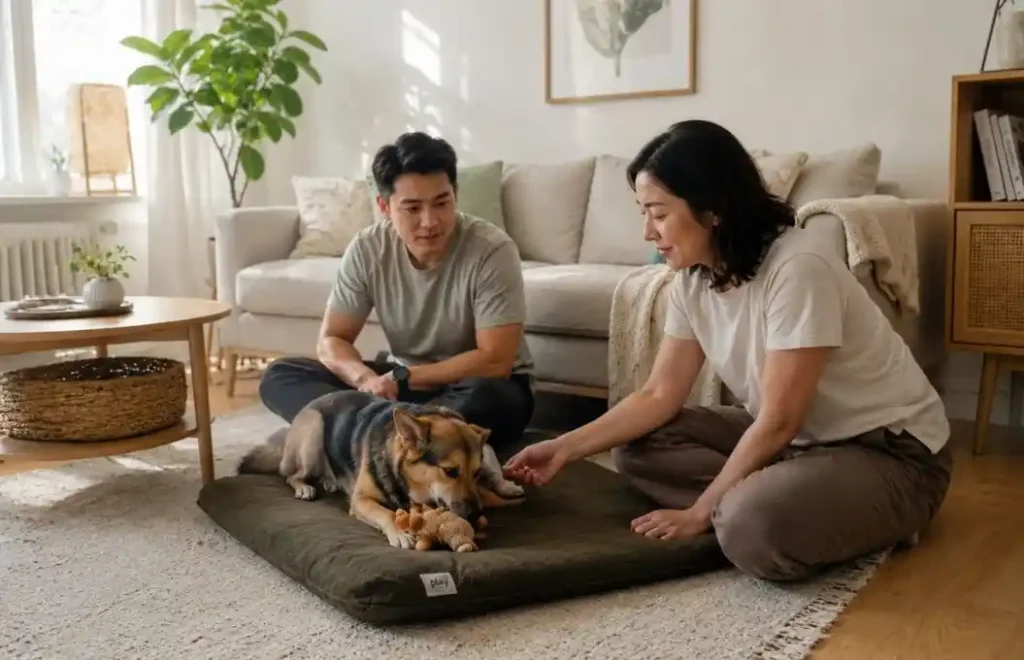
Start by rewarding any calm behavior that happens naturally. Dog lies down? Treat and quiet praise. Dog makes eye contact calmly? Mark and treat. You’re reinforcing the physical and emotional state of calm, which becomes a behavior the dog can offer deliberately.
Over time, pair the mat with good things: feeding meals on the mat, stuffed Kongs on the mat, calm petting while the dog is on the mat. The mat becomes a conditioned location for relaxation. In stressful situations, you can redirect to the mat and leverage the existing association.
Desensitization and counterconditioning for specific fears
For dogs with specific triggers (strangers, other dogs, loud noises, cars), desensitization and counterconditioning are the most effective approaches.
Desensitization means exposing the dog to the trigger at such a low intensity that it doesn’t produce a fear response. This might mean seeing another dog at 100 feet rather than 10, or hearing traffic sounds at low volume through a speaker rather than at full street volume.
Counterconditioning means pairing the low-intensity trigger with something genuinely positive, usually food. The goal is to change the emotional association: instead of “other dog = threat,” the dog starts building “other dog at a distance = chicken happens.”
This is slow, methodical work. The distance or intensity increases only when the dog is consistently relaxed and taking food at the current level. Moving too fast resets progress. This protocol is the same framework used for separation anxiety, applied to specific triggers rather than being-alone.
[→ Detailed look: Dog training for fear and anxiety: what actually works]
What to do when the dog goes over threshold
It will happen. The trigger appears suddenly, the distance closes too fast, something startles the dog. The dog is over threshold: barking, lunging, shutdown, or frozen.
The right response: calmly increase distance. Don’t jerk the leash, don’t correct, don’t try to force the dog past the trigger. Quietly move away until the dog’s body language relaxes. Wait for the dog to take food again: that’s your signal that they’re back below threshold. Then continue at a safer distance.
What not to do: push through the reaction hoping the dog will “get used to it.” Flooding (forcing exposure to the feared thing) reliably makes anxiety worse. It doesn’t build confidence. It erodes trust and makes future training sessions harder.
Consistency is the most important variable
Consistency matters as much as technique when you train an anxious dog. Anxious dogs need predictability. Inconsistent rules, unpredictable routines, and mixed signals from different family members all elevate baseline stress. The dog can’t relax because they can’t predict what comes next.
Consistent rules (the same behaviors are always rewarded and never rewarded) and a predictable daily routine (feeding, walks, and sleep at consistent times) reduce anxiety independently of training. They create a stable environment in which the dog can start to feel safe, and a safer-feeling dog is a more trainable dog.
When training isn’t enough
Even once you know how to train an anxious dog, some anxiety is severe enough that behavior modification alone doesn’t make meaningful progress. If a dog’s baseline stress is chronically elevated, the nervous system is too activated to learn effectively regardless of technique.
In those cases, a consultation with a veterinary behaviorist is worth having. Anti-anxiety medication doesn’t replace training, but it can lower baseline arousal enough that training starts working. Some dogs simply can’t access the learning state without pharmaceutical support for a period.
Signs that warrant a vet conversation: the dog is distressed most of the day regardless of triggers, there’s self-harming behavior, the anxiety is worsening despite consistent training, or the dog’s quality of life is visibly poor.
Where to go next
Once you understand how to train an anxious dog using the steps above, these related guides go deeper on specific situations:
- Dog training for separation anxiety: the complete guide: if the anxiety is specifically about being left alone
- Dog training for fear and anxiety: what actually works: deeper protocol for specific fear triggers
- Best anxiety wraps for dogs (2026): tools that lower baseline arousal during training
- Does crate training help with dog anxiety?: using the crate as a safe space during training