🐾 Does your dog panic when you leave? → Get the Free 7-Day


How to calm dog at night: 7 proven fixes that work
Is your dog restless or anxious at night? Discover 7 proven ways to calm your dog at night and finally get a good night's sleep for both of you.

The best way to calm dog at night starts with understanding why it happens. Nighttime restlessness and anxiety are among the most common complaints from dog owners – and one of the most exhausting. The good news: most cases have a clear cause and a straightforward fix.
Why Dogs Get Anxious at Night
Before you can calm your dog at night, it helps to understand what is driving the behavior. The most common causes are:
- Separation from you – Dogs are social animals. Being alone in a dark, quiet room can feel threatening, especially for anxious breeds.
- Insufficient exercise during the day – A dog with leftover energy will not settle at night. Period.
- Pain or discomfort – Older dogs especially may pace or whine due to arthritis or other physical issues.
- Cognitive dysfunction – Senior dogs can develop a condition similar to dementia that causes nighttime confusion and restlessness.
- Anxiety triggers – Sounds outside, other animals, or changes in routine can spike nighttime anxiety.
7 Proven Ways to Calm Your Dog at Night
1. Tire Them Out Before Bed
A 30-45 minute walk or active play session 1-2 hours before bedtime is the single most effective tool to calm a dog at night. Physical exhaustion overrides anxiety in most cases. Make it a non-negotiable part of the evening routine.

2. Establish a Consistent Bedtime Routine
Dogs thrive on predictability. A consistent sequence – walk, dinner, quiet time, sleep – signals to your dog that night is safe and expected. Disrupting this routine is one of the fastest ways to trigger nighttime anxiety.
3. Create a Comfortable Sleep Space
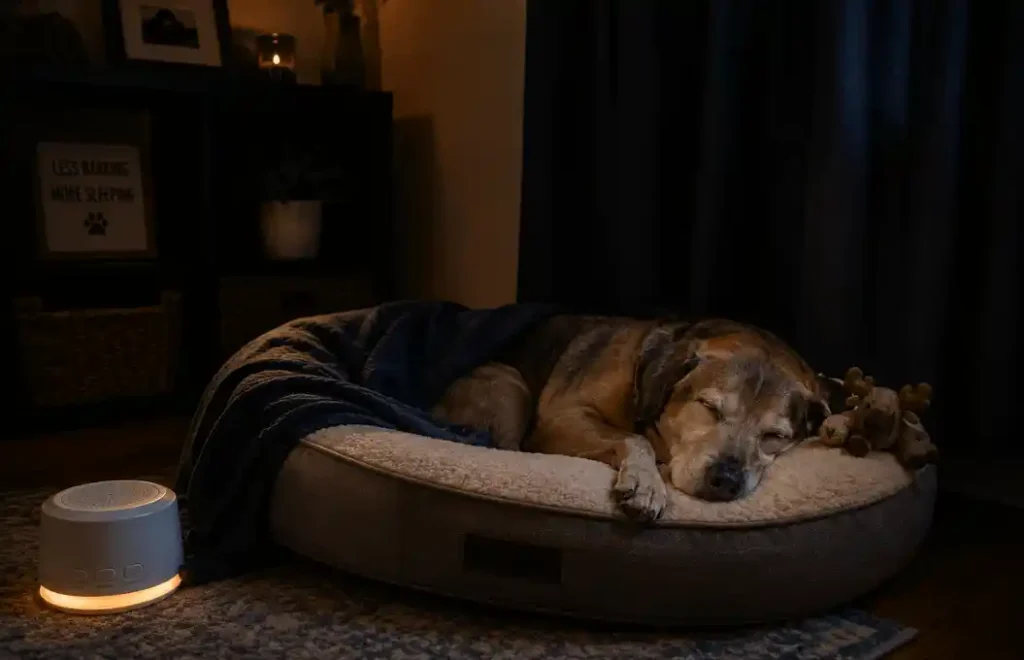
An anti-anxiety dog bed with raised edges gives your dog a sense of security – the enclosed shape mimics the feeling of a den. Place it in a quiet spot away from drafts and noise. Familiar scents (your worn t-shirt) can also help an anxious dog settle faster.
– Best options: Best Anti-Anxiety Dog Beds
4. Use White Noise or Calming Music
Outside sounds – traffic, neighbors, wildlife – can trigger anxiety in dogs with sensitive hearing. A white noise machine or a “dog calming music” playlist (classical or reggae works best) masks these sounds and creates a consistent audio environment your dog learns to associate with sleep.
5. Try a Calming Supplement at Bedtime
Melatonin is safe for most dogs and can promote sleep when given 30 minutes before bed. L-theanine supplements reduce anxiety without sedation. Both are available in chew form and easy to work into an evening routine.
– Compare picks: Best Calming Supplements for Dogs
6. Use an Anxiety Wrap for Reactive Dogs
If your dog startles at every sound or seems unable to physically relax, a pressure wrap worn during the first hour of sleep can help them settle. Remove it once they are asleep.
– See our guide: Best Dog Anxiety Vests
7. Let Them Sleep Closer to You
For dogs with separation-driven nighttime anxiety, simply moving their bed into your bedroom can solve the problem immediately. Your presence and scent are the most powerful calming signal for an attached dog. This is not “spoiling” – it is meeting a genuine social need.
When Nighttime Anxiety Needs a Vet
If your dog’s nighttime restlessness started suddenly in old age, or if no behavioral intervention helps, see your vet. Sudden-onset nighttime anxiety in senior dogs is often a medical issue – pain, thyroid problems, or cognitive dysfunction – not a behavioral one.
For a full overview of anxiety types and solutions, read our Complete Guide to Dog Separation Anxiety. And if daytime anxiety is also a problem, start with How to Calm an Anxious Dog: 9 Methods That Work Fast.
Frequently Asked Questions
Why is my dog restless at night all of a sudden?
Sudden nighttime restlessness – especially in older dogs – is often a medical issue. Pain, cognitive dysfunction, or hormonal changes are common causes. A vet visit is the right first step when the behavior starts without an obvious trigger.
What can I give my dog to calm them at night?
Melatonin (given 30 minutes before bed) and L-theanine supplements are the safest and most effective options. Always check dosing with your vet based on your dog’s weight.
Should I let my dog sleep in my bedroom?
If your dog has separation-driven nighttime anxiety, yes – letting them sleep in your room is one of the most effective solutions. Research shows it does not negatively affect human sleep quality in most cases.
