🐾 Does your dog panic when you leave? → Get the Free 7-Day Starter Plan

Dog Separation Anxiety Crate: Does Crate Training Help?
Crate training can help with dog anxiety - or make it worse. It depends on the dog, how the crate is introduced, and what the anxiety is about. Here's how to tell which applies to yours.

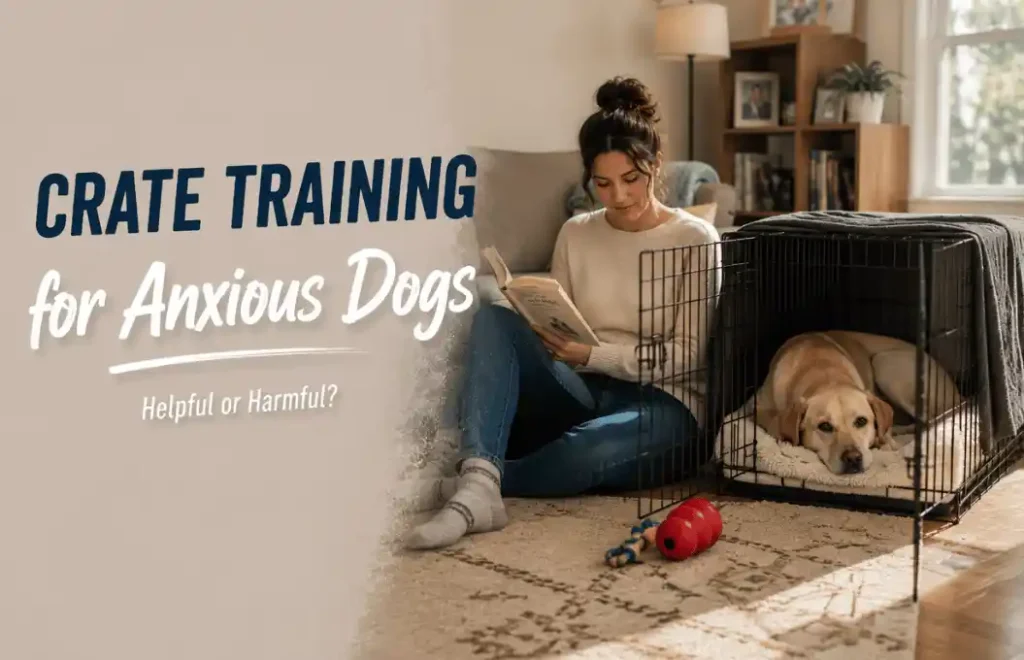
Crate training can help an anxious dog when the crate feels like a safe den, but it can make separation anxiety worse if your dog panics inside it.
A dog separation anxiety crate setup can help enormously, or it can backfire. The crate either helps or makes things worse. There’s rarely a middle ground with anxious dogs, and the only way to know which is to test it with a camera.
Table of Contents
A dog separation anxiety crate is one of the most debated training tools out there, and the debate persists because both sides are right. Some anxious dogs are genuinely calmer in a crate. Others are more distressed. The answer isn’t about the crate, it’s about the individual dog’s relationship with confinement, and how the crate was introduced. Good crate training respects that individual difference instead of forcing a one-size-fits-all approach.
The dog separation anxiety crate case: when it helps
Dogs are den animals by nature. A correctly sized, covered crate mimics the enclosed spaces dogs seek out naturally when they’re stressed, under beds, behind furniture, in small closets. For dogs who respond to this instinct, a crate provides a predictable, safe location. A space that belongs to them, where nothing bad happens.
The benefits when it works: the dog has somewhere to go when overwhelmed, which reduces decision fatigue during stressful situations. During separation anxiety training, the crate can lower the dog’s baseline arousal enough that graduated departures are easier to work through. The structure of “crate = safe place” gives the dog a behavioral option that replaces destructive coping.
The case against crate training with anxiety
For some dogs, confinement itself is a trigger. Dogs with claustrophobia-adjacent responses, where being enclosed feels threatening rather than safe, will escalate when crated. These dogs scratch at doors, spin, vocalize continuously, and in severe cases injure themselves trying to escape. Adding a crate to this dog’s routine adds stress, not reduces it.
The same logic applies to dogs whose anxiety is generalized: everything is threatening, including small enclosed spaces. A crate doesn’t feel safe to this dog, it feels like a trap.
How to find out which category your dog falls into
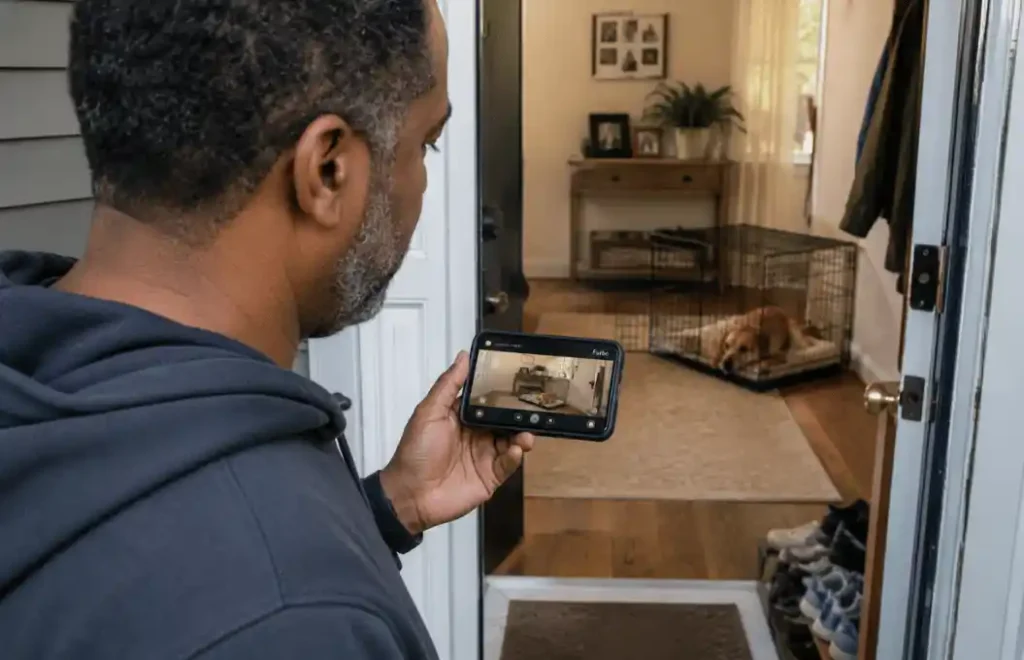
Set up a camera. Leave the house for 5 minutes with the dog crated, then 5 minutes with the dog loose. Review the footage. Look at body language: is the dog settled or actively distressed? Is the behavior better, worse, or the same?
The test should happen only after the crate has been properly introduced, not as a first-day experiment. A dog who has never seen a crate will be distressed in it regardless of whether crating would eventually help. The introduction process creates the association. The test reveals the result.
How to introduce a crate to an anxious dog
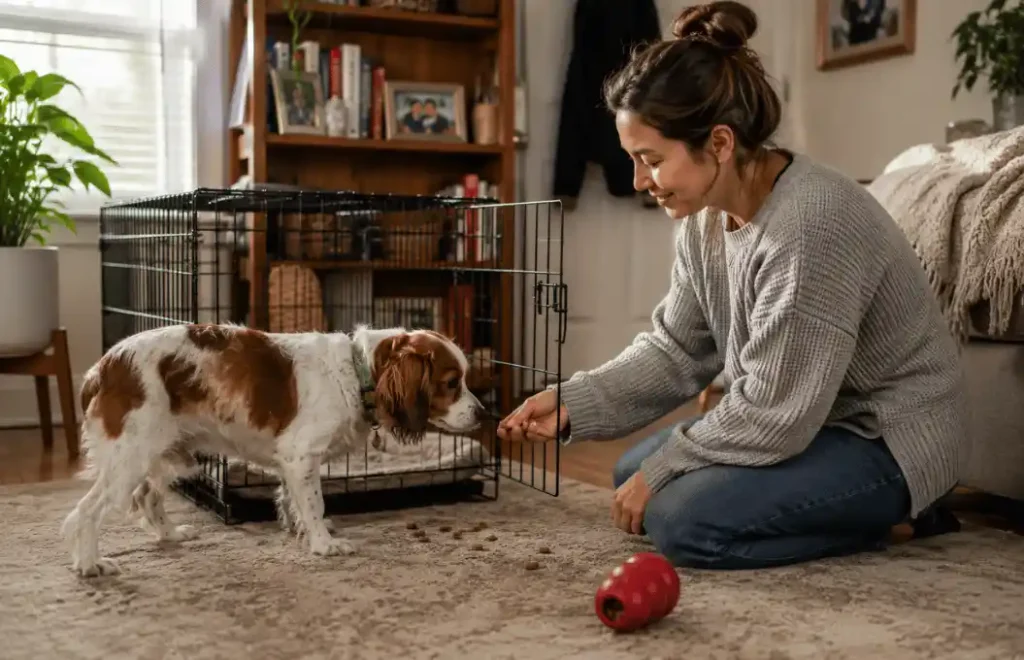
The introduction needs to happen during calm moments, completely separate from departures. The goal is to build a positive association before the crate is ever used during a stressful event.
Phase 1, Exploration (days 1-3): place the crate in the main living area with the door open. Scatter treats inside. Let the dog investigate on their own terms. No pressure to enter. The crate is just part of the furniture for now.
Phase 2, Meals inside (days 4-6): feed the dog’s regular meals inside the crate, door open. Once the dog walks in voluntarily and eats comfortably, close the door for the duration of the meal, then open it immediately after.
Phase 3, Closed door, increasing duration (days 7-10): extend the closed-door time gradually. 2 minutes, 5 minutes, 10 minutes. Provide a stuffed Kong to extend the positive association. Stay nearby, don’t leave the house yet.
Phase 4, Brief absences (week 2): once the dog is relaxed with the door closed for 15-20 minutes while you’re in the house, begin using the crate during short departures. This is where it integrates with the departure training protocol.
The most common mistake: skipping phases 1-3 and closing the dog in a crate during a departure on day one. The dog’s first experience of the crate is being alone and afraid. That association is very hard to reverse.
Crate setup for anxious dogs
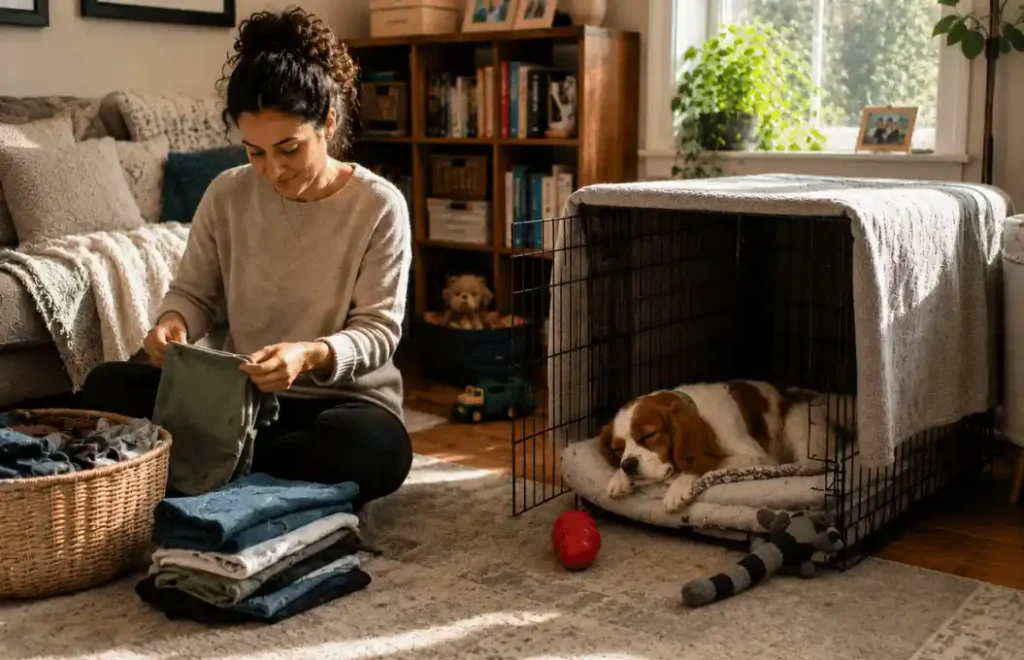
Size: just large enough to stand, turn around, and lie down. Too large removes the den effect.
Location: main living area, not a back room. Adding isolation on top of separation increases distress.
Cover: three sides covered with a blanket or fitted cover, front open for airflow. Most anxious dogs settle faster in a covered crate.
Bedding: something that smells like you. A worn t-shirt is more effective than expensive bedding for most anxious dogs.
Chew: a stuffed, frozen Kong given only when the dog is crated. Builds positive association and occupies the dog during early departures.
[→ Full crate comparison: Best crates for dogs with separation anxiety (2026)]
When crating isn’t the answer
Skip the crate if the camera shows the dog is more distressed inside it than loose. Don’t push through, work the departure protocol without the crate instead. Many dogs with separation anxiety do perfectly well left loose with appropriate management.
Also skip it if the dog has a history of escape or self-injury in a crate. This is a safety issue that needs a different approach, either a significantly more escape-resistant crate introduced very gradually, or no crate at all.
FAQ
Should I crate my dog if they have separation anxiety?
A dog separation anxiety crate only helps if they’re calmer in it. Test with a camera. If the crate reduces distress, use it as part of the training protocol. If it makes things worse, leave the dog loose.
How long does crate training take for an anxious dog?
2-3 weeks to build a solid positive association before using it during departures. Rushing this phase leads to the crate becoming a stressor. The introduction investment pays off later in the training process.
My dog hates the crate, what should I do?
Check whether the introduction was rushed. If the crate went from “new object” to “locked in during departures” in less than a week, the negative association came from the process, not the crate itself. Start the introduction over from phase 1, more slowly. If after a proper 3-week introduction the dog still shows significant distress in the crate, drop it and work without it.
Can a crate make anxiety worse?
Yes, if confinement is a separate trigger for that dog, or if the crate was introduced during stressful situations. A panicking dog who is repeatedly crated during full panic has the fear reinforced, the crate becomes associated with the worst moments rather than with safety.
- Dog training for separation anxiety: the complete guide, the full protocol the crate supports
- Best crates for dogs with separation anxiety (2026), which crate holds up under real anxiety
- How to train an anxious dog: step-by-step guide, broader training adjustments for anxious dogs