🐾 Does your dog panic when you leave? → Get the Free 7-Day Starter Plan

Signs of Separation Anxiety in Dogs at Night: How to Tell for Sure
Signs of separation anxiety in dogs at night can look different after dark. Learn the real warning signs and how to calm your dog before bedtime tonight.

Affiliate disclosure: This article and its sidebar contain affiliate links. If you buy through these links, PetCalmZone may earn a commission at no extra cost to you.
The main signs of separation anxiety are destructive chewing, constant barking or howling, pacing, drooling, and accidents that only happen when you are gone.
Signs of separation anxiety in dogs at night often look different from the ones everyone expects.
Table of Contents
- What is separation anxiety in dogs really?
- What are the real signs of separation anxiety in dogs?
- How do you tell separation anxiety apart from boredom?
- How can you confirm it s separation anxiety? the camera test
- Which tools help you assess and manage separation anxiety early?
- What are the most common mistakes dog owners make?
- FAQ
- Recognizing the Signs Is the First Step to Helping Your Dog
The ASPCA’s page on separation anxiety is a good companion resource if you want more background on the condition.
Recognizing the signs of separation anxiety in dogs early makes treatment far more effective than waiting until the behavior is severe.
Barking. Chewing. Accidents on the floor. Most owners assume these mean separation anxiety. Sometimes they do. Sometimes they mean a bored dog, a dog who needs more exercise, or a dog who figured out that destroying the couch is actually pretty entertaining.
The difference matters, not because one is “worse,” but because the treatment is completely different. Training a bored dog and treating a dog with separation anxiety require opposite approaches in several key ways. Getting it wrong wastes months.
Here’s how to tell which one you’re actually dealing with.
Quick answer: Signs of separation anxiety in dogs include distress within 5 minutes of departure (barking, pacing, targeting exit points), pre-departure stress signals (panting, lip-licking, whale eye when you grab your keys), refusal to eat when alone, and frantic greetings on your return. Boredom looks different: calm for 30–60 minutes, then random destruction. Signs of separation anxiety in dogs at night follow this same pattern, just after dark instead of at the front door.
[→ Full guide: The Complete Guide to Dog Separation Anxiety]
What is separation anxiety in dogs really?
Separation anxiety isn’t a behavior problem. It’s a fear response.
When a dog with separation anxiety is left alone, their nervous system reads the absence of their attachment figure as a genuine threat. Cortisol and adrenaline spike. The dog isn’t choosing to bark or destroy things: they’re in a state that’s neurologically similar to a panic attack. Deliberate choices aren’t really part of it.
This is why the usual fixes don’t work. More exercise, puzzle feeders, ignoring the behavior: none of those reach the root. You can’t train a dog out of a panic response the same way you train them to sit.
Before you can treat it, you have to confirm it’s actually what you’re dealing with.
What are the real signs of separation anxiety in dogs?
Signs that appear before you leave
This is where most people miss it. Separation anxiety often starts well before you walk out the door.
Velcro behavior: Following you from room to room as departure approaches. Not unusual on its own, but when it intensifies specifically around your pre-departure routine, it’s a signal.
Pre-departure stress signals: Yawning, lip-licking, whale eye (showing the whites of the eyes), and panting that starts when you pick up your keys or put on your shoes. These are subtle, easy to miss, and often the earliest indicators.
Refusal to eat or engage: A dog who won’t touch their food or ignores a toy they normally love as you’re getting ready to leave is showing signs of anxiety, not preference.
[alt: a dog showing whale eye stress signal while watching owner put on shoes near front door]
Signs that appear while you’re gone
These are the ones most owners know about, but the timing and pattern matter as much as the behavior itself.
Vocalization within minutes of departure: A dog who starts barking or howling within 5–10 minutes of you leaving is showing a different pattern than a dog who settles for an hour before getting restless. Early, rapid onset vocalization is a strong indicator of separation anxiety.
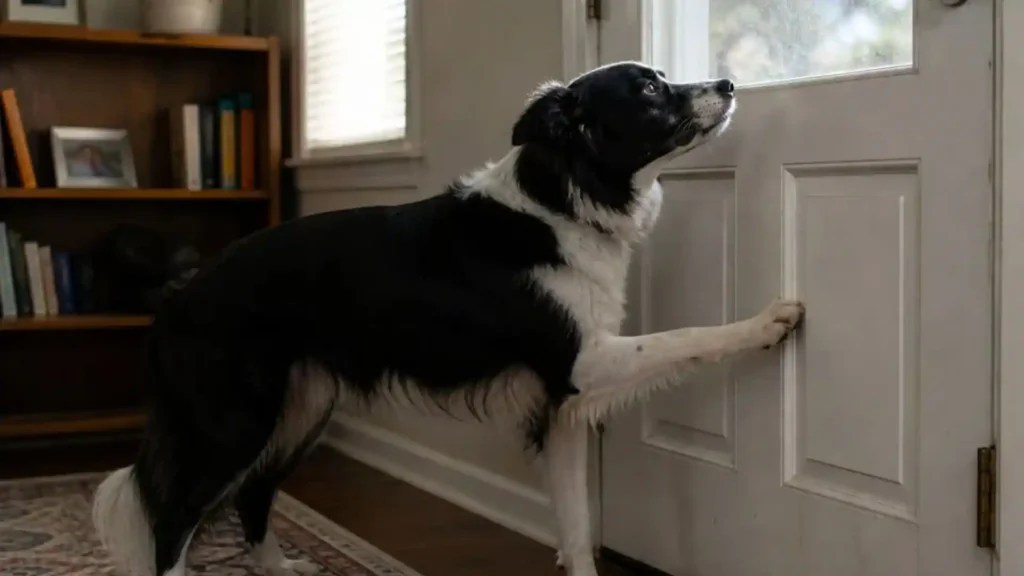
Targeting exit points: Scratching at doors, chewing window frames, pawing at gates. A bored dog chews things. An anxious dog tries to escape specifically toward the places you left from.
Pacing and circling: Repetitive movement with no goal. Not exploring, not playing: just moving because staying still is unbearable.
Physiological signs: Drooling, panting, and self-grooming to the point of skin irritation. These reflect the physical stress response, not behavioral choices.
Inability to settle: A dog who genuinely can’t lie down and relax for more than a few minutes during an absence, even after the initial departure anxiety has passed, is showing sustained distress.
Signs that appear when you return
Extreme, prolonged greeting: Every dog is happy to see their owner. A dog with separation anxiety is frantic, jumping, vocalizing, unable to calm down for several minutes. It’s a release of accumulated stress, not just excitement.
Immediate toileting: A dog who has full bladder and bowel control when you’re home but reliably has accidents when alone isn’t being defiant. Stress affects the bladder. This is a physiological response.
How do you tell separation anxiety apart from boredom?
This is where a camera becomes essential. You can’t reliably distinguish between the two without watching what actually happens during an absence.
| Separation Anxiety | Boredom | |
|---|---|---|
| Onset | Within minutes of departure | After 30–60+ minutes |
| Target | Exit points (doors, windows) | Random or high-value items |
| Settling | Rarely settles | Eventually settles |
| Eating when alone | Usually won’t | Usually will |
| Pre-departure signs | Yes, stress signals before you leave | No |
| Physiological signs | Drooling, panting, skin irritation | Absent |
| Returns | Frantic, prolonged | Normal excitement |
The clearest signal is onset time. If your dog is distressed within 5 minutes of you leaving, that’s anxiety. If they’re calm for an hour and then start getting into things, that’s much more likely boredom or under-stimulation.
How can you confirm it’s separation anxiety? the camera test
The most reliable way to know what you’re dealing with is to watch footage from a real absence.
Set up a camera (any decent pet cam or even a phone propped on a shelf will do) and leave for 20–30 minutes. Watch the footage and note when the first stress signal appears, what the dog does in the first 5 minutes, whether they’re targeting exit points or random items, and whether they settle at any point or the distress is sustained.
If you see rapid-onset distress, exit-point targeting, and inability to settle, you’re looking at separation anxiety. If the dog wanders around, plays with a toy, naps, and eventually gets into the trash after 45 minutes. That’s a different problem with different solutions.
Which tools help you assess and manage separation anxiety early?
Pet camera (~$30–$80): Non-negotiable for accurate assessment. You cannot reliably diagnose separation anxiety without watching what actually happens. Check price on Amazon
Calming supplements (Zylkene, Composure) (~$30–$50/mo): If you’ve confirmed mild-to-moderate anxiety, a supplement can lower baseline arousal while you work on a training protocol. Not a fix, a bridge.
Anxiety vest (~$25–$55): Gentle pressure wraps like ThunderShirt can reduce situational stress during the desensitization process. Works best introduced before the anxiety trigger, not during a panic episode. Check price on Amazon
Adaptil diffuser (~$25–$40): Pheromone-based calming for mild anxiety. Worth trying as a low-risk first step while you assess severity. Check price on Amazon
[→ Compare calming products: Best Calming Supplements for Dogs]
[→ Pressure wraps: Best Dog Anxiety Vests]
What are the most common mistakes dog owners make?
Diagnosing without a camera. Owner reports of what happens during absences are often wrong, not because owners are inattentive, but because you’re not there. The camera tells you what’s actually happening.
Treating boredom with separation anxiety protocols. Desensitization training won’t help a dog who’s bored. It wastes time and can create confusion. Confirm the diagnosis first.
Confusing excitement with anxiety on return. A happy greeting isn’t the same as a frantic, prolonged release of stress. Know the difference: it changes whether you need to treat anything at all.
Assuming it will resolve on its own. Mild separation anxiety occasionally does improve with time and routine. Moderate-to-severe cases reliably don’t. Waiting usually means more entrenched behavior and a longer treatment timeline.
Skipping the vet. Once you’ve confirmed separation anxiety, especially moderate-to-severe cases, a vet conversation about whether medication belongs in the treatment plan is worth having early. Many owners spend months on training that stalls, and then find out medication was what the protocol needed to work.
FAQ
What do signs of separation anxiety in dogs at night look like?
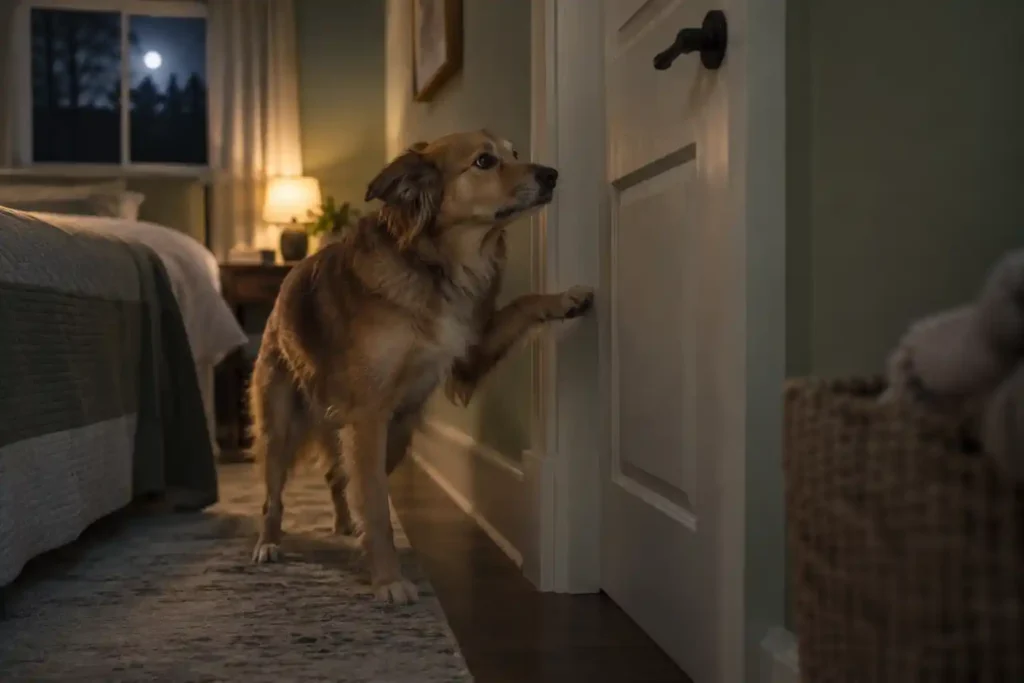
Yes. Signs of separation anxiety in dogs at night can show up even while you’re home and asleep, or once your dog realizes you’ve settled in for the evening. Pacing, whining, pawing at the bedroom door, or restlessness after lights-out are common nighttime signals, and they respond to the same routines that help with daytime departures.
Can a dog have separation anxiety and still eat when alone?
Yes, particularly in mild cases. Refusal to eat is common with moderate-to-severe anxiety, but some dogs with genuine separation anxiety will still eat, especially if the food is extremely high-value or the anxiety has a delayed onset. Eating alone doesn’t rule it out.
My dog only destroys things sometimes when I’m gone. Does that mean it’s not separation anxiety?
Inconsistency is common, especially early on or with mild cases. Severity often varies with duration of absence, the dog’s physical state, and environmental factors. Inconsistent destruction doesn’t rule out anxiety, so watch the camera footage for the timing and targeting pattern.
Can separation anxiety develop suddenly in an older dog?
Yes. Late-onset anxiety in dogs over 6–7 years should always prompt a vet check, since it can be associated with cognitive dysfunction, pain, or other medical conditions that are worth ruling out before starting behavioral treatment.
Recognizing the Signs Is the First Step to Helping Your Dog
The signs that actually confirm separation anxiety aren’t the dramatic ones, they’re the early ones. A dog who starts showing stress before you’ve even left, who targets the door you walked out of, who can’t settle in the first few minutes of an absence. That pattern, confirmed on camera, is what you’re looking for.
If you’re seeing it, the next step is getting a training protocol in place, and talking to your vet about whether the severity warrants medication alongside training.
If you’re not seeing it, the good news is you’re probably dealing with something more straightforward. Boredom, under-stimulation, or a habit that needs redirecting: manageable problems with faster solutions.
[→ Read: The Complete Guide to Dog Separation Anxiety]
[→ Training: How to Train a Dog With Separation Anxiety]
[→ Calming supplements: Best Calming Supplements for Dogs]
[→ Anxiety vests: Best Dog Anxiety Vests]