🐾 Does your dog panic when you leave? → Get the Free 7-Day Starter Plan

Goldendoodle Separation Anxiety: Signs and How to Treat It
Goldendoodle separation anxiety can be tough. Learn the signs, common triggers, and proven ways to help your Goldendoodle stay calm and confident alone.


Goldendoodle separation anxiety is one of the most reported behavioral problems in this breed, and it makes sense once you understand where Goldendoodles come from. Two highly social parent breeds, raised in homes where they’re rarely alone, producing a dog that genuinely struggles when the family disappears.
This guide covers why Goldendoodles are wired this way, what the signs look like, and what actually works to fix it.
Table of Contents
Why Goldendoodles get separation anxiety
Goldendoodles are a cross between Golden Retrievers and Poodles, two breeds that were both developed to work closely with people. Golden Retrievers were bred as hunting companions. Poodles, despite the haircuts, were working water retrievers. Neither breed was built to function independently. Both were selected for attentiveness to humans, eagerness to please, and a strong social bond.
Combine those two, and you get a dog that is intensely social, highly aware of your movements, and genuinely motivated by your presence. That’s what makes Goldendoodles so easy to train and so good with families. It’s also exactly what makes being left alone hard for them.
There’s also a practical factor. Goldendoodles became one of the most popular family dogs in the last decade. Many are raised in homes where someone is almost always around, such as kids, remote workers, or stay-at-home parents. When that changes, the dog has no experience with solitude and no tools to cope with it.
The intelligence factor matters too. Poodles are among the most cognitively capable dogs. That intelligence cuts both ways. A smart dog learns routines fast, which means they read your departure cues earlier and more accurately than most breeds. They start dreading the departure before you’ve even left.
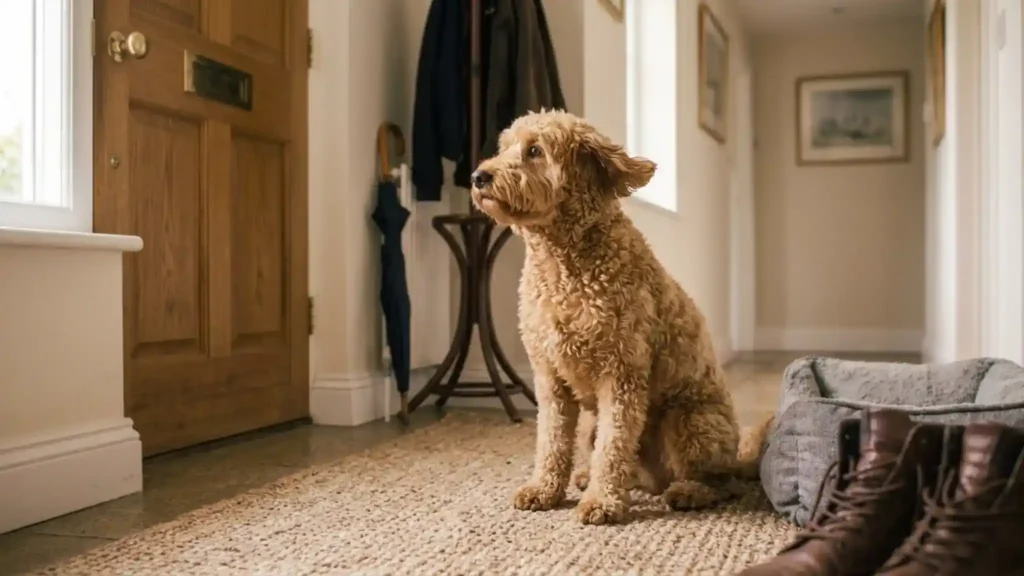
Signs of Goldendoodle separation anxiety
Before assuming separation anxiety, set up a camera. A lot of behaviors that look like anxiety at home are actually boredom or frustration, and those need different solutions. What genuine separation anxiety looks like on camera:
- Barking, whining, or howling that starts soon after you leave and continues
- Pacing between rooms or near exits
- Destructive behavior, often focused on the door or items with your scent
- Refusing to eat food or treats left behind
- Accidents despite being housetrained
- Excessive salivation or panting
At home, the clearest warning sign is velcro behavior: following you everywhere, unable to settle in a separate room, monitoring your movements constantly. Some Goldendoodles will wait outside the bathroom door every time. That level of dependence usually predicts problems when you leave the house.
Watch what happens when you pick up your keys, put on shoes, or grab your bag. A dog that suddenly goes from calm to frantic at those cues has already learned the pattern. The anxiety starts long before you’re out the door.
Mild vs severe: what you’re dealing with
Mild separation anxiety looks like 20-30 minutes of distress, then your dog settles. Moderate means distress that runs most of the time you’re gone. Severe means self-injury, escape attempts, or complete inability to function: not eating, not drinking, sometimes injuring paws or mouths trying to get through doors.
Severity matters because it determines your approach. Mild cases often respond well to training alone. Moderate to severe cases usually need veterinary support alongside behavioral work.
What actually works
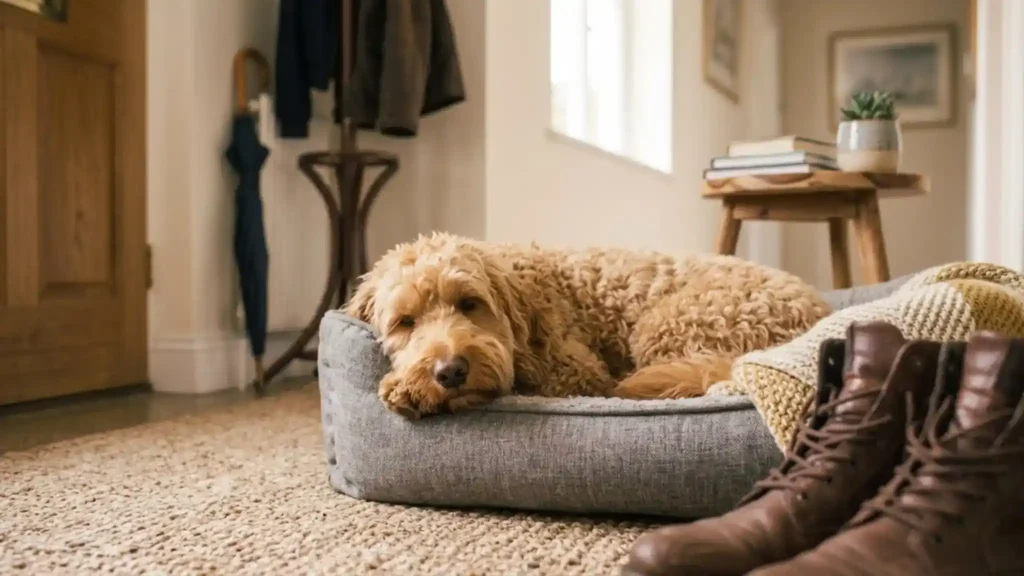
Teach independence before working on absence
Most people skip this step. Before you practice leaving, you need a dog that can be calm in a separate room while you’re still home. Start by giving your Goldendoodle a chew or puzzle feeder in another room and stepping away. Come back before they finish. Do this daily. The goal is a dog that can self-entertain for 20-30 minutes without checking on you.
Desensitize departures gradually
Leave for 30 seconds. Come back before your dog reacts. Then one minute. Then five. Build duration slowly. The key is always returning before distress kicks in. If your dog is barking for 20 minutes, you’ve skipped too many steps. Go back to shorter absences.
Returns matter too. Don’t come back with big energy. Greet your dog calmly, wait until they’re settled, then give attention. Dramatic reunions teach the dog that your return is an event worth suffering for.
Neutralize departure cues
Because Goldendoodles are smart, they pick up on your routine early. Pick up your keys and put them back down. Put your shoes on and stay home. Grab your bag and sit on the couch. Repeat these cues out of context until they stop predicting your departure. It takes time but it works.
Use calming support strategically
Evidence for calming supplements in dogs is limited and varies by ingredient and formulation. Research on an ingredient does not establish that a particular chew treats separation anxiety, and effects cannot be assumed for this breed. Ask your veterinarian whether a supplement is appropriate, including possible side effects and interactions. Supplements do not replace an individualized behavior plan. Related resources: best calming supplements for dogs
For a step-by-step training protocol, see our complete guide to dog separation anxiety.
Common mistakes
Crating a dog that hasn’t been trained to accept the crate. For some Goldendoodles, a crate becomes a safe den. For others, especially those not crate trained as puppies, it becomes a source of additional panic. If your dog is already anxious and hates the crate, don’t use it as a containment solution for separation anxiety. It makes both problems worse.
Long absences too soon. If you’re doing 8-hour workdays while trying to treat separation anxiety, progress will be slow or none. The dog gets re-traumatized every day. If possible, use a dog walker, daycare, or a neighbor during treatment. Shorter absences more consistently is more effective than occasional long ones.
Punishment after the fact. Coming home to a destroyed couch and scolding your dog teaches them nothing useful. They can’t connect your reaction to something that happened hours ago. They learn only that you sometimes come home angry, which adds stress to an already anxious situation.
When to involve a vet
If your dog is injuring itself, cannot settle or has stopped eating, contact your veterinarian promptly. For persistent or severe distress, consult your veterinarian or a board-certified veterinary behaviorist. Prescription medication may be considered alongside behavior modification. Reconcile (fluoxetine) and Clomicalm (clomipramine) are veterinary products approved in the United States for canine separation anxiety as part of a behavior management plan. Suitability, response, side effects and monitoring depend on the individual dog. Do not start, combine or adjust medication without your veterinarian. Related resources: veterinary behaviorist
Also worth ruling out: pain, hyperthyroidism, or other medical conditions that can drive anxiety. If your Goldendoodle developed separation anxiety suddenly without a clear trigger, get a physical check first.
Frequently asked questions
Are Goldendoodles more prone to separation anxiety than other breeds?
More than average, yes. Both parent breeds score high on social bonding and human attentiveness. Add the fact that most Goldendoodles are raised as family pets with constant company, and you get a dog that struggles more than most when left alone.
How long can you leave a Goldendoodle alone?
Adult Goldendoodles can typically manage 4-6 hours with proper training. Puppies under 6 months shouldn’t be left more than 1-2 hours. Without deliberate independence training, even adult Goldendoodles can struggle beyond an hour or two.
Does getting a second dog help with Goldendoodle separation anxiety?
Sometimes. If your Goldendoodle’s anxiety is about general social isolation rather than specifically about you, a second dog can help. But if the anxiety is centered on you, triggered by your absence specifically, a second dog won’t fix it. Don’t get a second dog hoping it solves the problem.
Can Goldendoodle separation anxiety be cured completely?
Many dogs with mild to moderate separation anxiety improve significantly with consistent training. “Cured” is probably the wrong word, since the underlying temperament stays the same. But most owners can get to a point where their dog handles normal absences without distress. Severe cases can also improve substantially with the right combination of medication and behavioral work.
At what age does it typically show up?
Most commonly between 6 months and 2 years, often triggered by a change in routine, such as an owner going back to work, kids returning to school, or a move. It can also appear in older dogs after a loss. Early signs during puppyhood are worth taking seriously rather than waiting to see if the dog “grows out of it.”
Related guides