🐾 Does your dog panic when you leave? → Get the Free 7-Day Starter Plan

Bernedoodle Separation Anxiety: Signs and Support
Bernedoodles combine the loyalty of a Bernese Mountain Dog with the social intelligence of a Poodle. That mix makes separation anxiety common and sometimes severe. Here's what works.


Bernedoodle separation anxiety can involve vocalizing, pacing, escape attempts or difficulty settling during an absence. This guide explains what to observe, how to approach short practice absences, and when to seek veterinary support.
Why a Bernedoodle may struggle with being alone
Bernedoodles are Bernese Mountain Dog–Poodle crosses, with substantial variation between individuals. Parentage alone cannot tell you whether a dog will develop separation anxiety. A change from frequent company to regular absences is useful history to discuss with your veterinarian; it is not proof of a genetic cause.
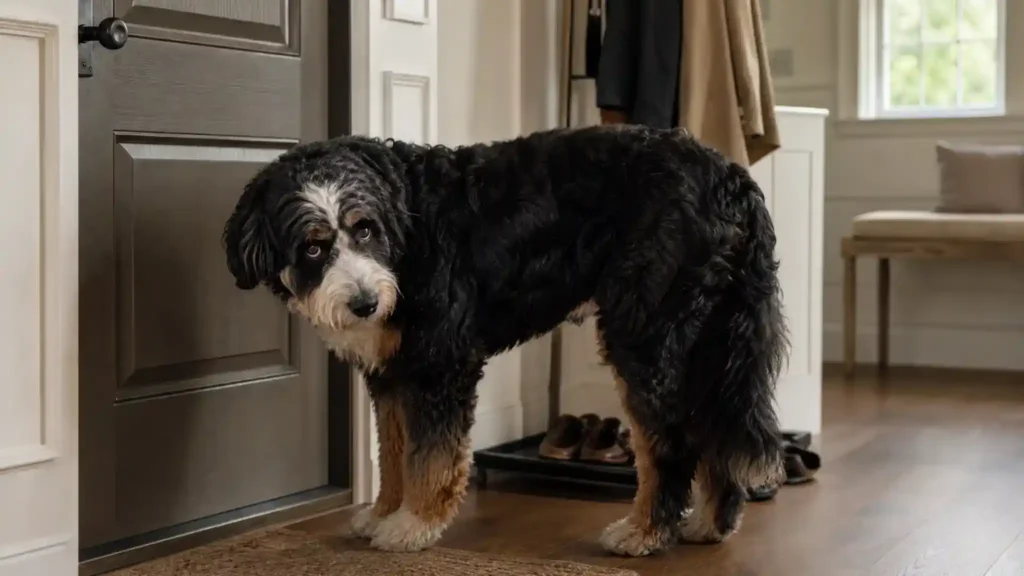
Signs of Bernedoodle separation anxiety
Keep a record of relaxed duration, early signs of distress and equipment fit. Do not use an F1/F1b label, coat type or mini/standard label as a prediction of separation-anxiety severity.
These signs can have other causes. Record the context and discuss persistent or concerning behavior with your veterinarian.
Signs vary between dogs. Record what your Bernedoodle does during a necessary absence; do not classify a quiet dog as “Bernese-like” or a vocal dog as “Poodle-like.”
What to look for on camera:
- Whining, barking, or howling soon after you leave
- Pacing near doors or windows
- Destructive behavior focused on your belongings or exit points
- Refusal to eat food or treats left behind
- Excessive salivation or panting
- Accidents inside despite being housetrained
- Inability to settle: lying down and getting back up repeatedly
Following you around is not enough to diagnose anxiety. Distress around departure cues is worth recording and discussing with your veterinarian; it does not establish severity or predict how difficult treatment will be.
F1 vs F1b vs multigenerational: does it change anything?
F1, F1b and multigenerational labels describe ancestry, not a validated separation-anxiety risk score. Use the dog’s observed comfort, health and history to choose the pace of training.
An individualized approach to alone-time practice

Start independence training early, ideally in puppyhood
Start with a separation your dog can handle without signs of distress, which may be only a moment out of sight. Monitor body language rather than waiting for barking to stop. If distress appears, end the attempt calmly and make the next session easier. Increase duration only after repeated relaxed sessions; do not follow a fixed schedule.
Desensitize departure cues
If keys, shoes or a bag trigger distress, practice a less intense version of one cue while your dog remains relaxed. Reduce difficulty if the cue is upsetting. Progress depends on your dog’s response, not a set number of repetitions.
Keep departures and arrivals low-key
Keep departures and returns calm and predictable. Adjust the routine if it increases arousal, but do not assume that affection caused the anxiety or withhold support from a distressed dog.
Use calming support during the training phase
Evidence for calming supplements in dogs is limited and varies by ingredient and formulation. Research on an ingredient does not establish that a particular chew treats separation anxiety, and effects cannot be assumed for this breed. Ask your veterinarian whether a supplement is appropriate, including possible side effects and interactions. Supplements do not replace an individualized behavior plan. Related resources: best calming supplements for dogs
A pressure wrap such as ThunderShirt may be considered as optional support. Check fit, introduce it under supervision and stop if your dog appears uncomfortable. Benefit cannot be assumed for Bernedoodles.
For the complete training protocol, see our complete guide to dog separation anxiety.
What doesn’t work
Relying on a goodbye ritual as treatment. A calm routine may help some dogs, but reassurance alone does not treat separation anxiety. Do not describe comforting a dog as reinforcing the emotion of anxiety.
Observe whether your dog remains relaxed with another trusted person while you leave. Distress when completely alone differs from distress despite familiar company. Another dog is not a reliable treatment; do not obtain a companion as a substitute for an individualized assessment.
Do not assume persistent distress will disappear with age. Ask for an assessment rather than waiting for your dog to grow out of it.
When to get veterinary help
If your dog is injuring itself, cannot settle or has stopped eating, contact your veterinarian promptly. For persistent or severe distress, consult your veterinarian or a board-certified veterinary behaviorist. Prescription medication may be considered alongside behavior modification. Reconcile (fluoxetine) and Clomicalm (clomipramine) are veterinary products approved in the United States for canine separation anxiety as part of a behavior management plan. Suitability, response, side effects and monitoring depend on the individual dog. Do not start, combine or adjust medication without your veterinarian.
A certified separation anxiety trainer (CSAT) can also be worth the investment for Bernedoodles with well-established anxiety patterns. They work with remote camera sessions, which means your dog is practicing in their actual environment with their actual triggers.
Frequently asked questions
Are Bernedoodles more prone to separation anxiety than other Doodles?
The sources checked for this guide do not establish that Bernedoodles are more prone to separation anxiety than other Doodle crosses. Compare individual behavior and history rather than inferring risk from a parent breed.
How long can a Bernedoodle be left alone?
There is no universally suitable alone-time limit for a Bernedoodle. Age, toileting needs, health and observed comfort matter. During treatment, arrange support for absences that exceed the dog’s current relaxed tolerance.
Do mini Bernedoodles have worse separation anxiety than standard?
Mini and standard labels do not provide a validated anxiety-risk ranking. Choose equipment for your dog’s actual size and assess behavior individually.
Can separation anxiety in Bernedoodles be prevented?
Comfortable, gradual practice may help a puppy learn about brief separations, but prevention is not guaranteed. Keep practice below the puppy’s distress threshold and seek advice if separation causes persistent distress.
Is separation anxiety in Bernedoodles related to their coat type?
Coat appearance is not a reliable way to assess separation-anxiety risk. Evaluate behavior and health rather than assuming that a curly or wavy coat predicts temperament.
Related guides

