🐾 Does your dog panic when you leave? → Get the Free 7-Day Starter Plan

Vizsla Separation Anxiety: Why They Struggle and How to Help
Vizslas are called velcro dogs for a reason. Here's what's behind their separation anxiety - and a realistic plan to help your dog cope when you're not there.

Affiliate disclosure: This article and its sidebar contain affiliate links. If you buy through these links, PetCalmZone may earn a commission at no extra cost to you.
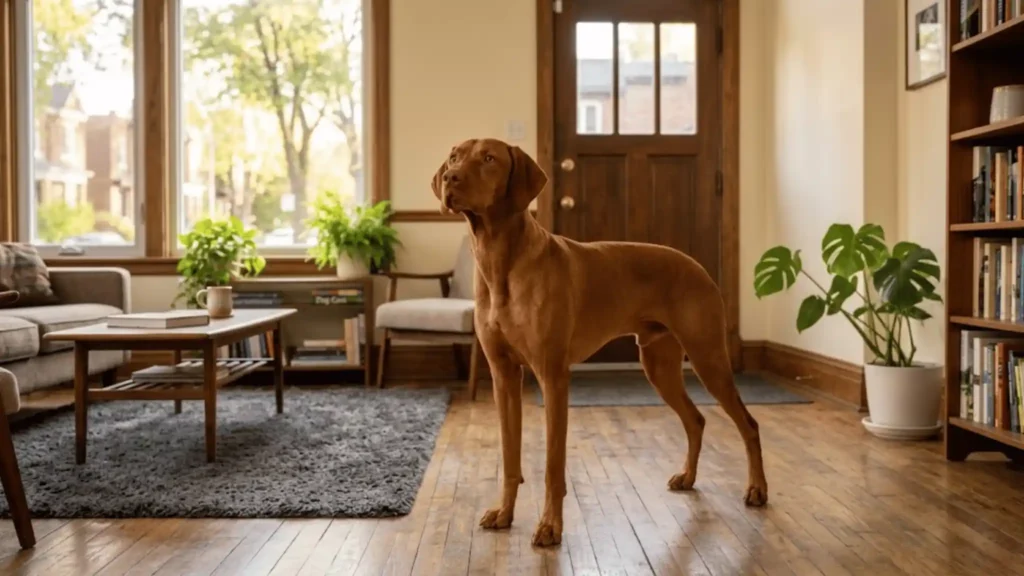
Vizsla separation anxiety should be assessed from the individual dog’s behavior. Close companionship does not establish a diagnosis or predict severity. See our guide to anxiety-prone dog breeds and dog anxiety by breed guide.
Assess your Vizsla’s behavior rather than assuming a breed diagnosis
The breed’s hunting background can inform discussions about suitable activity. It does not establish a special nervous-system deficit, an inability to self-regulate or a particular attachment pattern. Observe your dog’s triggers and comfortable tolerance.
Signs your Vizsla has separation anxiety
Note whether a normal activity routine is followed by relaxed rest, and whether confinement itself triggers distress. Use a resting area the individual dog tolerates; do not force hard exercise or crate use based on breed.
These signs can have other causes. Record the context and discuss persistent or concerning behavior with your veterinarian.
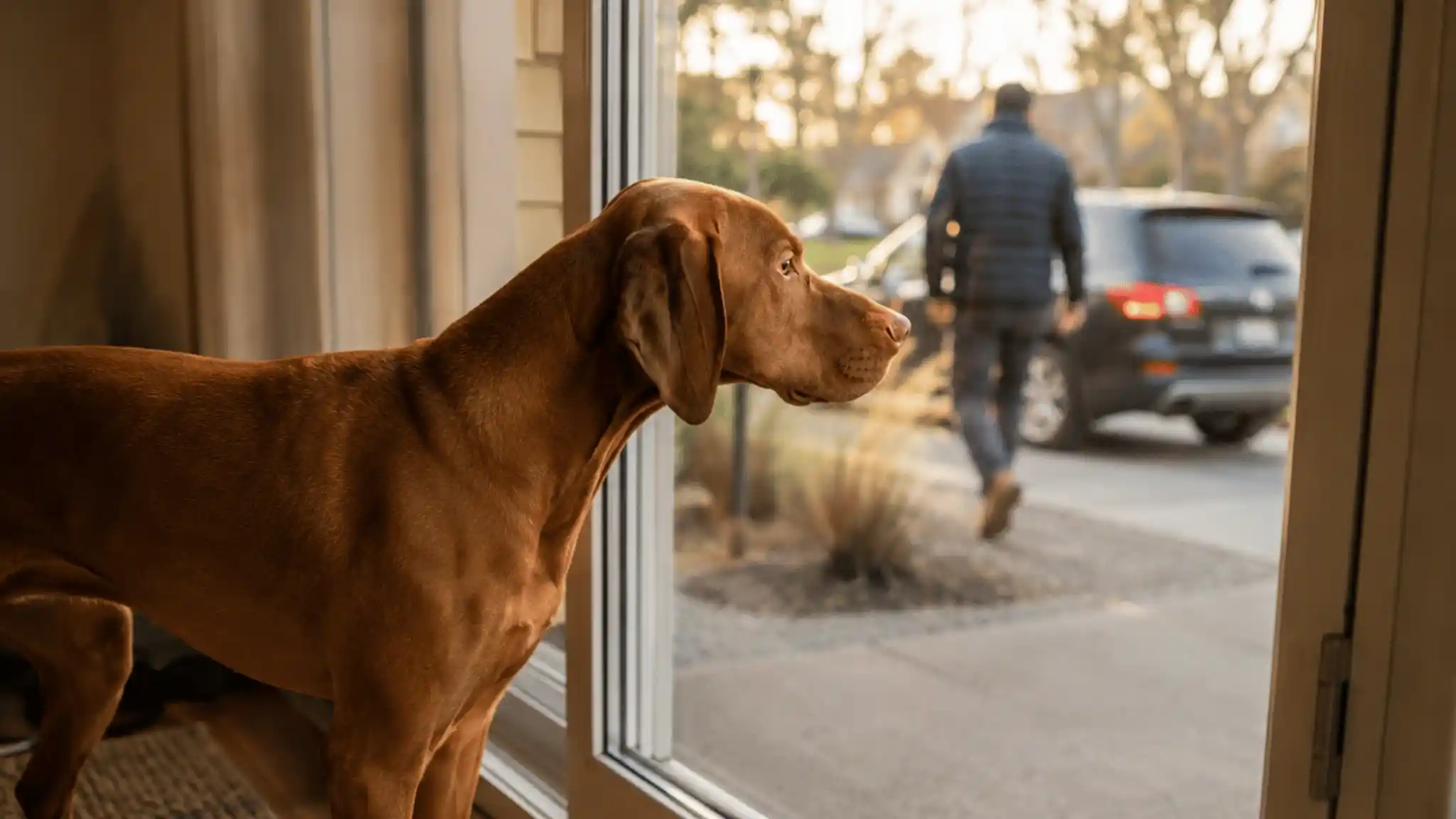
Vizsla separation anxiety doesn’t always look the same. Some dogs destroy. Some vocalize. Some just shut down and don’t eat. What they have in common is that the behavior starts when you leave, or when they sense you’re about to.
What you might see while you’re away
- Howling or barking that starts within minutes of you leaving and doesn’t stop
- Chewing through furniture, baseboards, or anything near the door
- Scratching at exits: some Vizslas damage their paws or nails trying to get out
- House accidents despite being fully trained
- Refusing to touch food or water until you return
- Frantic, over-the-top greeting when you walk back in (more than normal excitement)
Pre-departure signals to watch for
- Gluing themselves to you as you get ready in the morning
- Trembling or panting when they hear your alarm or see you put on shoes
- Yawning, lip-licking or drooling in context; these signs alone do not establish anxiety
- Whining or pacing before you’ve even picked up your bag
A camera can document the onset, context and duration of behavior. Rapid distress after departure warrants assessment, but a ten-minute cutoff does not establish a diagnosis. Share recordings with your veterinarian.
An individualized support plan
Choose management and practice based on your Vizsla’s observed response. Background sound or enrichment may be optional support, but neither substitutes for assessment.
Step 1: Offer suitable activity without forcing exhaustion
Choose activity according to age, health and preference, and allow recovery and relaxed rest before practice. There is no validated “energy capacity” percentage or universal exercise dose that makes separation tolerable.
Step 2: Desensitize your departure cues
Practice mild departure cues only while your dog remains comfortable. Actual separation may need to begin with a moment out of sight. Reduce difficulty if distress appears; do not progress automatically from thirty seconds to one or five minutes.
Step 3: Give them something to do when you walk out
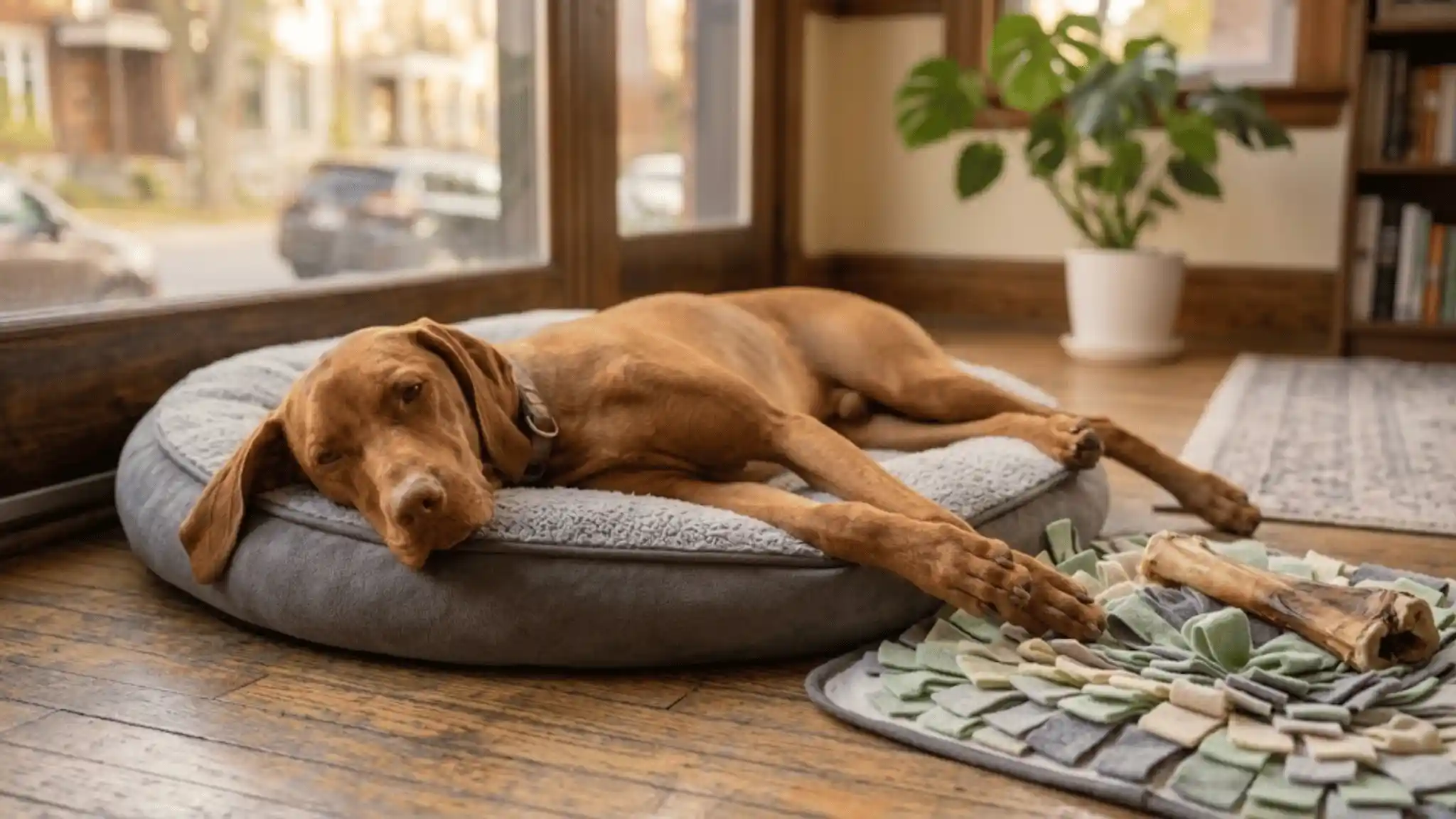
Introduce food enrichment while you are home and your dog is relaxed. It is optional support, not proof that separation anxiety is resolved. Follow the product’s sizing and supervision instructions. If your dog stops eating, becomes distressed, or damages the toy, stop the session and reassess. Do not extend an absence because food is available.
- An appropriately sized food toy introduced under supervision; if peanut butter is used, check for xylitol and dietary suitability
- A lick mat spread with plain yogurt or wet food
- A Kong Wobbler or similar food-dispensing toy that gives them something to work for
Introduce any enrichment while you are home first. Retain it only if your dog enjoys it comfortably and the manufacturer’s supervision guidance permits the planned use.
Step 4: Set up the environment carefully
Some Vizslas do better with free roam, while others spiral worse with too much space. A middle ground works well: one or two rooms with no access to exits or windows that face the driveway.
- Use a familiar resting area. Do not leave clothing within reach if your dog chews or swallows fabric; owner scent is not a proven replacement for treatment.
- White noise or a radio on low can help muffle outside sounds that would otherwise trigger alert barking
- If watching outside appears to trigger distress, test a less stimulating location while your dog remains comfortable. Do not assume that every Vizsla at a window is anxious.
Crates are a mixed bag with this breed. Some Vizslas find them genuinely soothing once properly introduced. Others feel confined in a way that amplifies the panic. If your dog is hurting themselves trying to get out of a crate, that’s your answer: the crate isn’t helping.
Step 5: Cap alone time during training
Arrange support for necessary absences that exceed your dog’s current relaxed tolerance. A brief midday visit does not prevent panic earlier in the absence; discuss a practical management plan with your professional.
Products worth trying
None of these replace the training above. But alongside a consistent plan, they can help.
Calming supplements
Evidence for calming supplements in dogs is limited and varies by ingredient and formulation. Research on an ingredient does not establish that a particular chew treats separation anxiety, and effects cannot be assumed for this breed. Ask your veterinarian whether a supplement is appropriate, including possible side effects and interactions. Supplements do not replace an individualized behavior plan.
→ Zesty Paws Calming Bites on Amazon
→ View VetriScience Calm & Confident on Amazon
Food enrichment toys
Food toys and lick mats provide optional enrichment, not a cure. Select the exact size and follow supervision instructions. The current Toppl destination shows a Small model; do not assume it holds more food than an unspecified KONG or suits every Vizsla.
→ Kong Classic on Amazon
→ View West Paw Toppl on Amazon
→ LickiMat Tuff Soother on Amazon
ThunderEase collar or Adaptil diffuser
A pheromone product may be considered as an adjunct after discussion with your veterinarian. Response varies, and benefit cannot be assumed for this breed. Follow the instructions for the exact product; it does not replace a behavior plan. Distinguish a collar from a diffuser refill and use the correct size or compatible device.
→ Check price on Amazon
The linked collar listing initially selects Large; check sizing and manufacturer instructions for your individual dog.
Pet camera
A camera can document behavior during necessary absences. The current Furbo link identifies a Furbo 360° model; check feature and subscription details. The link labelled Wyze Cam v4 currently leads to a eufy camera, so it should not be retained under the Wyze name. Stop remote audio if distress increases.
Use this optional planning resource at your dog’s pace. It does not guarantee recovery in seven days. Get it here →
When to bring in professional help
The appropriate plan and level of support depend on the individual dog. Persistent distress warrants professional assessment rather than assuming that a standard plan works for most Vizslas.
If your dog is injuring itself, cannot settle or has stopped eating, contact your veterinarian promptly. For persistent or severe distress, consult your veterinarian or a board-certified veterinary behaviorist. Prescription medication may be considered alongside behavior modification. Reconcile (fluoxetine) and Clomicalm (clomipramine) are veterinary products approved in the United States for canine separation anxiety as part of a behavior management plan. Suitability, response, side effects and monitoring depend on the individual dog. Do not start, combine or adjust medication without your veterinarian.
A qualified separation-anxiety professional may help with the behavioral plan. Severe cases need veterinary assessment and may require combined support; training and medication should not be presented as competing alternatives.
FAQ
Are Vizslas the worst breed for separation anxiety?
The checked sources do not establish that Vizslas are the worst breed for separation anxiety. Breed descriptions and “velcro dog” labels do not provide a clinical ranking. Assess the individual dog.
Can a Vizsla be left alone all day?
There is no universally suitable Vizsla alone-time limit. Health, age, toileting needs and observed comfort matter. Arrange care for an absence beyond the dog’s current tolerance rather than assuming four to six hours is acceptable.
Does getting a second dog help Vizsla separation anxiety?
Observe whether your dog remains relaxed with another trusted person while you leave. Distress when completely alone differs from distress despite familiar company. Another dog is not a reliable treatment; do not obtain a companion as a substitute for an individualized assessment.
How long does it take to treat Vizsla separation anxiety?
There is no reliable timeline based on breed or severity alone. Progress varies between dogs. Your veterinarian or a qualified behavior professional can help you adjust the plan.
Is Vizsla separation anxiety permanent?
Many dogs improve with appropriate support, but outcome and comfortable duration vary. Review the plan with your veterinarian if progress stalls or distress returns.
Final thoughts
Vizsla separation anxiety deserves an individualized plan. Record triggers, arrange support for difficult absences and practice only at comfortable levels. Improvement varies; the breed label does not establish that treatment will be harder than for other dogs.
Use this optional planning resource at your dog’s pace. It does not guarantee recovery in seven days. Get it here →

