🐾 Does your dog panic when you leave? → Get the Free 7-Day Starter Plan

Bichon Frise Separation Anxiety: Signs and Support

Affiliate disclosure: This article and its sidebar contain affiliate links. If you buy through these links, PetCalmZone may earn a commission at no extra cost to you.
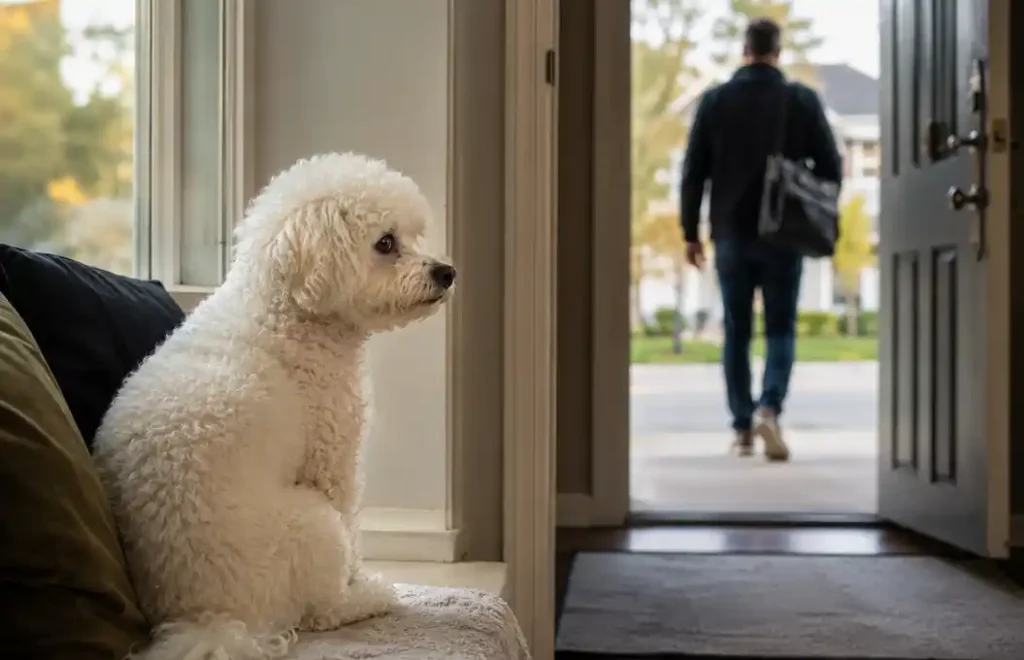
You walk to the front door and your Bichon Frise is already at your feet. You grab your keys and the whining starts. You step outside, and it’s chaos. Barking, scratching, sometimes a chewed pillow waiting when you get back.
Bichon Frise separation anxiety should be assessed from the dog’s behavior, not assumed from its companion-breed background. This guide covers signs, careful practice and support options. For broader context, see our guide to anxiety-prone dog breeds.
Why your Bichon may struggle with being alone
Breed background can provide context, but it does not diagnose separation anxiety or predict severity. Assess the individual dog’s health, history, behavior during absences and response to the plan.
Factors to record Note your dog’s experience with short absences, any recent routine changes, and sounds heard in an apartment. Carrying your dog or sharing a bed is not proof that you caused separation anxiety. Following you around can occur without a clinical disorder.
Signs of Bichon Frise Separation Anxiety
Note whether barking starts with your departure, a corridor sound or confinement. Where possible, compare ordinary recordings with familiar company present; avoid deliberately provoking panic to run a test.
These signs can have other causes. Record the context and discuss persistent or concerning behavior with your veterinarian.
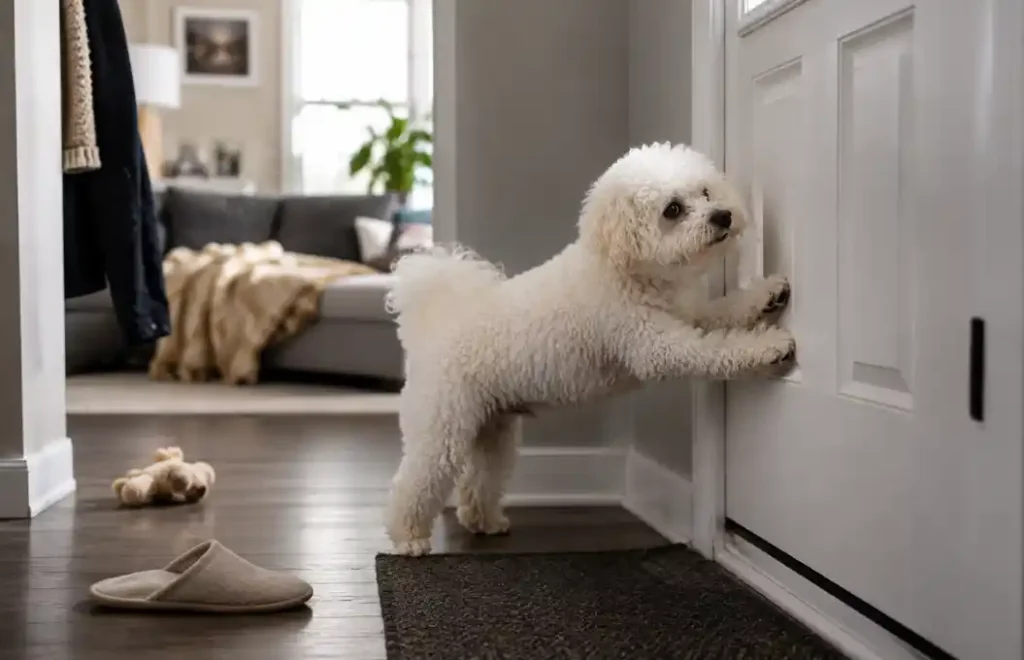
Some of these you’ll see before you leave. Some you’ll only find out about from the neighbor complaint or the damage you come home to.
Before you leave
- Follows you from room to room more than usual
- Gets restless the moment you pick up your keys or bag
- Paws at you, whines, or jumps repeatedly while you’re getting ready
- Won’t eat breakfast if you’re about to leave
While you’re gone
- Barking or howling that starts within minutes (neighbors will tell you)
- Scratching at doors or windows
- Chewing furniture, shoes, or anything near the exit
- Pacing or circling
- Urinating or defecating indoors despite being house-trained
When you get home
- Frantic greeting that lasts longer than 5 minutes
- Panting, pacing, or trembling even after you’ve returned
- Excessive licking or clinging for the rest of the evening
One sign that trips people up: Bichons with separation anxiety often seem completely fine once you’re home. The distress is real: it just shuts off when the trigger (your absence) is resolved. That can make owners underestimate how bad things get while they’re away. A dog camera is genuinely useful here.
The 5-Step Bichon Frise Separation Anxiety Plan
This isn’t about punishing the behavior or flooding your dog with alone time to “toughen him up.” Both approaches backfire with Bichons. What works is a slow, structured desensitization, giving your dog evidence, over and over, that being alone is safe.
Step 1: Practice comfortable distance at home
Start with a separation your dog can handle without signs of distress, which may be only a moment out of sight. Monitor body language rather than waiting for barking to stop. If distress appears, end the attempt calmly and make the next session easier. Increase duration only after repeated relaxed sessions; do not follow a fixed schedule.
Step 2: Build a departure routine that signals safety
Right now, your departure cues (keys jingling, putting on shoes, picking up your bag) are stress triggers. Your dog has learned that these sounds mean panic time.
Desensitize them one at a time. Pick up your keys and sit back down. Put on your shoes and watch TV for ten minutes. Open the front door and close it without leaving. Do this multiple times a day until none of these actions cause your dog to react.
Keep your departure routine calm. Do not use the dog’s distress as a reason to withhold comfort or assume that reassuring words caused the problem.
Step 3: Give them something better to do than panic
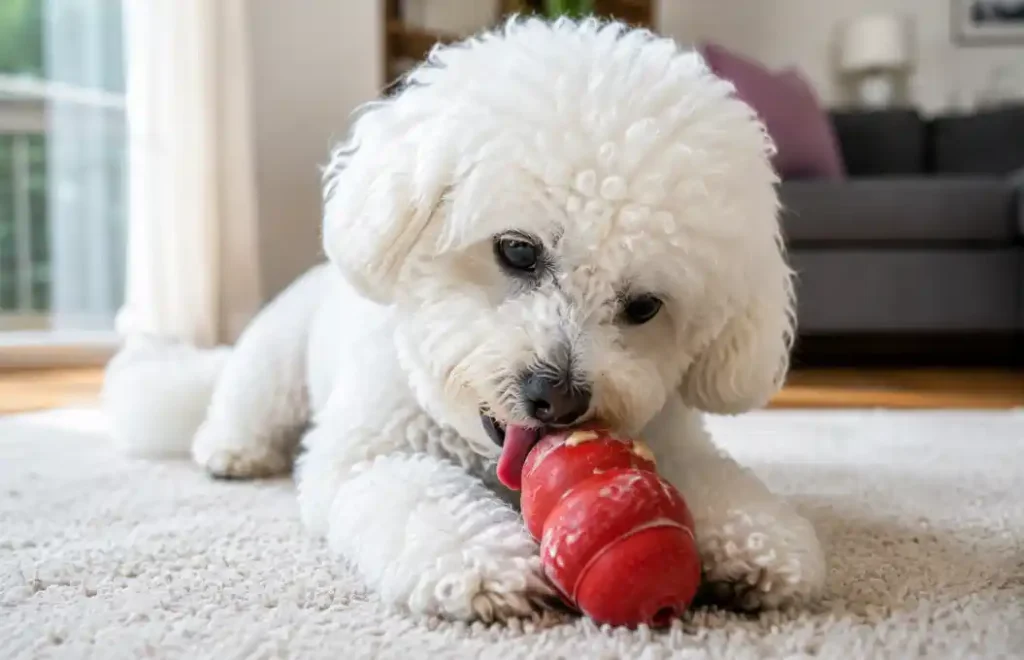
Introduce food enrichment while you are home and your dog is relaxed. It is optional support, not proof that separation anxiety is resolved. Follow the product’s sizing and supervision instructions. If your dog stops eating, becomes distressed, or damages the toy, stop the session and reassess. Do not extend an absence because food is available. Use your dog’s usual food where appropriate; if using peanut butter, check that it contains no xylitol. Ask your veterinarian about dietary restrictions.
Step 4: Add calming support, but use it right
A pheromone product may be considered as an adjunct after discussion with your veterinarian. Response varies, and benefit cannot be assumed for this breed. Follow the instructions for the exact product; it does not replace a behavior plan.
Three things worth trying for bichon frise anxiety specifically:
- A pheromone product may be considered as an adjunct after discussion with your veterinarian. Response varies, and benefit cannot be assumed for this breed. Follow the instructions for the exact product; it does not replace a behavior plan.
- If outside sounds appear to trigger barking, a quiet, steady background sound may be worth testing while you are home. Stop if your dog becomes more alert. There is no established breed-specific tempo prescription.
- A familiar resting area may be comfortable for your dog. Do not leave clothing accessible if your dog chews or swallows fabric; scent is not a substitute for treatment.
Step 5: Increase alone time gradually using data
This is where a dog camera earns its price. You need to know what actually happens when you leave, not what you imagine, not what the neighbors say. What you can see on video.
Start with a separation your dog can handle without signs of distress, which may be only a moment out of sight. Monitor body language rather than waiting for barking to stop. If distress appears, end the attempt calmly and make the next session easier. Increase duration only after repeated relaxed sessions; do not follow a fixed schedule.
There is no reliable breed-specific recovery timetable. Track relaxed behavior at each duration and adjust the plan with your veterinarian or qualified behavior professional. Do not test a full workday before shorter absences are comfortable.
Products That Help With Bichon Frise Separation Anxiety
These products are optional tools for observation or enrichment. They are not proven Bichon-specific treatments. Choose them according to your dog’s needs and the exact product instructions.
KONG Classic: choose the correct size
Use the manufacturer’s size and chewing-strength guidance for your individual dog. The current Amazon destination shows a Small two-pack; it is not a verified Medium option. Supervise use and inspect for damage. View KONG Classic listing on Amazon.
Adaptil Calm Home Diffuser
The current link leads to a ThunderEase pheromone refill powered by ADAPTIL, not a verified diffuser starter kit. A refill requires the compatible diffuser specified by the manufacturer. Benefit cannot be assumed for your dog.
Furbo Dog Camera
A camera can help record behavior during necessary absences. Check the exact model’s features and any subscription requirements. Two-way audio may upset some dogs; stop using it if distress increases. Check price on Amazon.
Snuggle Puppy Behavioral Aid
A heartbeat toy may be an optional comfort item, but it is not a proven treatment for Bichon separation anxiety. Follow instructions for the toy and heat pack, supervise use, and remove it if damaged or chewed. Check price on Amazon.
Nina Ottosson Dog Tornado: optional enrichment
A food puzzle can provide supervised enrichment if your dog enjoys it. Engagement time varies; do not rely on it to make an otherwise distressing absence tolerable. Check price on Amazon.
Free 7-Day Dog Anxiety Starter Plan
Our free 7-Day Dog Anxiety Starter Plan is an optional planning resource. Adapt practice to your dog’s comfort and your veterinarian’s advice; its name does not promise recovery in seven days.
Adjust any suggested practice to your dog’s comfort. A fixed daily sequence cannot determine when an individual dog is ready to progress.
Use this optional planning resource at your dog’s pace. It does not guarantee recovery in seven days. Download the 7-Day Dog Anxiety Starter Plan here.
When to Call Your Vet or a Behaviorist
Seek veterinary advice promptly for persistent distress, loss of appetite, escape attempts, self-injury or a sudden change in behavior. You do not need to wait several weeks before asking for help. Your veterinarian can assess medical causes and recommend a qualified behavior professional.
If your dog is injuring itself, cannot settle or has stopped eating, contact your veterinarian promptly. For persistent or severe distress, consult your veterinarian or a board-certified veterinary behaviorist. Prescription medication may be considered alongside behavior modification. Reconcile (fluoxetine) and Clomicalm (clomipramine) are veterinary products approved in the United States for canine separation anxiety as part of a behavior management plan. Suitability, response, side effects and monitoring depend on the individual dog. Do not start, combine or adjust medication without your veterinarian.
Bichon Frise Separation Anxiety FAQ
How long does it take to fix bichon frise separation anxiety?
There is no reliable breed-specific recovery timetable. Track relaxed behavior at each duration and adjust the plan with your veterinarian or qualified behavior professional. Do not test a full workday before shorter absences are comfortable.
Does getting a second dog help with bichon frise anxiety?
Observe whether your dog remains relaxed with another trusted person while you leave. Distress when completely alone differs from distress despite familiar company. Another dog is not a reliable treatment; do not obtain a companion as a substitute for an individualized assessment.
Should I crate my Bichon?
Only if your dog was already comfortable in the crate before the anxiety started. Crating a Bichon who dislikes the crate and already has separation anxiety makes both problems worse simultaneously. If the crate causes stress on its own, skip it and use a baby-gated room instead.
Are Bichon Frises worse for separation anxiety than other small breeds?
The checked sources do not establish a reliable ranking of separation-anxiety risk between these small breeds. A companion-breed history does not predict your dog’s diagnosis or response to training.
My Bichon only acts anxious on weekday mornings. Why?
Weekday cues may be associated with longer absences. Record the pattern and practice only cues or separations your dog can handle comfortably; do not add random five-minute absences if they cause distress.
Final Thoughts
Bichon Frise separation anxiety is a welfare concern, not evidence of spite or manipulation. Use your dog’s observed comfort to set the pace, and seek professional help when needed. Progress varies; this plan does not guarantee a result in a few weeks.
For more on how breed affects anxiety levels and what that means for your training approach, see our full guide to dog anxiety by breed.

