🐾 Does your dog panic when you leave? → Get the Free 7-Day Starter Plan

Chihuahua Separation Anxiety: Signs and Support

Affiliate disclosure: This article and its sidebar contain affiliate links. If you buy through these links, PetCalmZone may earn a commission at no extra cost to you.
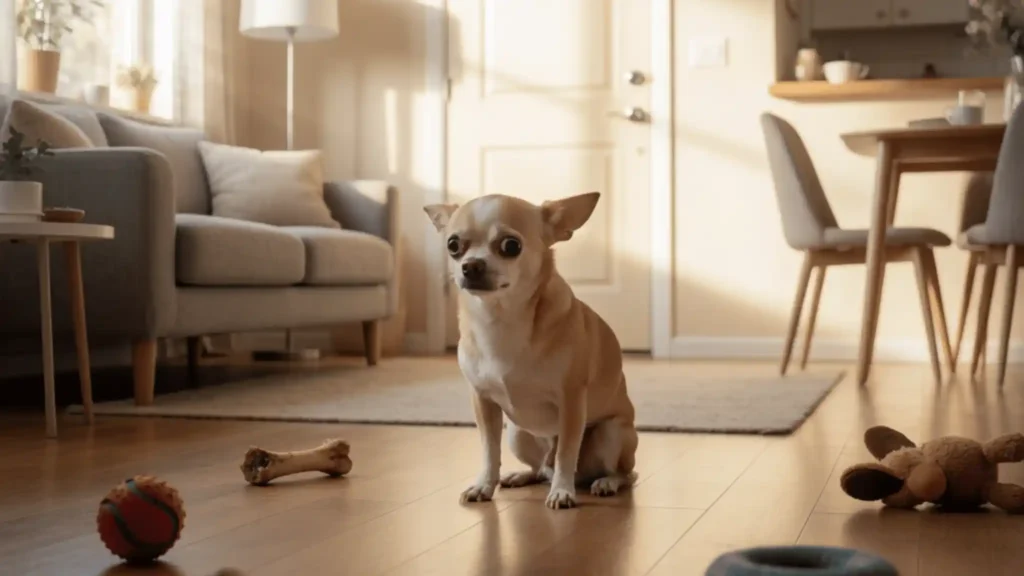
For a four-pound dog, a Chihuahua can create an impressive amount of chaos when left alone. The barking. The scratching at the door. The neighbor knocking. And when you get home, a dog that greets you like you survived a natural disaster.
Chihuahua separation anxiety should be assessed from the individual dog’s behavior. Small size and a close bond do not establish a diagnosis. See our guide to anxiety-prone dog breeds for broader context.
Here’s what’s actually driving the behavior, how to recognize it, and a 5-step plan that addresses the causes rather than just managing the symptoms.
Table of Contents
What to assess in your Chihuahua
Record whether distress occurs when one person leaves despite familiar company, or only when the dog is completely alone. Note outside noises, confinement and recent routine changes. Carrying a small dog or sharing a bed does not prove that the owner caused anxiety.
Signs of chihuahua separation anxiety
Check the actual fit of toys, gates and wraps. Record trembling in context and ask your veterinarian about new or persistent shaking rather than assuming it is cold or anxiety.
These signs can have other causes. Record the context and discuss persistent or concerning behavior with your veterinarian.
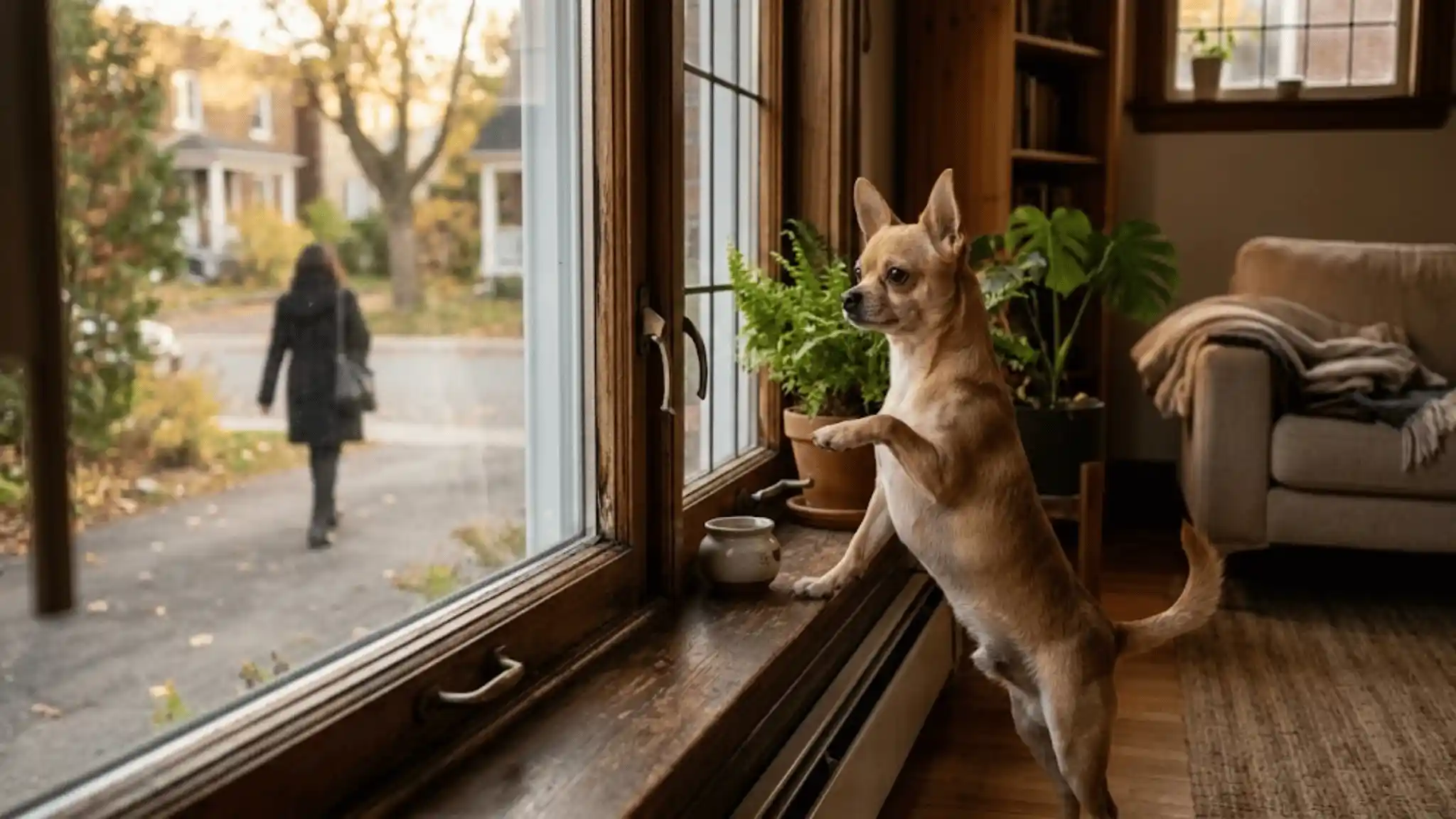
Trembling can have several causes, including temperature, excitement, pain or illness. A recording and veterinary assessment are more useful than assuming it is anxiety or cold. Seek advice for new, persistent or concerning shaking.
Before you leave
- Follows you from room to room, pressed against your leg
- Trembles or shakes when you start getting ready
- Refuses food despite normally being food-motivated
- Barks or cries when you pick up your bag or keys
- Tries to physically block the door
While you’re away
- Sustained barking or howling (neighbors will let you know)
- Scratching at doors, especially near the entrance
- Accidents inside despite being house-trained
- Pacing or circling
- In severe cases, self-directed behaviors like licking paws raw
When you return
- Greeting intensity that seems out of proportion: jumping, spinning, crying
- Shaking that continues for several minutes after you’re home
- Clinging behavior for the rest of the evening
A dog camera is particularly useful with Chihuahuas because so much of their anxiety behavior is vocal. If you’re getting noise complaints but your dog looks fine when you return, the camera will show you exactly what’s happening in the first 15 minutes after you leave.
The 5-step chihuahua separation anxiety plan
Use an individualized plan based on your Chihuahua’s actual triggers, size and comfortable separation duration.
Step 1: Reward comfortable rest at a manageable distance
Start with a separation your dog can handle without signs of distress, which may be only a moment out of sight. Monitor body language rather than waiting for barking to stop. If distress appears, end the attempt calmly and make the next session easier. Increase duration only after repeated relaxed sessions; do not follow a fixed schedule.
Step 2: Dismantle the departure trigger routine
Your keys, your shoes, your coat: these are already loaded signals. Your Chihuahua starts feeling anxious the moment they appear. You need to separate those signals from the actual departure.
Practice mild departure cues while your dog remains comfortable. Keep exits calm and predictable. There is no one-week deadline, and reassurance should not be presented as causing anxiety.
Step 3: Give them an occupation for the departure window
Introduce food enrichment while you are home and your dog is relaxed. It is optional support, not proof that separation anxiety is resolved. Follow the product’s sizing and supervision instructions. If your dog stops eating, becomes distressed, or damages the toy, stop the session and reassess. Do not extend an absence because food is available. If using peanut butter, check for xylitol. Select equipment for your dog’s weight, mouth and chewing style rather than prescribing XS solely because the dog is a Chihuahua.
Step 4: Manage the sound environment
If barking follows hallway or outside sounds, test a steady background sound at a comfortable volume while you are home. Keep it only if your dog remains relaxed. Noise management does not address every cause of separation distress.
A pheromone product may be considered as an adjunct after discussion with your veterinarian. Response varies, and benefit cannot be assumed for this breed. Follow the instructions for the exact product; it does not replace a behavior plan.
A pressure wrap is an optional support, not an established breed-specific treatment. Check fit and manufacturer instructions, introduce it under supervision, and stop if your dog appears uncomfortable. Being comfortable when held does not establish that a wrap will help.
Step 5: Build duration according to relaxed behavior
Start with a separation your dog can handle without signs of distress, which may be only a moment out of sight. Monitor body language rather than waiting for barking to stop. If distress appears, end the attempt calmly and make the next session easier. Increase duration only after repeated relaxed sessions; do not follow a fixed schedule.
There is no reliable breed-specific recovery timetable. Track relaxed behavior at each duration and adjust the plan with your veterinarian or qualified behavior professional. Do not test a full workday before shorter absences are comfortable.
Optional tools and product considerations with chihuahua separation anxiety
Chihuahuas are small enough that sizing matters. A large KONG or heavy puzzle feeder designed for a Labrador isn’t going to work the same way for a four-pound dog. Here’s what’s worth getting for this breed specifically.
KONG Classic: check the selected size
Follow the manufacturer’s guidance for your dog. The current linked listing is a Small two-pack, not the XS product stated here. Confirm the selected size before purchasing and supervise use. View KONG Classic listing on Amazon.
White noise machine
Particularly useful for apartment-dwelling Chihuahuas. Place it near the front door or in the main room to muffle hallway sounds that trigger barking. Any white noise machine works: look for one with a consistent, non-looping sound file. Check price on Amazon
ThunderShirt: check fit before purchase
A pressure wrap is an optional support, not an established breed-specific treatment. Check fit and manufacturer instructions, introduce it under supervision, and stop if your dog appears uncomfortable. Being comfortable when held does not establish that a wrap will help. The current linked listing opens a Large vest; it is not a verified Extra Small option.
Furbo Dog Camera
The barking alert feature is especially relevant for Chihuahuas: you’ll know within minutes whether the departure went well or not. Two-way audio means you can check in without going back home. Check price on Amazon
Adaptil Calm Home Diffuser
The current destination is a ThunderEase pheromone refill powered by ADAPTIL. It is not a verified Adaptil diffuser starter kit; check device compatibility and instructions before purchase.
Free 7-Day Dog Anxiety Starter Plan
Our free 7-Day Dog Anxiety Starter Plan is an optional planning resource. Adapt practice to your dog’s comfort and your veterinarian’s advice; its name does not promise recovery in seven days.
Use this optional planning resource at your dog’s pace. It does not guarantee recovery in seven days. Download the 7-Day Dog Anxiety Starter Plan here.
When to call your vet or a behaviorist
Seek veterinary advice promptly for persistent distress, loss of appetite, escape attempts, self-injury or a sudden change in behavior. You do not need to wait several weeks before asking for help. Your veterinarian can assess medical causes and recommend a qualified behavior professional.
If your dog is injuring itself, cannot settle or has stopped eating, contact your veterinarian promptly. For persistent or severe distress, consult your veterinarian or a board-certified veterinary behaviorist. Prescription medication may be considered alongside behavior modification. Reconcile (fluoxetine) and Clomicalm (clomipramine) are veterinary products approved in the United States for canine separation anxiety as part of a behavior management plan. Suitability, response, side effects and monitoring depend on the individual dog. Do not start, combine or adjust medication without your veterinarian. Related resources: canine separation anxiety
If progress stalls or distress is persistent, a veterinary behaviorist can help assess the situation and adjust the plan. Do not wait eight weeks when welfare is affected.
Chihuahua separation anxiety FAQ
Why does my Chihuahua only have separation anxiety with me and not my partner?
If your Chihuahua remains comfortable with your partner but is distressed when you leave, record that pattern for your veterinarian. It may involve separation from a particular person, but it is not an inevitable Chihuahua trait. Plan practice around the observed trigger.
My neighbors are complaining about barking. What do I do right now?
Arrange trusted care for absences that currently cause distress, record the barking pattern and seek veterinary guidance. Background sound or enrichment may be optional support if tolerated. Do not use anti-bark punishment to suppress distress.
Can chihuahua separation anxiety be cured permanently?
Many dogs improve with appropriate support, but a permanent cure cannot be promised. Monitor behavior after major routine changes and adjust the plan if distress returns; a Chihuahua-specific recurrence rate has not been established here.
Should I get a second dog to keep my Chihuahua company?
Observe whether your dog remains relaxed with another trusted person while you leave. Distress when completely alone differs from distress despite familiar company. Another dog is not a reliable treatment; do not obtain a companion as a substitute for an individualized assessment.
How long until my Chihuahua can be left alone for a full workday?
There is no reliable breed-specific recovery timetable. Track relaxed behavior at each duration and adjust the plan with your veterinarian or qualified behavior professional. Do not test a full workday before shorter absences are comfortable.
Final thoughts
Chihuahua separation anxiety deserves support, not blame. Base practice on relaxed behavior and arrange care for absences that are currently too difficult. Comforting or carrying your dog is not proof that you caused the problem. Improvement varies, and distress should not be treated as something to wait out.
For more on how breed history shapes anxiety behavior, see our guide to dog anxiety by breed.