🐾 Does your dog panic when you leave? → Get the Free 7-Day Starter Plan

Cavalier King Charles Separation Anxiety: What Owners Know
Cavalier King Charles Spaniels were bred to never leave their owner's side. That makes separation anxiety almost inevitable. Here's what it looks like and how to manage it.

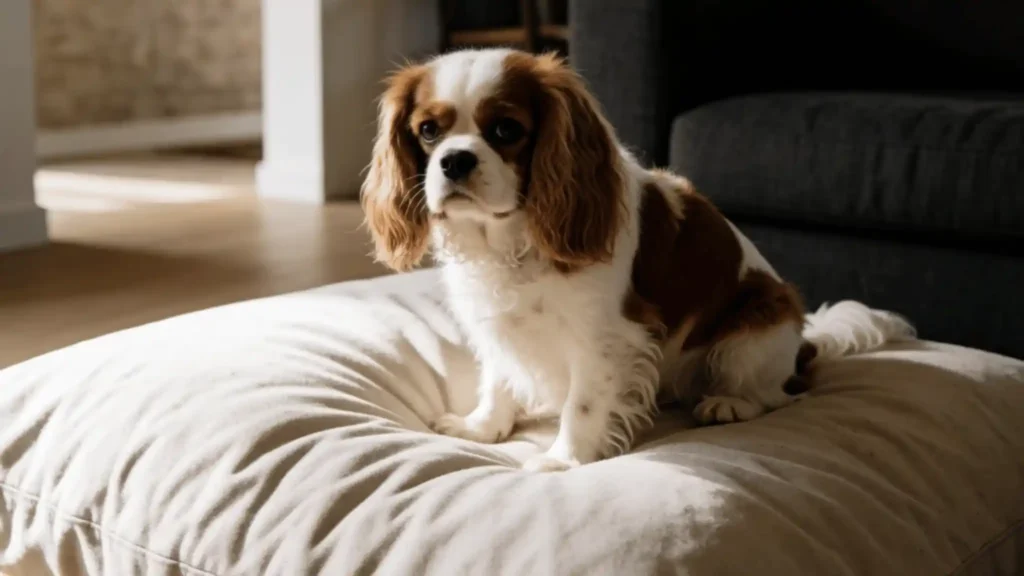
Cavalier King Charles separation anxiety is among the most common behavioral problems in the breed, and probably the most predictable. Cavaliers were bred over centuries to be constant human companions. They weren’t designed to be alone, and most of them make that clear.
Why Cavaliers are especially prone to separation anxiety
The Cavalier King Charles Spaniel has one of the clearest breeding histories of any companion dog. They were developed specifically to sit with royalty: on laps, in beds, in carriages. They were warmth, comfort, and company. Every generation was selected for one thing above all: closeness to a person.
That breeding has produced a dog with an unusually strong attachment drive. Cavaliers don’t just prefer company: they seem to need it at a biological level. Most owners describe their Cavalier as a shadow. Wherever you go, the dog goes. Whatever room you’re in, that’s where they want to be.
When that attachment figure disappears, even briefly, the dog’s nervous system responds as if something is genuinely wrong. That’s not drama. It’s a predictable result of what the breed was created to do.
There’s also a health dimension worth knowing. Cavaliers have high rates of mitral valve disease (MVD), a heart condition that affects most dogs in the breed by middle age. Chronic stress and anxiety place additional strain on the cardiovascular system. Managing separation anxiety in a Cavalier isn’t just a behavioral issue. It can have real health implications for a breed already carrying significant cardiac risk.
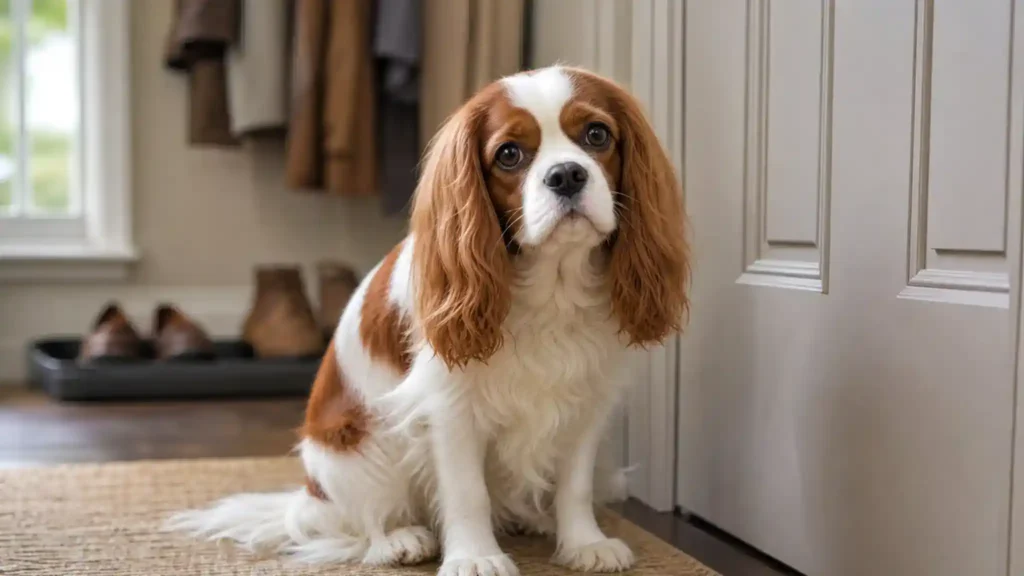
Signs of Cavalier King Charles separation anxiety
The signs in Cavaliers tend to start earlier and present more quietly than in high-energy breeds. You won’t always get the dramatic howling of a Husky or the door-destruction of a Frenchie. Cavalier distress can be subtler, which sometimes means owners don’t catch it until a neighbor complains or they set up a camera.
What to look for when you’re away:
- Whining or crying: lower and more persistent than barking in many cases
- Pacing, particularly near exits or windows that face the direction you left
- Refusing treats or food left behind
- Trembling or shaking: more common in Cavaliers than in other breeds
- Excessive drooling or lip-licking
- Accidents inside despite being housetrained
At home, the clearest warning sign is inability to be in a different room from you. A Cavalier that can’t settle unless they’re touching you, or that immediately gets up and follows when you move, is showing a dependence level that almost always predicts separation problems.
Watch for pre-departure anxiety too. Some Cavaliers start showing distress when they see you getting dressed for work, or when you pick up your keys. If your dog is trembling or whining before you’ve even left, the anxiety is building well before the actual separation.
How serious does it get?
Mild cases: some whining for 15-20 minutes, then the dog settles. This is manageable and often responds well to gradual desensitization.
Moderate cases: distress for most or all of your absence. Dog doesn’t eat, doesn’t rest, may develop GI symptoms from stress. Neighbors notice. This needs consistent behavioral work and often vet consultation.
Severe cases: self-injury attempts, extreme trembling, vomiting from anxiety. Given the Cavalier’s cardiac health issues, severe and sustained distress warrants urgent veterinary attention, not just behavioral management.
What actually helps

Build independence in small steps at home
Cavaliers tend to be sensitive to change and respond best to gentle, incremental progress. Start by teaching your dog to settle on a mat or bed while you’re still in the room: reward calm behavior, not just the following. Then practice brief separations within the house. Close a door between you for 30 seconds. Return before your dog reacts. Repeat until they stop caring.
Don’t rush this stage. Cavaliers who are pushed too fast through desensitization often plateau or backslide. Small, consistent steps work better than ambitious jumps.
Practice calm departures and arrivals
Cavaliers are highly attuned to your emotional state. If you leave with a lot of reassurance, “it’s okay, I’ll be back soon”, your dog reads that as confirmation something is wrong. Leave matter-of-factly. Return the same way. Greet your dog calmly, wait until they’re settled, then give attention. Over time this flattens the emotional peaks around your departures and returns.
Neutralize departure cues
Put on your shoes and stay home. Pick up your bag and put it down. Grab your keys and sit on the couch. Cavaliers read your routine carefully: disrupting the pattern breaks the predictive chain that triggers pre-departure anxiety.
Use calming support carefully
Evidence for calming supplements in dogs is limited and varies by ingredient and formulation. Research on an ingredient does not establish that a particular chew treats separation anxiety, and effects cannot be assumed for this breed. Ask your veterinarian whether a supplement is appropriate, including possible side effects and interactions. Supplements do not replace an individualized behavior plan. If your Cavalier has heart disease or takes cardiac medication, ask your veterinarian to review the exact ingredients before use.
A pressure wrap like a ThunderShirt can help reduce acute anxiety without any pharmacological effects, which makes them useful during the early stages of desensitization training or for specific triggers like thunderstorms or vet visits.
For the complete training protocol, see our complete guide to dog separation anxiety. For supplement options, read our guide to the best calming supplements for dogs.
What doesn’t work
Excessive reassurance. Telling your Cavalier it’s okay, holding them before you leave, drawing out goodbyes: this signals that your departure is an event worth worrying about. It reinforces the anxiety rather than reducing it.
Getting another dog as a quick fix. Some Cavaliers settle with a companion. But if the anxiety is specifically about you rather than general loneliness, another dog won’t solve it. Assess the nature of the anxiety first.
Waiting for them to “get used to it.” Cavaliers don’t typically habituate to solitude without deliberate help. Without intervention, most cases stay the same or worsen as the dog becomes older and more deeply attached.
When to involve your vet
If your dog is injuring itself, cannot settle or has stopped eating, contact your veterinarian promptly. For persistent or severe distress, consult your veterinarian or a board-certified veterinary behaviorist. Prescription medication may be considered alongside behavior modification. Reconcile (fluoxetine) and Clomicalm (clomipramine) are veterinary products approved in the United States for canine separation anxiety as part of a behavior management plan. Suitability, response, side effects and monitoring depend on the individual dog. Do not start, combine or adjust medication without your veterinarian.
A veterinary cardiologist and a behaviorist working together isn’t unusual with this breed. It’s worth asking for a referral if the anxiety is significantly affecting your dog’s quality of life.
Frequently asked questions
Are Cavaliers the most anxious breed?
They consistently rank near the top of separation anxiety prevalence lists. Their companion dog history, combined with their sensitivity and attachment drive, makes them one of the higher-risk breeds. Studies on separation anxiety in dogs regularly include Cavaliers in the top tier.
How long can a Cavalier be left alone?
Most adult Cavaliers can manage 3-4 hours with proper training. Beyond that, distress becomes likely for most dogs in this breed. Puppies should not be left alone for more than an hour or two. If your schedule requires longer absences regularly, a dog walker or sitter is worth the investment.
Does the heart condition affect separation anxiety treatment?
It can. If your Cavalier has been diagnosed with MVD or is on cardiac medication, talk to your vet before starting any supplement. Some calming products interact with cardiac drugs. Sustained anxiety also worsens cardiovascular strain, which gives extra reason to address it rather than manage around it.
Can Cavalier separation anxiety be fixed completely?
Many dogs improve significantly with consistent training. The underlying attachment drive doesn’t disappear, but most owners can reach a point where their dog handles normal absences without visible distress. Severe cases typically need medication alongside behavioral work to achieve meaningful improvement.
At what age does it typically start?
It can appear early, sometimes as soon as a Cavalier puppy comes home and bonds with its owner. It can also emerge or worsen later, triggered by a schedule change, a move, or the loss of another pet or person in the household. In this breed, even mild puppyhood anxiety is worth taking seriously before it becomes entrenched.
Related guides