🐾 Does your dog panic when you leave? → Get the Free 7-Day Starter Plan

French Bulldog Separation Anxiety: What Owners Should Know
French Bulldogs struggle badly with being alone. Here's why they develop separation anxiety, what the signs look like, and what actually works.


French bulldog separation anxiety is more common than most owners expect, and it tends to hit harder with this breed than with most others. French Bulldogs were bred to be with people constantly. That history shapes everything about how they respond when you leave.
This guide covers why it happens, how to spot it, and what actually works, plus what doesn’t.
Why French Bulldogs are prone to separation anxiety
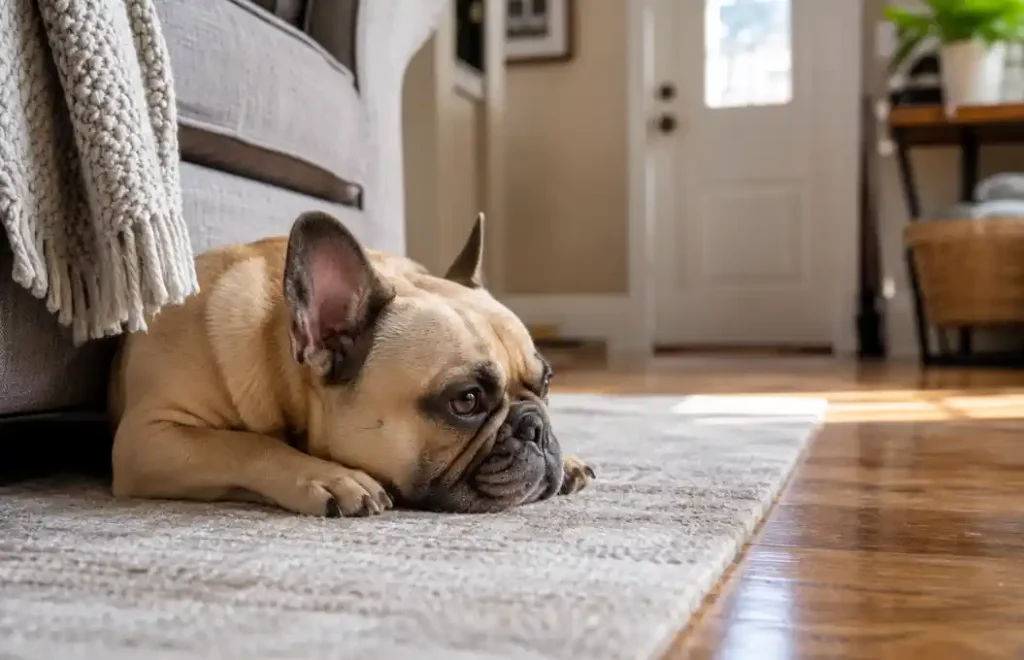
The short version: it’s in the breeding.
French Bulldogs were developed in France in the 1800s by lace workers who wanted a smaller, lap-friendly companion dog. They weren’t bred to herd, guard, or hunt. Every generation of selective breeding pushed toward one trait: closeness to people. The result is a dog that organizes its sense of safety almost entirely around your presence. Border Collies redirect their energy into motion when stressed. German Shepherds scan their environment. French Bulldogs don’t have that outlet. They just wait.
There’s also a physical factor that makes things worse. French Bulldogs are brachycephalic: their flat faces cause narrowed airways. Anxiety triggers panting. Panting is harder for Frenchies than for most dogs. More panting leads to more physical stress, which amplifies the anxiety. The cycle escalates faster than it would in a dog without a breathing restriction.

Signs of French Bulldog separation anxiety
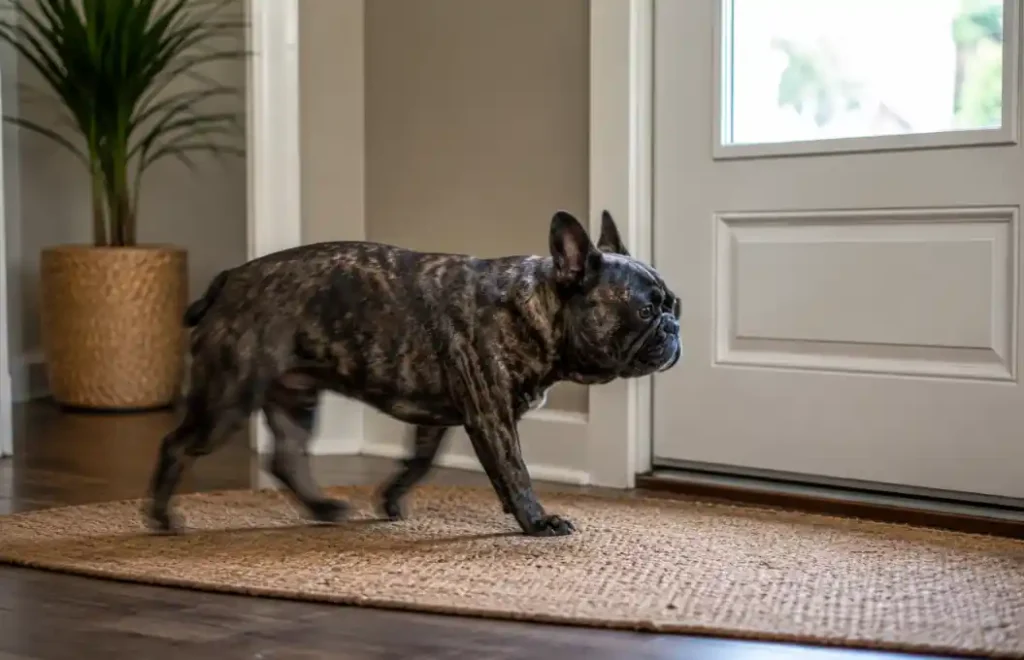
The clearest signal is what happens in the first 20-30 minutes after you leave. Most dogs settle eventually. A dog with separation anxiety doesn’t.
Set up a camera before you draw any conclusions. What you’ll see if the problem is real:
- Barking or howling that starts within a few minutes and doesn’t stop
- Pacing near exits, especially the front door
- Destructive behavior around entry points: scratching at doors, chewing baseboards
- Accidents inside despite being housetrained
- Excessive drooling
At home, watch for velcro behavior. If your Frenchie follows you room to room and can’t settle unless you’re visible, that pattern tends to predict separation anxiety. It means their sense of safety is entirely dependent on you being present.
Panting is tricky with this breed: it can mean anxiety, or it can mean they’re too warm, or it can just be normal Frenchie breathing. Context matters. Panting that starts the moment you reach for your keys is almost certainly anxiety-driven.
How serious can it get?
Mild cases look like 15-20 minutes of barking, then your dog settles. Moderate means it doesn’t stop. You come home to a hoarse dog and a chewed door frame.
Severe separation anxiety in French Bulldogs is a vet issue, not just a training issue. Sustained distress combined with brachycephalic breathing can cause real physical harm, especially in warm conditions. If your dog is showing prolonged panting, self-injury, or escape attempts, don’t try to manage that with a training guide alone. Talk to your vet first.
What actually helps


There’s no quick fix. But there are approaches that work when you’re consistent about them.
Build independence at home first

Before you practice being absent, teach your Frenchie that being out of your sight inside the house is fine. Feed meals from a puzzle feeder in another room. Practice short in-home separations: go to another room, close the door, come back in two minutes. Repeat until your dog stops caring. This is the foundation everything else builds on.
Work on departure desensitization
Leave for two minutes. Come back calm: no big greeting, no excitement. Then five minutes. Then ten. The goal is boring, predictable returns. Your dog learns you always come back, and that your return isn’t a party worth suffering for. Overdoing the greeting when you get home accidentally makes the problem worse.
Break apart your departure cues
Most anxious Frenchies start reacting to your routine before you’ve even touched the door. They’ve learned the pattern. Pick up your keys and sit back down. Put on your coat and watch TV. Gradually, those cues lose their predictive power and the pre-departure panic stops triggering.
Use calming support at the edges
Evidence for calming supplements in dogs is limited and varies by ingredient and formulation. Research on an ingredient does not establish that a particular chew treats separation anxiety, and effects cannot be assumed for this breed. Ask your veterinarian whether a supplement is appropriate, including possible side effects and interactions. Supplements do not replace an individualized behavior plan. Related resources: ThunderShirt
For a complete step-by-step training protocol, see our complete guide to dog separation anxiety.
What doesn’t work
Punishment. If you come home to a destroyed couch and scold your dog, they can’t connect it. The anxiety happened hours ago. All they know is that you came home angry, which makes the anxiety worse next time.
Getting a second dog. If your Frenchie’s anxiety is about you specifically, another dog won’t fix it. Some dogs improve with a companion. Most don’t. Don’t bring home a second dog to solve the first dog’s anxiety.
Waiting it out. Some dogs habituate on their own. French Bulldogs bred for constant companionship usually don’t. Without deliberate desensitization, most cases stay the same or get worse over time.
When to call a vet
If your dog is injuring itself, cannot settle or has stopped eating, contact your veterinarian promptly. For persistent or severe distress, consult your veterinarian or a board-certified veterinary behaviorist. Prescription medication may be considered alongside behavior modification. Reconcile (fluoxetine) and Clomicalm (clomipramine) are veterinary products approved in the United States for canine separation anxiety as part of a behavior management plan. Suitability, response, side effects and monitoring depend on the individual dog. Do not start, combine or adjust medication without your veterinarian.
One more thing worth noting: if your Frenchie is showing new anxiety symptoms without a clear trigger, rule out pain or illness first. Thyroid conditions and chronic pain can look exactly like behavioral anxiety.
Frequently asked questions
Do all French Bulldogs get separation anxiety?
No, but they’re one of the more vulnerable breeds. Because they were bred specifically as companion dogs, they tend to organize their sense of security around their owner. Not every Frenchie develops clinical separation anxiety, but the tendency is there more than in working or independent breeds.
How long can a French Bulldog be left alone?
Most adult Frenchies can handle 4 hours with proper conditioning. More than that is pushing it for most dogs in this breed. Puppies under six months shouldn’t be left alone for more than an hour or two. If your schedule requires long absences regularly, a dog walker or daycare is worth the cost.
Is crate training good for French Bulldogs with separation anxiety?
It can be, when introduced gradually and positively. A crate can give some dogs a safe space that reduces overall anxiety. But if your dog already hates the crate, forcing it during a separation anxiety crisis makes both problems worse. Go slowly, and always make the crate a positive place before relying on it.
Can calming treats help?
Evidence for calming supplements in dogs is limited and varies by ingredient and formulation. Research on an ingredient does not establish that a particular chew treats separation anxiety, and effects cannot be assumed for this breed. Ask your veterinarian whether a supplement is appropriate, including possible side effects and interactions. Supplements do not replace an individualized behavior plan.
At what age does separation anxiety appear in French Bulldogs?
It can show up at any age, but it most often appears between 6 and 18 months. Major life changes can also trigger it in adult dogs: a move, a schedule change, the loss of another pet. It’s not only a puppy problem.
Related guides