🐾 Does your dog panic when you leave? → Get the Free 7-Day Starter Plan

Husky Separation Anxiety: Signs, Causes and Real Solutions
Husky separation anxiety is common and misunderstood. Discover the real signs, root causes, and step-by-step solutions to keep your Husky calm when home alone.

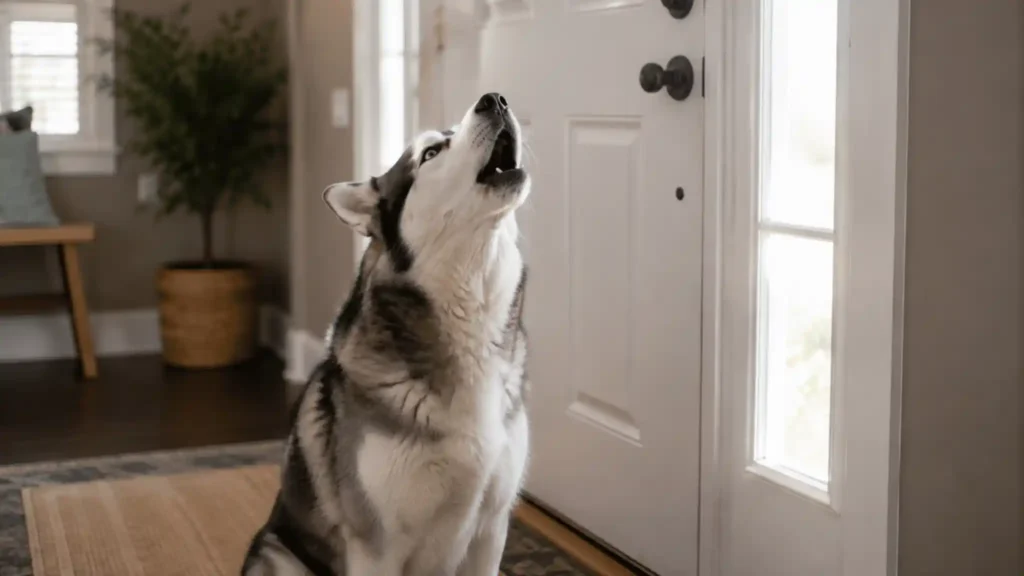
Husky separation anxiety is one of the loudest, most destructive, and most misunderstood problems in the breed. Huskies don’t just dislike being alone, they genuinely weren’t built for it. Understanding why helps you fix it.
Table of Contents
Why Huskies struggle so much when left alone
Siberian Huskies were developed by the Chukchi people of northeastern Asia over thousands of years. They weren’t pets. They were working dogs who ran in teams, slept together in groups, and functioned as part of a tight social unit. A Husky separated from its pack was a Husky in trouble, that was the context, the history, the wiring. This evolutionary history is why siberian husky separation anxiety shows up so consistently across the breed.
Modern Huskies carry that pack instinct. When you leave, their brain registers something wrong. Not “my owner is out”, more like “the pack has gone and I don’t know where.” The howling, the pacing, the escape attempts, those are pack-reunion behaviors, not tantrums. This reaction is the core of husky separation anxiety.
Energy is a separate but related factor. Huskies were bred to run 100 miles in a day. A dog with that energy level, left alone in a house without enough exercise, will find an outlet. Anxiety and unspent energy together produce some of the worst destruction you’ll see in a family dog.
One more thing: Huskies are escape artists. If separation anxiety is severe, they will get out. Through fences, through doors, through windows. This isn’t stubbornness, it’s a dog trying to find its pack by any means available.
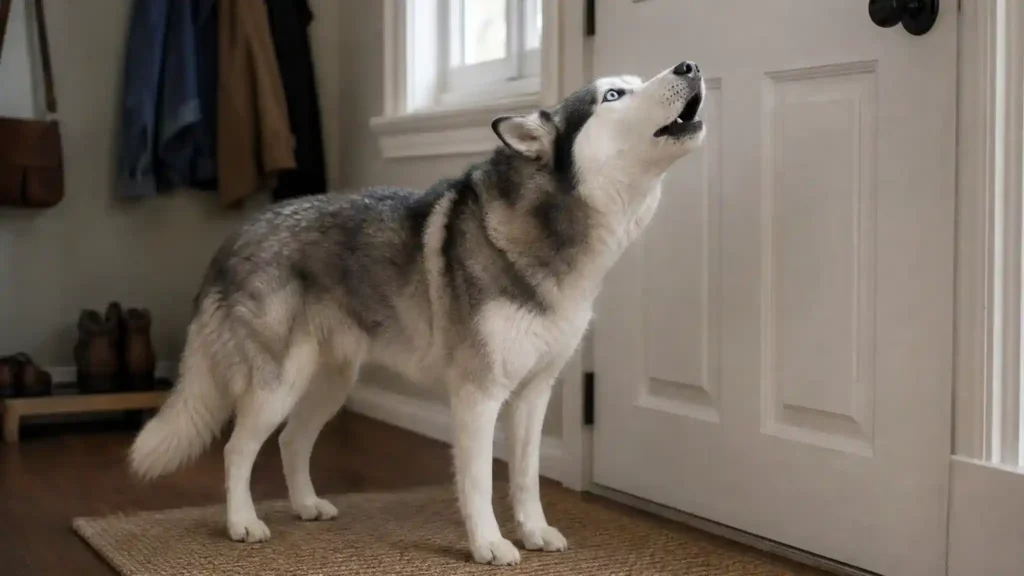
Signs of Husky separation anxiety
Huskies are vocal by nature, they howl, they “talk,” they complain. That normal vocalization can mask separation anxiety, or make it hard to know if what you’re hearing from a neighbor complaint is anxiety or just Husky being Husky. A camera solves this.
What genuine separation anxiety looks like in Huskies:
- Howling or crying that starts as soon as you leave and continues for a long time
- Clawing at doors or windows, sometimes causing injury to paws or nails
- Destroying items near exit points, or things that smell like you
- Pacing in repetitive patterns
- Attempts to escape the yard or house
- Accidents inside despite being housetrained
- Refusing food left behind
At home, watch for over-the-top greeting behavior when you return. Some excitement is normal. But a Husky that greets you like you’ve been gone for a week every single time, and can’t settle for 20 minutes after you’re back, is showing signs of anxiety around your arrivals and departures.
Is it separation anxiety or boredom?
This matters, because the fix is different. Boredom in Huskies looks like destructive behavior mid-day, after the initial settling period. The dog was calm for the first hour, then found something to chew. That’s a boredom and enrichment problem.
Separation anxiety starts immediately. The dog can’t settle at all. Distress is present from the moment you leave. If the camera shows calm for the first 30 minutes and then destruction, look at exercise and enrichment before assuming anxiety. If it shows distress from minute one, that’s husky separation anxiety, not boredom.
What actually helps
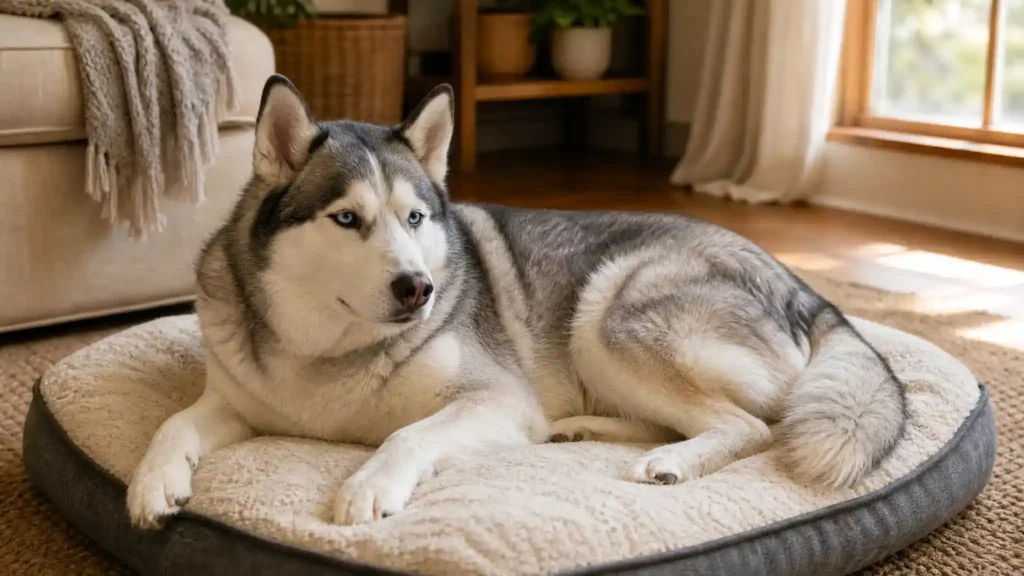
The strategies below address husky separation anxiety at its root, combining physical outlet, gradual independence, and calming support.
Exercise before you leave every time
This isn’t a cure for separation anxiety, but it’s a precondition for treatment. A Husky that gets a solid 45-60 minute run before you leave has a much lower baseline anxiety level and is far more likely to settle. A Husky that has been indoors since yesterday will struggle no matter how much training you do. Exercise first, then training.
Build independence gradually
Start with short separations at home different room, closed door, two minutes. Come back before your Husky reacts. Repeat many times over several days. Move to the backyard briefly, then to leaving the house for 5 minutes. Build duration in small steps, always returning before the anxiety response starts.
The goal is to lower the threshold at which your dog panics. You’re teaching them, through experience, not words that you always come back and that being alone is temporary and safe.
Consider a canine companion
This is one breed where a second dog often genuinely helps. Huskies are pack animals. If the anxiety is about social isolation rather than specifically about you, another dog can reduce distress significantly. It’s not a guaranteed fix and it shouldn’t be the first step but with Huskies more than most breeds, it’s worth taking seriously once you’ve assessed the nature of the anxiety.
Provide a job or enrichment
Huskies are working dogs. Leaving them with a stuffed Kong, a sniff mat, or a long-lasting chew gives them something to do and redirects their focus. A tired, mentally occupied Husky is less likely to spiral into panic. Puzzle feeders work particularly well for this breed because they engage the problem-solving instincts.
Calming support
For acute anxiety, vet visits, travel, the first weeks of a new routine, a pressure wrap like a ThunderShirt can reduce arousal enough to make other interventions work better. Some Huskies respond well, others tolerate it but don’t show obvious improvement. Try it as a tool, not a solution.
For daily anxiety support, see our guide on the best calming supplements for dogs. For the full training protocol, read the complete guide to dog separation anxiety.
What doesn’t work with Huskies
Punishment. Huskies are independent-minded. Punishment for anxiety related destruction backfires badly. They can’t connect your frustration to behavior that happened hours ago, and a punished Husky learns only that your returns are unpredictable and sometimes frightening.
Crating without training. Some Huskies do well in a crate as a den space. Many don’t. A Husky that panics in a crate can seriously injure itself, bent wire crates, broken teeth from chewing on bars, and paw injuries are all documented. Never crate a Husky with separation anxiety unless the crate has been introduced slowly and the dog actively chooses to use it.
Ignoring the exercise requirement. You can do everything right in terms of desensitization and it will barely work if the dog hasn’t had enough physical output. Exercise is not optional for this breed, it’s part of the treatment.
When to get professional help
If your Husky is injuring itself, escaping regularly, or showing no improvement after 6-8 weeks of consistent training, talk to a vet or veterinary behaviorist who treats husky separation anxiety directly. Anti-anxiety medication (fluoxetine, clomipramine, or trazodone for acute situations) can make the dog receptive to training in a way that anxiety alone doesn’t allow.
Behaviorists who specialize in separation anxiety, like those certified through CSAT (Certified Separation Anxiety Trainer), work specifically with this condition and can tailor a protocol to your dog’s specific response.
Frequently asked questions
Do all Huskies get separation anxiety?
Not all, but it’s common in the breed. Their pack-oriented history makes social isolation genuinely stressful for most Huskies. Even dogs without clinical separation anxiety often show distress behaviors when left alone for too long.
How long can a Husky be left alone?
With proper exercise and training, most adult Huskies can manage 4-6 hours. Beyond that, destructive behavior becomes likely regardless of anxiety, they simply need more activity and stimulation than most dogs. Puppies should not be left alone for more than 2 hours.
Why does my Husky only howl when I leave?
Howling is a pack-location call. In the wild, a separated pack member howls to find the group. Your Husky is doing exactly that, calling for the pack to come back. It’s not manipulation. It’s instinct responding to a situation their nervous system reads as dangerous.
Can exercise alone fix Husky separation anxiety?
No, but inadequate exercise can make it impossible to treat. Exercise reduces baseline anxiety, which makes desensitization training more effective. It won’t eliminate a genuine anxiety disorder on its own, but it’s a non negotiable foundation.
Is separation anxiety worse in Huskies than other breeds?
The pack instinct makes Huskies more likely to experience distress from social isolation. The vocalization and escape behaviors also tend to be more intense than in many other breeds, which makes the problem more visible and more disruptive for neighbors. Severity varies between individual dogs, but siberian husky separation anxiety, as a breed-wide pattern, does land in the higher risk category.
Related guides