🐾 Does your dog panic when you leave? → Get the Free 7-Day Starter Plan

Dog Having Anxiety Attack: Signs, What to Do, and How to Prevent Them


Affiliate disclosure: This article and its sidebar contain affiliate links. If you buy through these links, PetCalmZone may earn a commission at no extra cost to you.
If you’ve noticed your dog having anxiety attack symptoms: shaking, panting, pacing, maybe trying to escape, it’s distressing to watch. You want to help but don’t know if you’re making it worse. And if these episodes keep happening, you want to know why and how to stop them.
You want to help but don’t know if you’re making it worse. And if these episodes keep happening, you want to know why and how to stop them.
Here’s what a dog anxiety attack actually is, how to recognize one in progress, and what to do, and not do, when it’s happening. Knowing the difference can shorten a dog anxiety attack instead of prolonging it.
What is a dog anxiety attack?
“Anxiety attack” isn’t a formal veterinary diagnosis, but it describes something real: an acute, sudden spike in anxiety that’s more intense and more visible than baseline anxiety. Think of it as the nervous system going from low-level stress to full panic mode. For a broader overview of how anxiety shows up in dogs day-to-day, see the AKC’s guide to anxiety in dogs.
Dogs don’t have panic attacks in the clinical sense that humans do: there’s no equivalent research establishing that dogs experience the same sudden, intense fear response humans do. But they absolutely have acute stress events: moments where the anxiety response fires hard and the dog becomes visibly distressed, unable to settle, and sometimes dangerous to themselves. That’s what most owners mean when they say “anxiety attack.”
A dog anxiety attack is different from chronic, low-level anxiety. It has a beginning, a peak, and an end, usually triggered by something specific: a loud noise, being left alone past their threshold, an unfamiliar person or animal, or a past trauma trigger.
Signs your dog is having an anxiety attack
The signs of a dog anxiety attack look different from baseline stress. They’re more intense and often escalate rapidly.
Physical signs: Heavy panting despite cool temperatures, trembling or shaking, excessive drooling or foaming at the mouth, dilated pupils, rapid heart rate (you can feel this by placing your hand on the chest), and in severe cases vomiting or diarrhea from the stress response overloading the digestive system.
Behavioral signs: Frantic pacing, destructive behavior at exits (clawing, chewing), frenzied attempts to escape a confined space, self-harm (chewing their own paws or legs), inability to respond to their name or basic commands, and hiding. Some dogs go the opposite direction and become hyperattached: pressing against you, climbing on you, refusing to move away.
Vocalization: Intense barking, howling, or whining, often at a pitch or volume you don’t hear from them normally.
The key difference between normal anxiety and a dog anxiety attack: during the acute episode, normal interventions often don’t work. The dog may not respond to commands they know perfectly well, not because they’re ignoring you, but because the stress response has hijacked their cognitive function. According to the Merck Veterinary Manual, this fight-or-flight response can override a dog’s normal decision-making until the threat passes. A dog in full panic is not in a state where learning happens.
What to do when your dog having anxiety attack symptoms appear
These steps help you manage a dog anxiety attack in the moment, not train your dog out of it.
Stay calm yourself
Dogs read their owners constantly. If you become anxious or frustrated watching your dog panic, they pick that up and it escalates the episode. Calm, quiet presence is the most useful thing you can offer. Slow your movements, lower your voice, and if possible, lower your physical position (sitting or crouching).
Remove or reduce the trigger if possible
If the anxiety episode was set off by something specific (a noise, a visitor, another dog) and you can reduce that trigger, do it. Move your dog to a quieter room, ask the visitor to step outside, turn on white noise. You’re not “rewarding” the anxiety by removing the stressor. You’re managing an acute episode so your dog can return to a state where they can function.
Offer a safe space
If your dog has a crate, a specific room, or a spot they normally go to when stressed, give them access to it. Don’t force them in: give them the option. Dogs in a panic state often seek small, enclosed spaces. It’s a self-soothing behavior: lower stimulation, walls on multiple sides, feeling enclosed.
Use gentle physical contact if your dog accepts it
For dogs who find contact comforting, slow, firm strokes (not quick patting) along the back can help. Focus on the shoulders and back rather than the face or head. Coming at a panicked dog’s face can intensify anxiety or trigger a defensive snap. If your dog moves away, let them. Forcing contact during a panic episode is counterproductive.
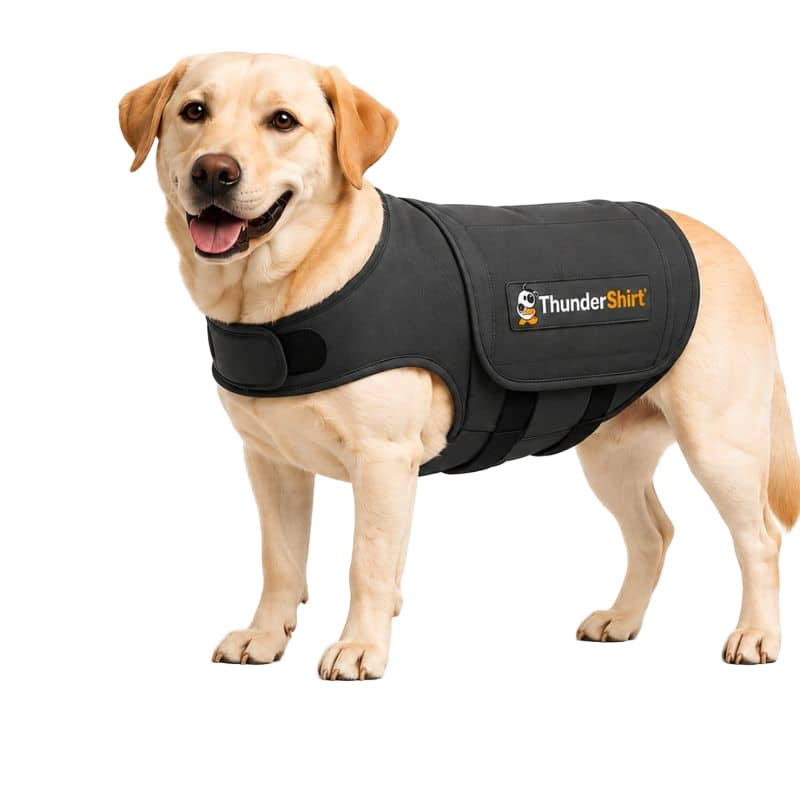
Try a ThunderShirt if one is available
Pressure wraps like ThunderShirt can help during acute episodes, especially noise-triggered ones. The constant, gentle pressure mimics the calming effect of being held. If your dog isn’t already wearing one and is too agitated to put it on, wait until the peak of the episode passes.
→ Check ThunderShirt on Amazon
Wait it out
Most dog anxiety attacks peak and then subside, usually within 20–45 minutes once the trigger is gone or reduced. Your job during this time is containment and comfort, not training or correction. Don’t try to get your dog to “work through it” by exposing them to more of what’s frightening them: that’s desensitization, and it only works in a controlled, planned context with the dog below their threshold.
What not to do
A few things make a dog anxiety attack worse, not better.
Don’t punish the behavior. Yelling at, hitting, or using aversive methods on a panicking dog intensifies the fear response. The destructive behavior and vocalization during a panic episode aren’t choices your dog is making. They’re symptoms. Punishment teaches the dog that scary situations also mean punishment, adding a new layer of fear.
Don’t force reassurance. Holding a panicking dog against their will, restraining them, or physically preventing them from moving to a different spot tends to escalate things. Offer comfort, but don’t impose it.
Don’t expose them to the trigger to “get over it.” Flooding (forced exposure to a fear trigger at full intensity) is a recognized behavioral technique, but it requires professional oversight and can go badly wrong. During an anxiety episode is not the time for improvised exposure therapy.
Don’t assume it’ll get better on its own. A single severe episode isn’t necessarily a crisis, but if anxiety attacks are recurring, they tend to worsen without intervention. The nervous system becomes more sensitized, not less.
How to prevent future anxiety attacks
Managing a dog anxiety attack in the moment is the short game. Preventing recurrence is the actual goal.
Identify and track triggers. Keep notes on when episodes happen, what preceded them, and how long they lasted. Patterns emerge faster than you’d expect. A dog who seems to have random anxiety attacks usually has patterns: times of day, specific sounds, specific people, specific environments.
Behavioral modification for the specific trigger. Once you’ve identified the trigger, systematic desensitization is the evidence-based approach. For separation anxiety, this means departure training starting with absences shorter than the threshold where anxiety kicks in. For noise anxiety, it means gradual sound exposure at low volume, paired with positive reinforcement, over weeks. Full separation anxiety protocol →
Daily calming aids to lower the baseline. Products like Adaptil (pheromone diffuser) and Purina Pro Plan Calming Care (probiotic supplement) work over weeks to reduce overall anxiety levels, making threshold breaches less likely. They’re most useful as a supplement to behavioral work, not a replacement. Full guide to anxiety treatment options →
Predictable routine. Anxiety is harder to trigger in dogs who have consistent, predictable daily schedules. Feeding times, walk times, and sleep schedules all contribute to a stable nervous system baseline. Disruption, even positive disruption, can temporarily raise anxiety levels.
Exercise. Not as a cure, but as a meaningful contributor. Physical exertion metabolizes stress hormones. A dog who’s had appropriate physical exercise has a lower cortisol baseline. This is not sufficient for true anxiety but it removes a contributing factor.
When to call a vet
Some dog anxiety attacks require veterinary attention. Call a vet if your dog injures themselves during an episode, if vomiting or diarrhea accompanies the anxiety, if episodes are lasting longer than an hour or recurring daily, if your dog becomes aggressive during episodes (a safety issue), or if behavioral work isn’t making a dent after several weeks of consistent effort.
For dogs with severe or recurrent episodes, situational medication, prescribed ahead of known triggers like thunderstorm season or holiday fireworks, is a legitimate tool. Trazodone and alprazolam are commonly used for situational anxiety. These are prescription medications that require veterinary evaluation but can make a significant difference for dogs who have predictable, severe episodes. If your regular vet isn’t equipped to manage complex behavioral cases, the American College of Veterinary Behaviorists directory can help you find a board-certified veterinary behaviorist near you.
FAQ
How long does a dog anxiety attack last?
Most acute episodes peak within 5–15 minutes of the trigger and then begin to subside, typically resolving within 20–45 minutes once the trigger is gone. Dogs who are left alone and the trigger persists (like being left alone all day) may stay in an elevated stress state much longer. Home cameras often show dogs who panic for 30–60 minutes after departure and then exhaust themselves.
Can dogs have anxiety attacks in their sleep?
What looks like anxiety attacks during sleep is usually REM behavior: dogs dreaming. Twitching, whimpering, paddling legs. This is normal and not anxiety. True anxiety is a waking experience. If your dog wakes from sleep already in a panic state, that’s unusual and worth a vet visit to rule out neurological causes.
Should I comfort my dog during an anxiety attack?
Yes, offering comfort is appropriate. The old idea that comforting an anxious dog “reinforces” the anxiety is not supported by behavioral science: fear responses aren’t operantly conditioned in the same way trained behaviors are. Calm presence, access to a safe space, and gentle contact (if accepted) help. Forced restraint or over-the-top distress on your part can make things worse.
What’s the fastest thing to stop a dog anxiety attack?
Remove or reduce the trigger if possible. Give your dog access to their safe space. Apply a ThunderShirt if you have one and your dog accepts it. Calming chews with L-theanine can take the edge off within 30–60 minutes but won’t stop an acute episode that’s already at its peak. There’s no instant fix: the goal in the moment is management, not elimination.
Are anxiety attacks dangerous for dogs?
Anxiety itself isn’t lethal, but the behavior during a dog anxiety attack can be dangerous. Self-injury from escape attempts (broken teeth, lacerated paws, impact injuries from throwing themselves against barriers) is the real risk. Dogs who injure themselves during anxiety episodes need both veterinary and behavioral support.
Bottom line
The worst thing you can do during a dog anxiety attack is panic yourself, force your dog through the fear, or assume they’ll get over it with time. The best thing is calm management in the moment and a real plan for preventing recurrence.
If dog anxiety attacks are recurring or severe, start with a vet visit to rule out medical causes and discuss whether situational medication makes sense. Then put behavioral work in place. Anxiety attacks are treatable, but they don’t treat themselves.
→ Check ThunderShirt on Amazon | → Check Adaptil diffuser on Amazon | Full anxiety treatment guide →

