🐾 Does your dog panic when you leave? → Get the Free 7-Day Starter Plan

How to Stop a Dog From Jumping on People: Step-by-Step Training
How to stop a dog from jumping on people, with this proven, step by step training guide featuring the right tools, techniques, and tips that truly work fast.

Affiliate disclosure: This article and its sidebar contain affiliate links. If you buy through these links, PetCalmZone may earn a commission at no extra cost to you.
If you’ve ever been knocked over by an excited greeting, had a guest’s clothes covered in muddy paw prints, or watched your dog launch at a child, you already know you need to learn how to stop a dog from jumping on people before it becomes a serious problem.. The good news: jumping is one of the most trainable behaviors out there. With the right technique, consistency, and a few key tools, you can teach your dog to greet people politely, even when they’re bursting with excitement.
Table of Contents
- Why Do Dogs Jump on People?
- How to Stop a Dog From Jumping on People, Step by Step
- What Mistakes Make Dog Jumping Worse?
- What Tools Make Dog Jumping Training Easier?
- How Long Does It Take to Stop Dog Jumping?
- What If Your Dog Jumps in Special Situations?
- How Do You Build a Polite Greeter?
- Final Thoughts on Stopping Dog Jumping on People
Why Do Dogs Jump on People?
Before you can fix the behavior, it helps to understand why it happens. Dogs jump up on people for a very simple reason: it works. As puppies, jumping up gets them closer to our faces, and we respond with attention, eye contact, and often touch. Even if that attention is “No! Down! Stop!”, it’s still attention, and dogs thrive on it.
Jumping is also a natural canine greeting behavior. When dogs greet each other, they sniff faces and necks. When a dog wants to greet a tall human, jumping up puts them closer to the action. It’s not dominance, it’s not aggression: it’s enthusiasm, poorly channeled, which is exactly why learning how to stop dog jumping on people starts with redirecting that energy, not punishing it.
The problem is that jumping can be dangerous. A large dog can knock over a child, an elderly person, or anyone who isn’t expecting it. It can also signal to other dogs (and people) that your dog has poor impulse control, which can escalate into other unwanted behaviors. Understanding the root cause helps you address it with the right approach, and the right approach here is always positive reinforcement dog training.
The Core Principle: Jumping Gets Nothing, Four Paws Get Everything
The entire strategy for stopping jumping revolves around one simple rule: jumping must result in zero reward, and four paws on the floor must result in maximum reward. Every single time. No exceptions. This is harder than it sounds, because it requires everyone in your household, and guests, to follow the same protocol. But once it clicks, it clicks fast.
How to Stop a Dog From Jumping on People, Step by Step
Step 1: Remove All Rewards for Jumping
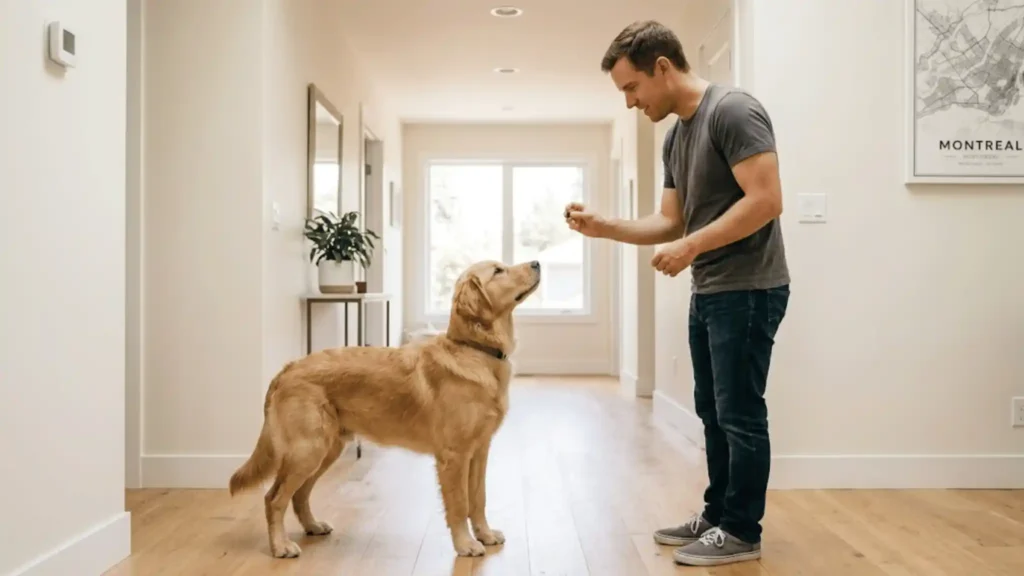
The moment your dog jumps up, immediately turn your back and cross your arms. No eye contact. No words. No pushing them down (that’s physical contact, still a reward). Just become a boring statue. The second all four paws hit the floor, turn back around, get calm and cheerful, and give praise and a treat.
If your dog jumps again when you turn back around, turn away again. Repeat as many times as needed. At first this will feel endless: some dogs test this dozens of times in a single session. Stay the course. Your dog is learning a new equation, and it takes repetition.
Step 2: Teach an Incompatible Behavior
Rather than just saying “no jumping,” give your dog something to do instead. “Sit” is the gold standard here: a dog who is sitting cannot simultaneously be jumping. Teach a solid sit first in low-distraction environments. Then practice specifically at greeting moments: ask for a sit before you open the door, before you pick up a toy, before you give a pet. Over time, your dog will start defaulting to sit when they want something, including greeting.
The key reward here is training treats, specifically ones your dog finds irresistible. Use tiny, soft, high-value treats that you can deliver instantly the moment paws hit the floor or the sit happens. Timing is everything with positive reinforcement. A treat that arrives three seconds late teaches nothing: it just confuses your dog.
Step 3: Use a Clicker for Precision
A training clicker is one of the most powerful tools you can use for this exact type of training. The click marks the precise moment your dog does the right thing (paws down, sitting, staying calm) and bridges the gap between the behavior and the treat. Without a clicker, you’re relying on your verbal “yes!” which varies in tone and timing. The click is consistent, sharp, and emotionally neutral.
Here’s a simple clicker drill for jumping:
- Approach your dog with energy (simulating a greeting).
- The moment your dog keeps four paws on the floor, click instantly.
- Follow with a treat immediately.
- If they jump, turn away, wait, and try again.
- Repeat 10–15 times per session, multiple sessions per day.
Within a few days of consistent clicker work, most dogs dramatically reduce jumping during practice sessions.
Step 4: Train at the Front Door
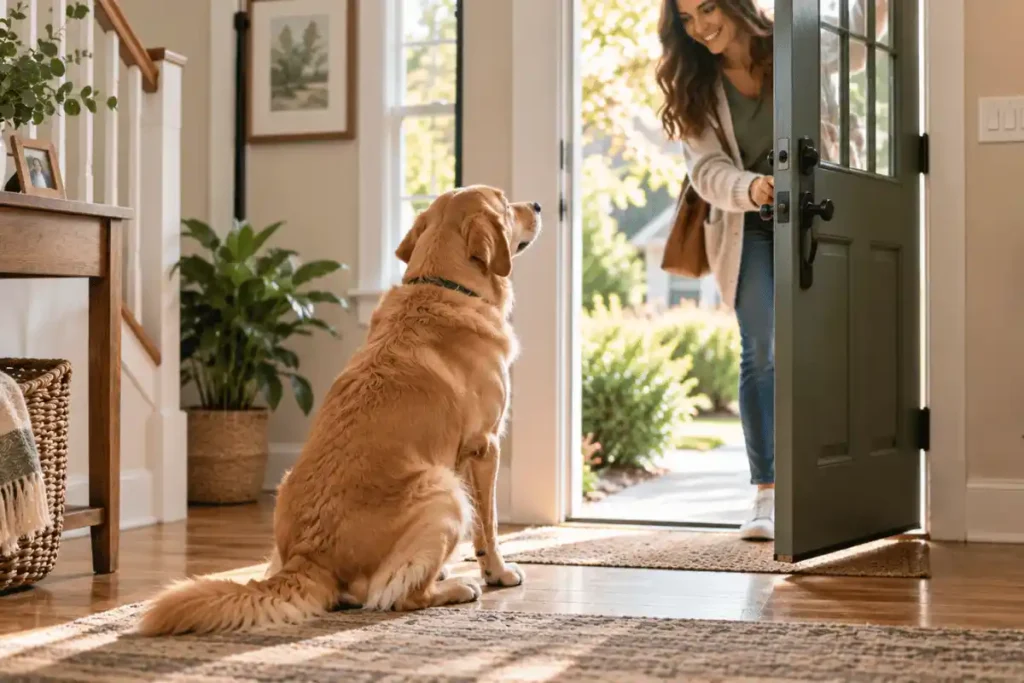
The front door is the highest-arousal jumping zone. The sound of the doorbell or a knock sends most dogs into orbit. You need to train specifically here, not just in your living room.
Start by desensitizing the doorbell itself: ring it dozens of times with no one actually arriving, rewarding calm behavior. Then practice with a helper: have someone ring the bell, ask your dog for a sit, reward the sit, then open the door. If your dog explodes, close the door. Try again. The door opening becomes the reward for staying calm, not the invitation to launch.
For dogs who are particularly difficult to manage at the door, a front-clip harness gives you physical control without yanking on a neck collar. The front clip redirects pulling and jumping energy by turning your dog toward you when tension is applied: it doesn’t cause discomfort, it just gently interrupts forward momentum. This is especially useful when having guests over before your dog has fully learned the new greeting behavior.
Step 5: Generalize the Training
One of the biggest mistakes owners make is only training in one context. Your dog may be perfect at home but a jumping maniac at the park or with strangers. You need to generalize: practice the same protocol in different locations, with different people, at different arousal levels.
Ask friends and family to help you train. Explain the protocol: no eye contact, no touch, no talking when the dog jumps. Calm rewards when four paws are on the floor. Most people are happy to help once you explain it, and your dog will learn that the rule applies everywhere, not just at home.
Step 6: Train Your Guests
Here’s an uncomfortable truth: if even one person in your life lets the dog jump on them “just because they don’t mind,” it will undermine your training. Variable reinforcement (sometimes jumping works, sometimes it doesn’t) is actually one of the most powerful ways to strengthen a behavior: it’s why slot machines are so addictive. If jumping gets rewarded even occasionally, your dog will keep trying it.
Have a short conversation with regular visitors. Put a note by the door. Use a baby gate to give yourself a moment to get your dog into a sit before greeting. Whatever it takes: consistency across all people is non-negotiable for this to work long-term.
For more on building the kind of impulse control that makes all of this easier, check out our positive reinforcement training overview: it covers the principles behind why these methods work so well and how to apply them across dozens of situations.
Step 7: Practice the “Off” Cue
Once your dog understands that jumping gets nothing, you can add a verbal cue, “Off”, to let them know when jumping has started and what you want instead. Note: “Off” is more useful than “Down” here, because “Down” typically means “lie down” in dog training, and you don’t want to confuse the two.
To teach “Off”:
- When your dog jumps, say “Off” in a calm, neutral tone (not angry).
- Turn away immediately.
- The moment all paws land, click and treat.
- Repeat. Over time, the word “Off” will cue your dog to bring their paws down.
What Mistakes Make Dog Jumping Worse?
Even well-intentioned owners accidentally reinforce jumping. Watch out for these:
- Pushing the dog down: This is physical contact and can actually feel like play to many dogs. It may excite them more.
- Saying “No!” repeatedly: Verbal engagement while jumping is still attention. Stay silent when paws are up.
- Kneeing the dog: This old-school advice can cause physical injury and damage trust. Avoid it entirely.
- Only training sometimes: If jumping works even 20% of the time, your dog will keep trying. Consistency is everything.
- Rewarding too late: If you click or treat after your dog has jumped up again, you’ve rewarded the jump, not the feet-on-floor moment. Timing is critical.
What Tools Make Dog Jumping Training Easier?
Training is about communication and consistency, but having the right tools makes it dramatically more effective. Here’s what we recommend for tackling jumping:
High-Value Training Treats
Your dog needs to want to work for the reward. Choose small (pea-sized), soft, smelly treats your dog doesn’t get any other time. Freeze-dried chicken, liver treats, or soft training bites work well. Keep a pouch on you during any greeting situation so you’re always ready to reward immediately.
Training Clicker
A clicker creates a precise, consistent marker that tells your dog exactly what they did right. It’s faster and more neutral than a verbal “yes” and helps you build behavior faster. Look for a clicker with a wrist strap so you always have it handy for surprise greeting moments.
Front-Clip Harness
A management tool for the training period. Front-clip harnesses redirect jumping and pulling by turning your dog toward you: no pain, no punishment, just gentle physical redirection. Great for walks, front door greetings, and any situation where you need more physical control while training is still in progress. According to the American Kennel Club, management tools like these are a valuable complement to behavior training, especially when you have guests or children involved.
How Long Does It Take to Stop Dog Jumping?
This is the most common question, and the honest answer is: it depends. Most dogs show significant improvement within 1–2 weeks of consistent training. For puppies, it can happen even faster. For adult dogs who have been jumping for years and have been inconsistently rewarded for it, expect 3–4 weeks of dedicated work before you see reliable results.
The variable that matters most is how consistent everyone around your dog is. If your household is perfectly consistent and guests follow the protocol, you’ll see faster results. If there are gaps in enforcement, it’ll take longer, but it will still work eventually.
Don’t get discouraged by setbacks. Dogs have good days and bad days. An exciting visitor, a long time away from home, or a new environment can trigger old behavior temporarily. Just calmly go back to basics: turn away, wait for four paws, click and treat. You’re not starting over: you’re refreshing a learned behavior.
What If Your Dog Jumps in Special Situations?
Dogs Who Jump on Kids
Children are especially vulnerable to jumping because they’re often at the dog’s height, they make high-pitched exciting sounds, and they don’t always know to turn away. Supervise all interactions between jumping dogs and children, and teach kids the “be a tree” method: stand still, look away, arms crossed. Practice this with your kids before the dog is present so they understand what to do.
Dogs Who Jump When You Come Home
Coming home is the highest-arousal jumping trigger for many dogs. The best technique here is to completely ignore your dog for the first 30–60 seconds when you walk in. No greeting, no eye contact, no talk. When they’ve calmed down (even slightly), then you acknowledge them. This is hard: our instinct is to greet our dogs!, but it teaches your dog that calm behavior gets the greeting, not frenzied excitement.
Dogs Who Jump on Strangers on Leash
Practice the “ask for a sit before greeting” protocol on every walk. Before allowing any stranger to pet your dog, ask for a sit. If your dog can’t hold the sit, the petting doesn’t happen. Most people will happily comply when you explain you’re training, and your dog quickly learns that calm = interaction with interesting people.
For a full look at how jumping connects to other behavior challenges, our guide on dog behavior problems covers the bigger picture, from jumping to pulling to anxiety-driven behaviors, and helps you see how many of these issues share the same training solutions.
How Do You Build a Polite Greeter?
The ultimate goal of training your dog not to jump, isn’t just to stop the behavior in the moment it’s to teach your dog a new default greeting behavior they offer automatically. For most well-trained dogs, this ends up being a sit or a “four paws on the floor” stance that they offer without being asked, because they’ve learned it’s the behavior that gets them what they want.
This takes time and practice, but it’s 100% achievable with virtually any dog, any age, any breed. The foundation is consistent positive reinforcement, rewarding the right behavior every single time it happens, especially in the beginning. Once the behavior is rock solid, you can fade the treats and rely on praise and attention as the reward.
Want a complete roadmap for teaching polite behavior across every situation? Our guide on positive reinforcement dog training breaks down the exact methods professional trainers use, and how to apply them yourself at home, for free, starting today.
Final Thoughts on Stopping Dog Jumping on People
Stopping dog jumping on people comes down to one simple principle: jumping never works, and calm greeting always pays. If you can enforce that rule consistently, across all people, all situations, all the time, your dog will learn the new pattern faster than you think.
Start with the turn-away technique, add a solid “sit” as the incompatible behavior, use a clicker for precision, and get a front-clip harness for management during the training period. Bring everyone in your household on board, and don’t let guests undermine your work. You’ll have a polite greeter before you know it.