🐾 Does your dog panic when you leave? → Get the Free 7-Day Starter Plan

Dog separation anxiety: complete owner’s guide (2026)
Dog separation anxiety affects 1 in 6 dogs. This guide covers the 4-Phase SA Protocol, causes, symptoms, medication, and tools to help your dog heal.


Dog separation anxiety is a panic response to being left alone, and it improves with gradual desensitization, exercise, and sometimes vet-prescribed medication.
Your dog isn’t bad. He’s distressed, and with patience and the right support, many dogs improve.
This guide explains what you can practice at home, and when it is worth calling a certified trainer or a veterinary behaviorist instead.
Table of Contents
- What Is Dog Separation Anxiety?
- Why Dogs Develop Separation Anxiety
- Recognizing the Signs: Separation Anxiety Symptoms
- The 4-Phase SA Protocol: A Step-by-Step Framework
- Separation Anxiety Treatment Options: What Actually Works
- Best Tools for Dogs with Separation Anxiety
- Common Mistakes That Make Separation Anxiety Worse
- Your Dog Can Get Better
- Frequently Asked Questions
- Key Takeaways
Separation problems are common. Research puts them at roughly 5% to 14% of pet dogs, depending on how strictly they are defined (Salonen et al., 2020, dvm360). Yet most owners don’t realize their dog has it until the damage is done: chewed furniture, broken blinds, noise complaints, and a dog who’s visibly distressed every single day.
Here’s what makes this condition so frustrating: the harder you try to comfort your dog before you leave, the worse the anxiety gets. The instinct to reassure is human. But for dogs, it backfires.
This guide changes that. You’ll get a step-by-step framework, the 4-Phase SA Protocol, built on the gradual desensitization methods that veterinary behaviorists recommend. We cover causes, symptoms, training strategies, and the tools that actually work, because managing dog separation anxiety well takes more than one trick.
What Is Dog Separation Anxiety?
Dog separation anxiety (SA) is a behavioral disorder in which a dog experiences extreme stress when left alone or separated from a specific person. It goes beyond normal restlessness or boredom. It’s a fear response: the dog’s nervous system believes it’s in genuine danger.
The condition exists on a spectrum:
| Severity Level | Description |
|---|---|
| Mild | Whining, pacing, following owner from room to room |
| Moderate | Barking, destructive chewing, inappropriate elimination |
| Severe | Self-injury (scratching doors, breaking teeth), full panic response |
Separation anxiety is not the same as boredom. A bored dog chews a toy. An anxious dog chews through a door. It is also distinct from isolation distress, where the dog is fine with any human company but panics when left completely alone.
Why Dogs Develop Separation Anxiety
Understanding the root cause is the first step toward fixing it. Age plays a role too, so if you’re wondering when this typically starts, see our guide on at what age dogs develop separation anxiety. The most common triggers include:
1. Over-attachment to one person
When a dog bonds exclusively to one person and that person becomes their primary source of security, any separation from that person triggers panic, not just being home alone.
2. Sudden schedule changes
The COVID period is a textbook example: dogs bonded to owners who were home 24/7, then experienced a sudden return to office. Predictability is safety for dogs. Disruption is threat.
3. Traumatic history
Rescue dogs or dogs with prior abandonment often develop SA. Their nervous system has learned that separation = permanent loss.
4. Genetics and breed predisposition
Some breeds, like Labrador Retrievers, German Shepherds, Vizslas, Border Collies, are genetically wired for high human attachment. That closeness is a feature. In the wrong conditions, it becomes a vulnerability. Small companion breeds are just as susceptible. See our guides on Toy Poodle, Chihuahua, and Bichon Frise separation anxiety.
5. Insufficient early socialization
Dogs who weren’t exposed to being alone as puppies often never learn that alone-time is safe.
Recognizing the Signs: Separation Anxiety Symptoms
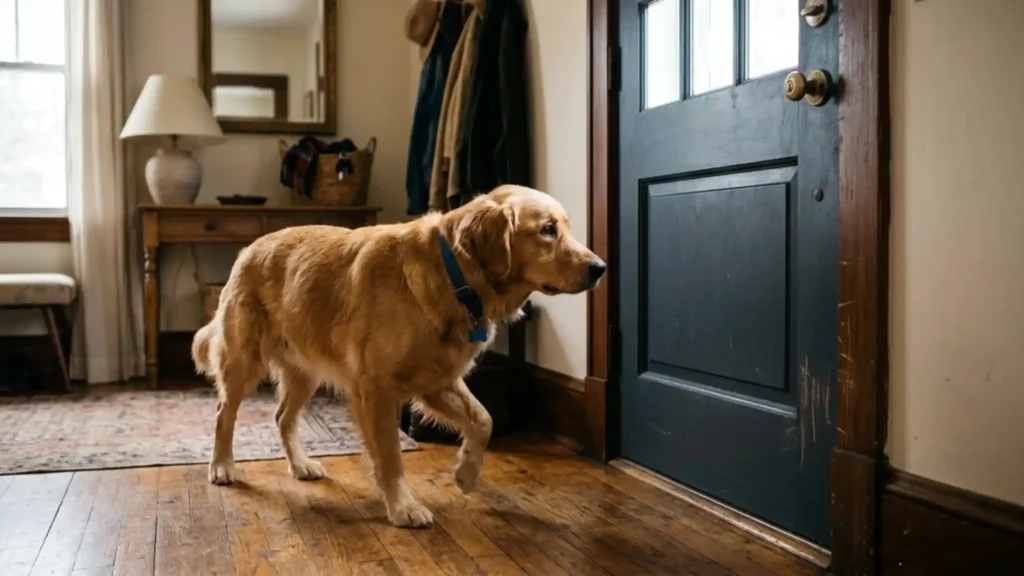
Symptoms typically begin within 15–30 minutes of your departure. A key diagnostic clue: the behaviors only happen when you’re gone.
Primary signs:
- Excessive barking, howling, or whining after departure
- Destructive behavior (chewing doors, window frames, furniture)
- Inappropriate urination or defecation
- Pacing, circling, or inability to settle
- Attempts to escape, sometimes causing self-injury
Pre-departure anxiety (common but missed):
- Shadowing you as you prepare to leave
- Trembling or panting when you pick up keys/bag
- Refusing to eat before you leave
📹 Pro tip: Set up a camera to record what happens after you leave. Many owners are shocked by what they see. Video footage is also useful if you work with a certified behavior consultant.
→ Signs of Separation Anxiety in Dogs: How to Tell for Sure
The 4-Phase SA Protocol: A Step-by-Step Framework
This is the core of this guide’s advice. The 4-Phase SA Protocol draws on systematic desensitization, the same principle used by human therapists for phobias. You gradually expose your dog to the feared stimulus (your absence) at a level low enough to avoid triggering panic, then slowly increase duration as your dog’s threshold rises.
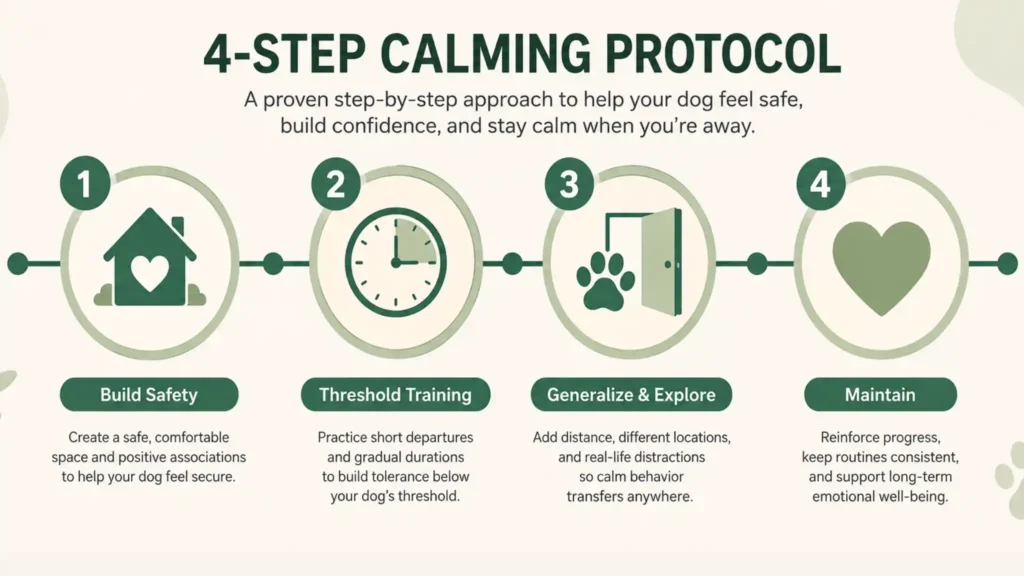
Phase 1: Build Baseline Safety
Goal: Establish that alone-time is survivable.
- Departure cue desensitization: Pick up your keys 20–30 times per day without leaving. Put on your coat, sit back down. Repeat until your dog stops reacting.
- Practice mini absences inside the home: Ask your dog to stay in one room while you go to another. Start with 10 seconds. Build to 5 minutes over several days.
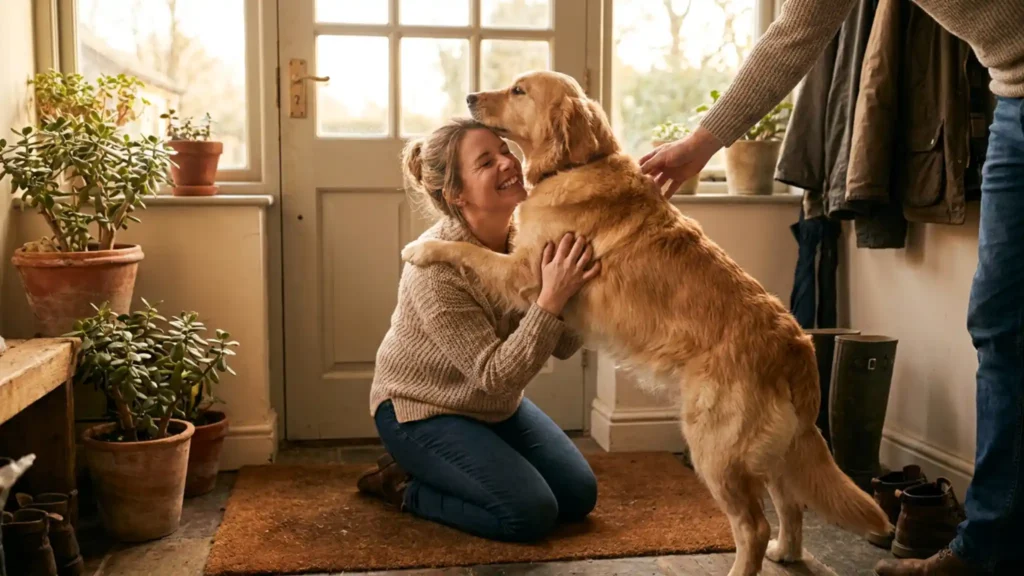
- No dramatic goodbyes: Keep departures and arrivals completely calm and emotionally neutral. This is counterintuitive but critical.
Tools that help in Phase 1: A dog crate used as a voluntary safe space → Best Anxiety Dog Crates | A calming dog bed → Best Anti-Anxiety Dog Beds | Calming music → Calming Music for Dogs
Phase 2: Threshold Training
Goal: Systematically increase the duration of absences without triggering panic.
The golden rule: Never leave your dog longer than their current threshold. If your dog can handle 3 minutes without anxiety, don’t leave for 20 minutes and hope for the best.
- Begin actual departures, starting at 5–30 seconds.
- Use a sub-threshold tracking sheet: log every session’s duration and your dog’s response (calm / mild stress / panic).
- Increase duration by no more than 10–20% between sessions.
- Vary durations: sometimes do shorter sessions to prevent anticipation anxiety.
Tools that help in Phase 2: Calming supplements with L-theanine → Best Calming Supplements for Dogs | Anxiety vests → Best Anxiety Wraps for Dogs
Phase 3: Generalization & Independence
Goal: Your dog handles alone-time reliably across contexts.
- Vary departure locations: Leave from the front door, back door, garage. Dogs are hyper-contextual.
- Introduce variability: Leave at different times of day to prevent anticipatory anxiety.
- Strengthen independent behaviors: Teach “go to your place” and reward voluntary disengagement.
- Introduce food puzzles: Kong toys filled with frozen peanut butter give anxious dogs something to focus on.
→ How to Train a Dog with Separation Anxiety: Step-by-Step
Phase 4: Maintenance & Long-Term Management (Ongoing)
Goal: Sustain progress and prevent relapse.
- Continue periodic sub-threshold sessions 2–3x per week even when your dog is doing well.
- Monitor for regression triggers: illness, schedule changes, moves, new pets.
- Maintain your toolkit: don’t pull calming tools away just because things are going well.
- Consult your vet annually for reassessment of medications or supplements.
Separation Anxiety Treatment Options: What Actually Works
Behavior Modification (First-line treatment)
The four sections above organize this guide’s advice. They are not a clinically validated protocol. Gradual desensitization should be tailored to your dog’s response, with professional guidance when needed.
Medication for Separation Anxiety
In moderate-to-severe cases, veterinary medication can lower your dog’s anxiety baseline enough to make behavior modification effective.
- Fluoxetine (Reconcile®): FDA-approved for canine SA. Takes 4–6 weeks to reach full effect.
- Clomipramine (Clomicalm®): Also FDA-approved. Works on serotonin and norepinephrine pathways.
- Situational medications (trazodone, alprazolam): For acute events such as vet visits, storms or the first days of longer absences.
- Tasipimidine (Tessie®): approved by the FDA on May 6, 2026 as the first drug for both noise aversion and separation anxiety in dogs (FDA announcement). It’s given about an hour before you leave and starts working within hours, making it useful for situational relief alongside longer-term training.
⚠️ Medication is a support tool, not a cure. Always combine with behavior training.
→ Best Anxiety Medication for Dogs (2026): Vet’s Guide
Natural Remedies
- Adaptil DAP diffuser: Synthetic dog-appeasing pheromone. Mimics the calming pheromone nursing mothers produce.
- Melatonin: May help with anxiety-related sleep disruption.
- L-theanine: Found in green tea, promotes calm without sedation.
- Valerian root: Used in several over-the-counter calming supplements.
→ Natural Remedies for Dog Anxiety: What Works
Professional Help: Finding a Dog Trainer for Separation Anxiety
If you’re not seeing progress after 4–6 weeks of consistent work, it’s time to find a dog trainer for separation anxiety or a certified behaviorist:
- Certified Separation Anxiety Trainer (CSAT): A specialist credential created by Malena DeMartini.
- Veterinary Behaviorist (DACVB): The highest level of care for complex cases.
- Certified Applied Animal Behaviorist (CAAB): A PhD-level behavior specialist.
🔗 Find a CSAT near you: iaabc.org/csat
Best Tools for Dogs with Separation Anxiety
Products don’t replace training. But the right tools make training dramatically more effective and make day-to-day management easier. For our full comparison, see the best products for dogs with separation anxiety.
Crates & Safe Spaces
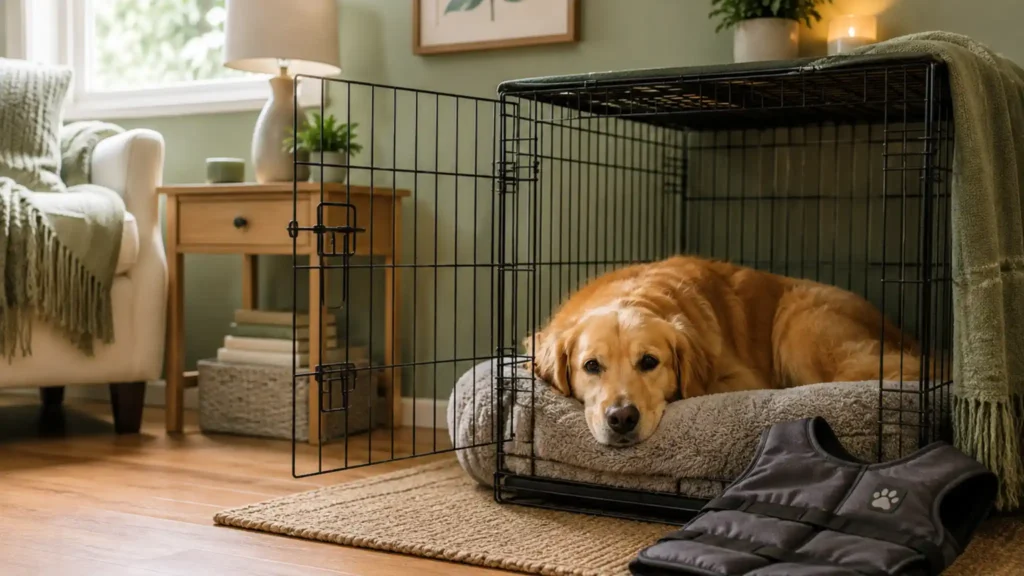
A properly introduced crate is not a prison. It’s a den, a space your dog associates with safety and calm. → Best Anxiety Dog Crates: 5 Picks That Actually Help (2026)
Calming Beds
Donut-shaped or bolster-style beds with raised edges trigger a burrowing instinct that reduces stress. → Best Anti-Anxiety Dog Beds: 5 Picks That Actually Calm (2026)
Anxiety Vests
The Thundershirt and similar wraps apply gentle, constant pressure, similar to the calming effect of swaddling an infant. → Best Anxiety Wraps for Dogs That Actually Work (2026)
Calming Supplements
Look for formulas combining L-theanine, ashwagandha, melatonin, and chamomile. → Best Calming Supplements for Dogs with Anxiety
CBD for Dogs
A 2025 study by Cornell University researchers in eight healthy beagles found that CBDA was absorbed better than CBD, and that both were well tolerated over one week at a low dose. The study looked at absorption and safety, not at anxiety, so it does not show that CBD helps with separation anxiety. Talk to your vet before trying it. (Source: Frontiers in Veterinary Science, 2025) Quality matters enormously. Look for third-party tested, research-backed-formulated products. → Best CBD for Dog Anxiety (2026): 7 Top Picks
AI Monitoring & Smart Collars
A new generation of AI-powered tools can help you track anxiety in real time. Smart pet cameras use AI to detect pacing, barking, and destructive behavior, sending instant alerts and letting you talk to your dog remotely. AI health collars go a step further, monitoring physiological signals like heart rate and activity patterns to flag rising stress while you’re away.
Common Mistakes That Make Separation Anxiety Worse
- Punishing anxious behaviors: Your dog isn’t being spiteful. Punishment increases fear and makes SA dramatically worse.
- Getting another dog as a “companion”: If the anxiety is attachment-based, a second dog does nothing and can increase household stress.
- Flooding (leaving for long periods hoping the dog “gets used to it”): This traumatizes dogs further.
- Relying on exercise alone: A tired anxious dog is still an anxious dog.
- Emotional departures and arrivals: Prolonged goodbyes signal that departures are events to be anxious about.
- Giving up too early: Separation anxiety training takes weeks to months. Consistency is the entire game.
Your Dog Can Get Better
Dog separation anxiety feels overwhelming, but it is not a permanent sentence for you or your dog. The 4-Phase SA Protocol offers a structured starting point to discuss with a qualified professional. An individualized plan, practical support and consistent monitoring can help guide next steps. Progress varies by dog.
Your next steps:
- 🛋️ Set up your dog’s safe space → Best Anxiety Dog Crates
- 📋 Learn the training in detail → How to Train a Dog with Separation Anxiety
- 💊 Explore medication options → Best Anxiety Medication for Dogs
- 🌿 Explore natural options → Natural Remedies for Dog Anxiety
- 🐾 Check the signs → Signs of Separation Anxiety in Dogs
Your dog isn’t giving up on you. Don’t give up on them.
Frequently Asked Questions
How long does it take to treat dog separation anxiety?
Mild cases can see significant improvement in 4–8 weeks of consistent training. Moderate-to-severe cases typically take 3–6 months. Progress depends on severity, consistency of training, and whether behavior modification is combined with appropriate medication or supplements.
Can separation anxiety be cured completely?
Many dogs improve dramatically and reach a point where they’re comfortable being alone for normal durations. SA is better thought of as a manageable chronic condition. Many owners who follow a structured plan see real progress. Results vary, and some dogs need long-term management with help from a professional.
Should I crate my dog with separation anxiety?
It depends. A properly introduced crate can be a powerful safe haven. But if your dog was never crate-trained, force-confining an anxious dog will make things worse. Always introduce the crate positively before using it during alone-time.
What breeds are most prone to separation anxiety?
Labrador Retrievers, German Shepherds, Vizslas, Border Collies, Cavalier King Charles Spaniels, and Cocker Spaniels are highest risk. That said, any dog regardless of breed can develop separation anxiety.
Should I try medication for my dog’s separation anxiety?
If your dog’s anxiety is moderate or severe, consult your vet. Fluoxetine and clomipramine are both FDA-approved for canine separation anxiety. Medication doesn’t replace training. It makes training possible for dogs whose anxiety is too high to learn otherwise.
How do I know if my dog has separation anxiety or is just bored?
Separation anxiety behaviors happen specifically when you’re absent, often within the first 15–30 minutes of departure. Boredom behaviors happen whenever the dog is under-stimulated, including when you’re home. Set up a camera and watch the footage.
Key Takeaways
- Dog separation anxiety is a fear response, not bad behavior or spite
- The 4-Phase SA Protocol organizes this guide’s advice on desensitization and counter-conditioning. It is not a clinically validated protocol
- Never progress training faster than your dog’s threshold allows
- Medication, supplements, and calming tools support behavior modification. They don’t replace it
- Consistent, calm departures and arrivals are non-negotiable
- Most dogs with SA can reach a point where they’re genuinely comfortable being alone

